



 Chat with AI
Exam 11: Managing Successful Products, Services, and Brands

Exam 1: Creating Customer Relationships and Value Through Marketing239 Questions
Exam 2: Developing Successful Organizational and Marketing Strategies349 Questions
Exam 3: Scanning the Marketing Environment275 Questions
Exam 4: Ethical and Social Responsibility for Sustainable Marketing192 Questions
Exam 5: Understanding Consumer Behavior361 Questions
Exam 6: Understanding Organizations As Customers202 Questions
Exam 7: Understanding and Reaching Global Consumers and Markets252 Questions
Exam 8: Marketing Research: From Customer Insights to Actions287 Questions
Exam 9: Market Segmentation, Targeting, and Positioning200 Questions
Exam 10: Developing New Products and Services271 Questions
Exam 11: Managing Successful Products, Services, and Brands347 Questions
Exam 12: Services Marketing215 Questions
Exam 13: Building the Price Foundation237 Questions
Exam 14: Arriving at the Final Price319 Questions
Exam 15: Managing Marketing Channels and Supply Chains304 Questions
Exam 16: Retailing and Wholesaling329 Questions
Exam 17: Integrated Marketing Communications and Direct Marketing240 Questions
Exam 18: Advertising, Sales Promotion, and Public Relations312 Questions
Exam 19: Using Social Media and Mobile Marketing to Connect With Consumers321 Questions
Exam 20: Personal Selling and Sales Management147 Questions
Exam 21: Implementing Interactive and Multi-Channel Marketing317 Questions
Exam 22: Pulling It All Together: the Strategic Marketing Proces171 Questions
Exam 23: Building an Effective Marketing Plan83 Questions
Exam 24: Financial Aspects of Marketing24 Questions
Select questions type


The fourth and final step in the sequential process of building brand equity is to
(Multiple Choice)
4.9/5  (77)
(77) Define brand equity. List the four sequential steps used to develop brand equity. Which step is the most difficult?
(Essay)
4.8/5 (77)
(77) Reducing the number of features, qualities, or price when repositioning a product is referred to as
(Multiple Choice)
4.8/5 (74)
(74)  Figure 11-1
-Figure 11-1 above represents the stages of the product life cycle. What does the section of the graph labeled B represent?
Figure 11-1
-Figure 11-1 above represents the stages of the product life cycle. What does the section of the graph labeled B represent? (Multiple Choice)
4.8/5 (83)
(83) Gatorade is most likely in which stage of its product life cycle?
(Multiple Choice)
4.8/5 (72)
(72) Many U.S. consumers purchase store brands like Kirkland at Costco because they provide a lower cost alternative to other brands. Companies like Costco use a ________ strategy to sell products that they do not manufacturer themselves.
(Multiple Choice)
4.9/5 (75)
(75) Your product has been suffering from steadily eroding sales. You have tried a number of options to revitalize the product's sales and profits, but after seven changes in your strategy, you have yet to find success. Which of the following actions would be the least appropriate next step?
(Multiple Choice)
4.9/5 (71)
(71) There is no set time that a product takes to move through its life cycle. But as a rule,
(Multiple Choice)
4.7/5 (73)
(73) Which of the following statements about perceptual benefits conveyed by a product's packaging and labeling is false?
(Multiple Choice)
5.0/5 (75)
(75) Mixed branding refers to a branding strategy in which a firm
(Multiple Choice)
4.9/5 (72)
(72) 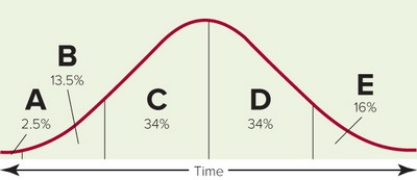 Figure 11-5
-The consumers represented by Segment D in Figure 11-5 above are called
Figure 11-5
-The consumers represented by Segment D in Figure 11-5 above are called (Multiple Choice)
4.9/5 (81)
(81) Hot-Can Café Latte coffee comes in single-serving, self-heating containers. Not only does this benefit people on the go, it is a popular product with backpackers and hunters because they can still have hot coffee when there is no electricity - no heat source necessary! This demonstrates which benefit of good packaging?
(Multiple Choice)
4.7/5 (80)
(80) 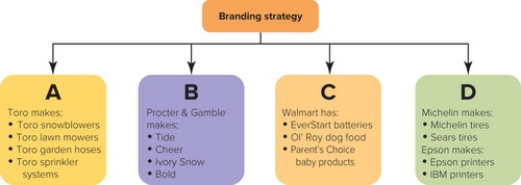 Figure 11-7
-Companies can employ several different branding strategies. In Figure 11-7 above, B represents a ________ strategy.
Figure 11-7
-Companies can employ several different branding strategies. In Figure 11-7 above, B represents a ________ strategy. (Multiple Choice)
4.8/5 (77)
(77) When Coca-Cola promoted Coke as a morning beverage for those consumers who don't drink coffee, it used a ________ strategy.
(Multiple Choice)
4.9/5 (74)
(74) Customer value can assume numerous forms. For Pez Candy, Inc., customer value manifests itself in the form of
(Multiple Choice)
4.9/5 (79)
(79) 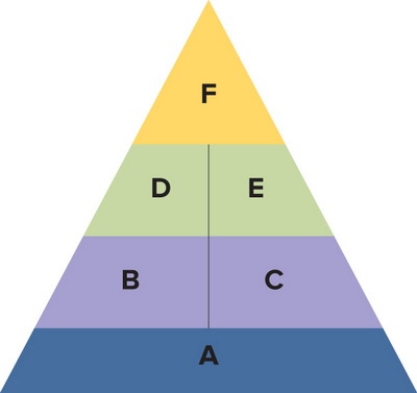 Figure 11-6
-Figure 11-6 above shows the sequential process of building brand equity. F represents the fourth and last step, which is to
Figure 11-6
-Figure 11-6 above shows the sequential process of building brand equity. F represents the fourth and last step, which is to (Multiple Choice)
4.8/5 (80)
(80) If a customer is reluctant to try a new product because she's afraid it might make her ill, the product is most likely facing ________ barrier.
(Multiple Choice)
4.8/5 (70)
(70) Three important aspects of product life cycles are their length, the shape of their sales curves, and
(Multiple Choice)
4.9/5 (94)
(94) What is the marketing objective for the decline stage of the product life cycle?
(Multiple Choice)
4.7/5 (91)
(91) Which of the following quotes from a new-product adopter would signal the need for a firm to counteract a psychological barrier?
(Multiple Choice)
4.8/5 (84)
(84) 
Filters
- Essay(0)
- Multiple Choice(0)
- Short Answer(0)
- True False(0)
- Matching(0)