



 Chat with AI
Exam 30: American Life in the Roaring Twenties

Exam 1: New World Beginnings100 Questions
Exam 2: The Contest for North America98 Questions
Exam 3: Settling the English Colonies99 Questions
Exam 4: American Life in the Seventeenth Century87 Questions
Exam 5: Colonial Society on the Eve of Revolution103 Questions
Exam 6: The Road to Revolution99 Questions
Exam 7: America Secedes From the Empire98 Questions
Exam 8: The Confederation and the Constitution100 Questions
Exam 9: Launching the New Ship of State100 Questions
Exam 10: The Triumphs and Travails of the Jeffersonian Republic100 Questions
Exam 11: The Second War for Independence and the Upsurge of Nationalism101 Questions
Exam 12: The Rise of a Mass Democracy100 Questions
Exam 13: Forging the National Economy100 Questions
Exam 14: The Ferment of Reform and Culture101 Questions
Exam 15: The South and the Slavery Controversy101 Questions
Exam 16: Manifest Destiny and Its Legacy97 Questions
Exam 17: Renewing the Sectional Struggle101 Questions
Exam 18: Drifting Toward Disunion99 Questions
Exam 19: Girding for War the North and the South100 Questions
Exam 20: The Furnace of Civil War101 Questions
Exam 21: The Ordeal of Reconstruction101 Questions
Exam 22: The Industrial Era Dawns100 Questions
Exam 23: Political Paralysis in the Gilded Age100 Questions
Exam 24: America Moves to the City100 Questions
Exam 25: The Conquest of the West100 Questions
Exam 26: Rumbles of Discontent99 Questions
Exam 27: Empire and Expansion101 Questions
Exam 28: Progressivism and the Republican Roosevelt101 Questions
Exam 29: Wilsonian Progressivism in Peace and War101 Questions
Exam 30: American Life in the Roaring Twenties101 Questions
Exam 31: The Great Depression and the New Deal101 Questions
Exam 32: Franklin D Roosevelt and the Shadow of War101 Questions
Exam 33: America in World War II101 Questions
Exam 34: The Cold War Begins101 Questions
Exam 35: American Zenith101 Questions
Exam 36: The Stormy Sixties101 Questions
Exam 37: A Sea of Troubles100 Questions
Exam 38: The Resurgence of Conservatism101 Questions
Exam 39: America Confronts the Post Cold War Era98 Questions
Exam 40: The American People Face a New Century100 Questions
Select questions type


Identify and state the historical significance of Al Capone.

Free
(Essay)
5.0/5  (76)
(76) Correct Answer: Verified
Chicago gangster and booze peddler who made millions off gang warfare.
Identify and state the historical significance of Ernest Hemingway.
Free
(Essay)
4.9/5 (74)
(74) Correct Answer:Verified
VerifiedWriter whose hard-boiled realism typified the post-war literary period.
Identify and state the historical significance of Henry Ford.
Free
(Essay)
4.8/5 (84)
(84) Correct Answer:Verified
VerifiedAutomaker whose Model T popularized cars for the middle class.
In what ways did writers like F. Scott Fitzgerald, Ernest Hemingway, Langston Hughes, and Theodore Dreiser reflect the prevalent American cultural milieu of the 1920s? In what ways did these authors criticize severely particular prevalent cultural trends in America during the 1920s?
(Essay)
4.8/5 (84)
(84) The zeal of federal agents in enforcing prohibition laws against liquor smugglers strained U.S. diplomatic relations with
(Multiple Choice)
4.9/5 (87)
(87) Disillusioned by war and peace, Americans in the 1920s did all of the following EXCEPT
(Multiple Choice)
4.7/5 (81)
(81) All of the following helped to make the prosperity of the 1920s possible EXCEPT
(Multiple Choice)
4.9/5 (79)
(79) The American airline industry in the 1920s made most of its early profits through
(Multiple Choice)
4.9/5 (79)
(79) Henry Ford's most distinctive contribution to the automobile industry was
(Multiple Choice)
4.9/5 (75)
(75) The Scopes "Monkey Trial" represented a tragic, embarrassing, and final political curtain call for prosecution expert
(Multiple Choice)
4.8/5 (72)
(72) 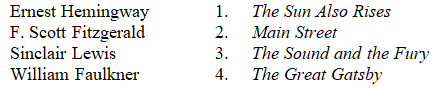
The religion of almost all Polish immigrants to America was
(Multiple Choice)
4.8/5 (72)
(72) Which of the following was NOT among the industries that prospered mightily with widespread use of the automobile?
(Multiple Choice)
4.8/5 (82)
(82) During the 1920s and after, many American immigrant ethnic groups
(Multiple Choice)
4.9/5 (78)
(78) Most American writers and cultural commentator before World War I had celebrated American democracy and politics. Why did the 1920s produce a cultural critic like H.L. Mencken who mocked democracy and middle American values? Was Mencken's criticism itself a healthy reflection of democracy or the sign of a dangerous cynicism entering American life?
(Essay)
4.8/5 (80)
(80) 
Filters
- Essay(0)
- Multiple Choice(0)
- Short Answer(0)
- True False(0)
- Matching(0)