



 Chat with AI
Exam 11: Worldwide Accounting Diversity and International Accounting Standards

Exam 19: Accounting for Estates and Trusts85 Questions
Exam 18: Accounting and Reporting for Private Not-For-Profit Organizations74 Questions
Exam 17: Accounting for State and Local Governments, Part II51 Questions
Exam 16: Accounting for State and Local Governments, Part I87 Questions
Exam 15: Partnerships: Termination and Liquidation73 Questions
Exam 14: Partnerships: Formation and Operation91 Questions
Exam 13: Accounting for Legal Reorganizations and Liquidations88 Questions
Exam 12: Financial Reporting and the Securities and Exchange Commission79 Questions
Exam 11: Worldwide Accounting Diversity and International Accounting Standards65 Questions
Exam 10: Translation of Foreign Currency Financial Statements101 Questions
Exam 9: Foreign Currency Transactions and Hedging Foreign Exchange Risk108 Questions
Exam 8: Segment and Interim Reporting120 Questions
Exam 7: Consolidated Financial Statements - Ownership Patterns and Income Taxes127 Questions
Exam 6: Variable Interest Entities, Intra-Entity Debt, Consolidated Cash Flows, and Other Issues119 Questions
Exam 5: Consolidated Financial Statements Intra-Entity Asset Transactions126 Questions
Exam 4: Consolidated Financial Statements and Outside Ownership128 Questions
Exam 3: Consolidations - Subsequent to the Date of Acquisition123 Questions
Exam 2: Consolidation of Financial Information124 Questions
Exam 1: The Equity Method of Accounting for Investments123 Questions
Select questions type


A foreign subsidiary of a U.S.-based company has been notified of a loss contingency with an estimated cost ranging between $250,000 and $275,000 which is probable of resulting in an actual loss. Each dollar amount within this range of cost is equally likely of being the actual outcome.According to U.S. GAAP, what is the amount recognized as a provision for loss contingency?
(Multiple Choice)
4.8/5  (63)
(63) Which of the following statements is false regarding a country's legal system?
(Multiple Choice)
4.9/5 (60)
(60) Teapot, Ltd. is a foreign company that uses IFRS for its financial reporting. Teapot is a wholly-owned subsidiary of Davis Housewares Corp. which is a U.S. company that prepares its consolidated financial statements in accordance with U.S. GAAP. Teapot purchased a piece of equipment for $3,000,000 on January 1, 2020. The equipment has an overall useful life of 20 years and no salvage value. The equipment is comprised of the following three significant components, shown with their associated cost and useful life. 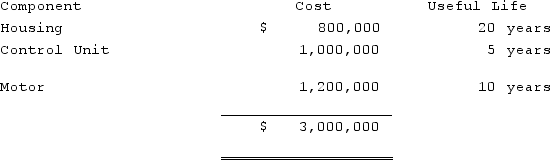 As a corporate policy, Davis Housewares Corp. utilizes the straight-line method of depreciation for machinery and equipment and plans to extend this policy to Teapot, Ltd.Prepare the journal entry to convert the 2020 Teapot, Ltd. financial statements from IFRS to U.S. GAAP.
 (Essay)
4.8/5 (77)
(77) A foreign subsidiary of a U.S.-based company has been notified of a loss contingency with an estimated cost ranging between $250,000 and $275,000 which is probable of resulting in an actual loss. Each dollar amount within this range of cost is equally likely of being the actual outcome.According to IFRS, what is the amount recognized as a provision for loss contingency?
(Multiple Choice)
4.8/5 (66)
(66) Which of the following is not a problem caused by diversity in accounting practices across countries?
(Multiple Choice)
4.9/5 (74)
(74) All of the following are successful FASB-IASB convergence projects except
(Multiple Choice)
4.8/5 (66)
(66) With regard to IFRS, what does SME refer to, and what is the significance with regard to financial reporting requirements?
(Essay)
4.9/5 (76)
(76) Why do countries have their own unique set of financial reporting practices?
(Essay)
4.8/5 (78)
(78) Foreign companies whose stock is listed on a U.S. stock exchange and using foreign GAAP other than IFRS must file their annual report with the SEC on:
(Multiple Choice)
5.0/5 (90)
(90) What does the IASB's Conceptual Framework for Financial Reporting state as the objective of general purpose financial reporting?
(Essay)
4.7/5 (88)
(88) All of the following are ways a country may use IFRS except:
(Multiple Choice)
4.8/5 (87)
(87) A company is preparing financial statements using IFRS for the first time for the year ended December 31, 2021. The "transition date" for reporting is
(Multiple Choice)
4.8/5 (74)
(74) Which of the following is not a problem caused by diverse accounting practices across countries?
(Multiple Choice)
4.9/5 (82)
(82) What are the two primary methods used by countries to incorporate IFRS into their financial reporting requirements for listed companies?
(Essay)
4.9/5 (82)
(82) ASU, Inc., a U.S. company, was acquired by an international company and ASU has a transition date of January 1, 2021 for first-time adoption of IFRS. ASU has a new cookie brand that is ready to be marketed but the company has not yet received copyright approval for the brand's logo. All costs for development of the copyright were expensed prior to IFRS January 1, 2021. ASU and its new international parent both have December 31 year-end accounting years. What should ASU do to prepare financial statements for the first time in accordance with IFRS?
(Multiple Choice)
4.8/5 (87)
(87) Which of the following is not one of the optional exemptions provided by IFRS 1 to first-time adopters of IFRS in preparing the opening balance sheet?
(Multiple Choice)
4.9/5 (85)
(85) A U.S. company has many foreign subsidiaries and wants to convert its consolidated financial statements from U.S. GAAP to IFRS. Which of the following items is not one of the likely accounting issues to resolve for the opening IFRS balance sheet?
(Multiple Choice)
4.9/5 (79)
(79) A U.S. company has many foreign subsidiaries and is converting its consolidated financial statements from U.S. GAAP to IFRS. Which of the following items is not one of the likely accounting issues to resolve for the conversion?
(Multiple Choice)
4.8/5 (92)
(92) 
Filters
- Essay(0)
- Multiple Choice(0)
- Short Answer(0)
- True False(0)
- Matching(0)