



 Chat with AI
Exam 15: Partnerships: Termination and Liquidation

Exam 19: Accounting for Estates and Trusts85 Questions
Exam 18: Accounting and Reporting for Private Not-For-Profit Organizations74 Questions
Exam 17: Accounting for State and Local Governments, Part II51 Questions
Exam 16: Accounting for State and Local Governments, Part I87 Questions
Exam 15: Partnerships: Termination and Liquidation73 Questions
Exam 14: Partnerships: Formation and Operation91 Questions
Exam 13: Accounting for Legal Reorganizations and Liquidations88 Questions
Exam 12: Financial Reporting and the Securities and Exchange Commission79 Questions
Exam 11: Worldwide Accounting Diversity and International Accounting Standards65 Questions
Exam 10: Translation of Foreign Currency Financial Statements101 Questions
Exam 9: Foreign Currency Transactions and Hedging Foreign Exchange Risk108 Questions
Exam 8: Segment and Interim Reporting120 Questions
Exam 7: Consolidated Financial Statements - Ownership Patterns and Income Taxes127 Questions
Exam 6: Variable Interest Entities, Intra-Entity Debt, Consolidated Cash Flows, and Other Issues119 Questions
Exam 5: Consolidated Financial Statements Intra-Entity Asset Transactions126 Questions
Exam 4: Consolidated Financial Statements and Outside Ownership128 Questions
Exam 3: Consolidations - Subsequent to the Date of Acquisition123 Questions
Exam 2: Consolidation of Financial Information124 Questions
Exam 1: The Equity Method of Accounting for Investments123 Questions
Select questions type


Jones, Marge, and Tate LLP decided to dissolve and liquidate the partnership on September 30, 2021. After realization of a portion of the noncash assets, the capital account balances were Jones $50,000; Marge $40,000; and Tate $15,000. Cash of $35,000 and other assets with a carrying amount of $100,000 were on hand. Creditors' claims totaled $30,000. Jones, Marge, and Tate shared net income and losses in a 2:1:1 ratio, respectively.Prepare a working paper to compute the amount of cash that may be paid to creditors and to partners at this time, assuming that no partner is solvent.
(Essay)
4.9/5  (80)
(80) The Keller, Long, and Mason partnership had the following balance sheet just before entering liquidation: 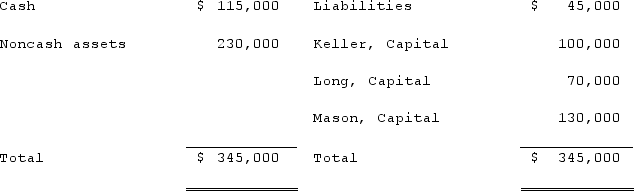 Keller, Long, and Mason share profits and losses in a ratio of 2:4:4.Assuming noncash assets were sold for $70,000 and liquidation expenses in the amount of $18,500 were incurred, how much will each partner receive in the liquidation?
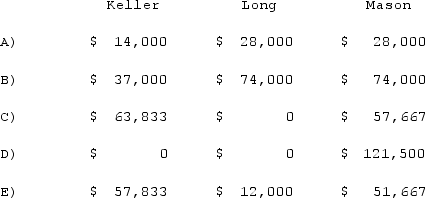
Keller, Long, and Mason share profits and losses in a ratio of 2:4:4.Assuming noncash assets were sold for $70,000 and liquidation expenses in the amount of $18,500 were incurred, how much will each partner receive in the liquidation? (Multiple Choice)
4.9/5 (76)
(76) A partnership has assets of cash of $10,000 and equipment with a book value of $160,000. All liabilities have been paid. The partners' capital accounts are as follows Michael $80,000, Gregory $60,000 and Phillips $30,000. The partners share profits and losses on a 4:3:3 basis. If the equipment is sold for $100,000 and there are no liquidation expenses what amount should Gregory receive in the final settlement?
(Multiple Choice)
5.0/5 (78)
(78) On January 1, 2021, the partners of Won, Cadel, and Dax (who shared profits and losses in the ratio of 5:3:2, respectively) decided to liquidate their partnership. The trial balance at this date was as follows: 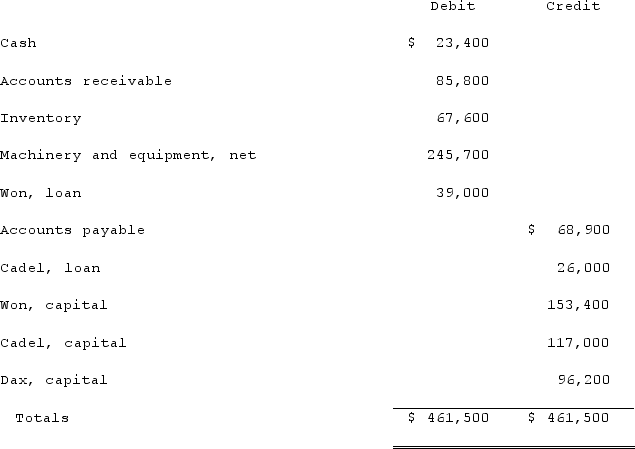 The partners planned an installment program to dispose of the business assets and to minimize liquidation losses. All available cash, less an amount retained to provide for future expenses, was to be distributed to the partners at the end of each month. A summary of liquidation transactions follows:
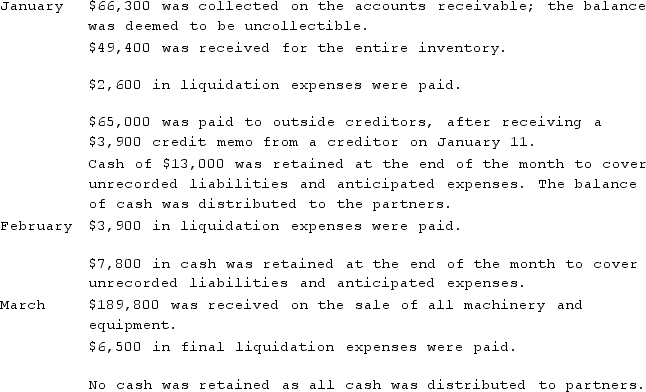 Prepare a schedule to calculate the safe installment payments to be made to the partners at the end of February.
The partners planned an installment program to dispose of the business assets and to minimize liquidation losses. All available cash, less an amount retained to provide for future expenses, was to be distributed to the partners at the end of each month. A summary of liquidation transactions follows: Prepare a schedule to calculate the safe installment payments to be made to the partners at the end of February. (Essay)
4.9/5 (85)
(85) A local partnership was in the process of liquidating and reported the following Capital account balances:  Douglass indicated that the $14,000 deficit would be covered by a forthcoming contribution. However, the two remaining partners asked to receive the $31,000 that was then in the cash account.How much of the $31,000 in the cash account should Justice receive?
 (Multiple Choice)
4.9/5 (89)
(89) Dancey, Reese, Newman, and Jahn were partners who shared profits and losses on a 4:2:2:2 basis, respectively. They were beginning to liquidate their business. At the start of the process, Capital account balances were as follows: 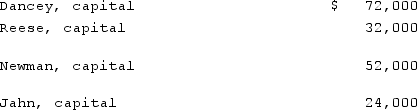 Which one of the following statements is true for a predistribution plan?
 (Multiple Choice)
4.8/5 (82)
(82) Xygote, Yen, and Zen were partners who were liquidating their partnership. Each partner has a deficit balance in their respective capital account. Assuming all assets from the partnership have been liquidated and all of the liabilities have been paid, how should any additional cash coming into the partnership be distributed to the partners?
(Essay)
4.8/5 (65)
(65) White, Sands, and Luke has the following capital account balances and profit and loss ratios:$60,000 (30%); $100,000 (20%); and $200,000 (50%).The partnership has received a predistribution plan.How would $90,000 be distributed? 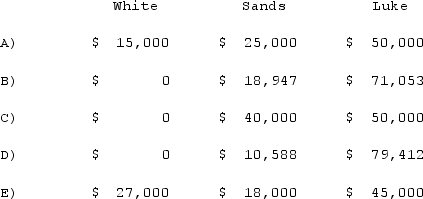
(Multiple Choice)
4.7/5 (85)
(85) The Allen, Bevell, and Carter partnership began the process of liquidation with the following balance sheet: 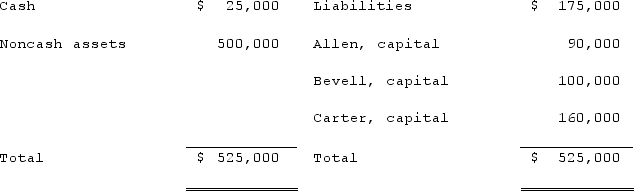 Allen, Bevell, and Carter share profits and losses in a ratio of 3:2:5. Liquidation expenses are expected to be $14,000.Assuming that, after the payment of liquidation expenses in the amount of $14,000 was made and the noncash assets were sold, if Carter has a deficit of $10,000, for what amount would the noncash assets have been sold?
 (Multiple Choice)
4.8/5 (92)
(92) For each of the following situations, select the correct entry that would be required on a consolidation worksheet.
Correct Answer: Verified
Premises:
Responses:
(Matching)
4.9/5 (74)
(74) 
Filters
- Essay(0)
- Multiple Choice(0)
- Short Answer(0)
- True False(0)
- Matching(0)