



 Chat with AI
Exam 5: The Skeletal System

Exam 1: Human Biology, Science, and Society85 Questions
Exam 2: The Chemistry of Living Things118 Questions
Exam 3: Structure and Function of Cells124 Questions
Exam 4: From Cells to Organ Systems107 Questions
Exam 5: The Skeletal System95 Questions
Exam 6: The Muscular System107 Questions
Exam 7: Blood114 Questions
Exam 8: Heart and Blood Vessels112 Questions
Exam 9: The Immune System and Mechanisms of Defense118 Questions
Exam 10: The Respiratory System: Exchange of Gases94 Questions
Exam 11: The Nervous System: Integration and Control111 Questions
Exam 12: Sensory Mechanisms107 Questions
Exam 13: The Endocrine System94 Questions
Exam 14: The Digestive System and Nutrition91 Questions
Exam 15: The Urinary System73 Questions
Exam 16: Reproductive Systems97 Questions
Exam 17: Cell Reproduction and Differentiation95 Questions
Exam 18: Cancer: Uncontrolled Cell Division and Differentiation89 Questions
Exam 19: Genetics and Inheritance81 Questions
Exam 20: DNA Technology and Genetic Engineering75 Questions
Exam 21: Development and Aging84 Questions
Exam 22: Evolution and the Origins of Life89 Questions
Exam 23: Ecosystems and Populations85 Questions
Exam 24: Human Impacts, Biodiversity, and Environmental Issues74 Questions
Select questions type


Surgically removed growth plates from a child result in no further increases in bone length.
(True/False)
4.9/5  (73)
(73) 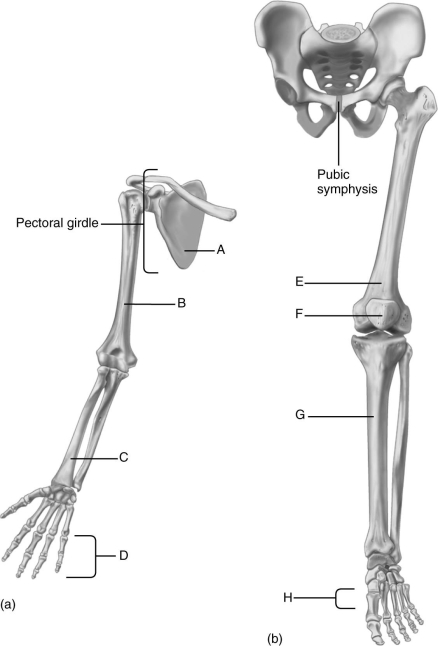 Using the figure above, identify the bones of the appendicular skeleton.
-Label D represents the ________ bone.
Using the figure above, identify the bones of the appendicular skeleton.
-Label D represents the ________ bone. (Multiple Choice)
5.0/5 (92)
(92) Which bone is frequently broken when someone dies of deliberate strangulation?
(Multiple Choice)
4.9/5 (70)
(70) The outer ear and epiglottis have a small amount of flexibility associated with them because of the presence of ________ cartilage.
(Short Answer)
4.8/5 (89)
(89) If a child needed to have surgery that removed all growth plates, what would be the effect on bone growth?
(Essay)
4.9/5 (64)
(64) Vertebrae of the spinal cord are separated from each other by compressible, flat structures called ________ disks.
(Short Answer)
4.9/5 (80)
(80) 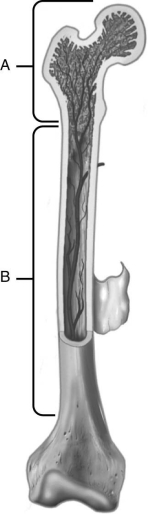 Using the figure above, match the following.
-location of red bone marrow
Using the figure above, match the following.
-location of red bone marrow (Short Answer)
4.7/5 (75)
(75) Which one of the following is the correct classification of vertebrae, from the skull to the pelvis?
(Multiple Choice)
4.7/5 (85)
(85) Using the figure above, identify the bones of the appendicular skeleton.
-Label B represents the ________ bone.
Using the figure above, identify the bones of the appendicular skeleton.
-Label B represents the ________ bone. (Multiple Choice)
4.7/5 (81)
(81) All of the following statements about the sinuses are TRUE EXCEPT which one?
(Multiple Choice)
4.8/5 (86)
(86) Match the following bones of the skull to their description.
-lower jaw
(Multiple Choice)
4.7/5 (91)
(91) Stem cells in red bone marrow give rise to ________ and ________ blood cells.
(Short Answer)
4.7/5 (78)
(78) Osteoporosis is a common condition that essentially results when homeostasis cannot be maintained in ________ and ________.
(Multiple Choice)
4.9/5 (76)
(76) The stability of a synovial joint is due largely to the presence of calcium salts.
(True/False)
4.9/5 (76)
(76) The coxal bones of the pelvic girdle meet in front at the ________, where they are joined by cartilage.
(Short Answer)
4.9/5 (84)
(84) Match the following.
-condition in which bones decrease in size over time due to an imbalance in the activities of osteoblasts and osteoclasts
(Multiple Choice)
4.7/5 (68)
(68) Match the following bones of the skull to their description.
-anchors the upper row of teeth
(Multiple Choice)
4.9/5 (80)
(80) Using the figure above, identify the bones of the appendicular skeleton.
-Label H represents the ________ bone.
Using the figure above, identify the bones of the appendicular skeleton.
-Label H represents the ________ bone. (Multiple Choice)
5.0/5 (85)
(85) 
Filters
- Essay(0)
- Multiple Choice(0)
- Short Answer(0)
- True False(0)
- Matching(0)