



 Chat with AI
Exam 16: Reproductive Systems

Exam 1: Human Biology, Science, and Society85 Questions
Exam 2: The Chemistry of Living Things118 Questions
Exam 3: Structure and Function of Cells124 Questions
Exam 4: From Cells to Organ Systems107 Questions
Exam 5: The Skeletal System95 Questions
Exam 6: The Muscular System107 Questions
Exam 7: Blood114 Questions
Exam 8: Heart and Blood Vessels112 Questions
Exam 9: The Immune System and Mechanisms of Defense118 Questions
Exam 10: The Respiratory System: Exchange of Gases94 Questions
Exam 11: The Nervous System: Integration and Control111 Questions
Exam 12: Sensory Mechanisms107 Questions
Exam 13: The Endocrine System94 Questions
Exam 14: The Digestive System and Nutrition91 Questions
Exam 15: The Urinary System73 Questions
Exam 16: Reproductive Systems97 Questions
Exam 17: Cell Reproduction and Differentiation95 Questions
Exam 18: Cancer: Uncontrolled Cell Division and Differentiation89 Questions
Exam 19: Genetics and Inheritance81 Questions
Exam 20: DNA Technology and Genetic Engineering75 Questions
Exam 21: Development and Aging84 Questions
Exam 22: Evolution and the Origins of Life89 Questions
Exam 23: Ecosystems and Populations85 Questions
Exam 24: Human Impacts, Biodiversity, and Environmental Issues74 Questions
Select questions type


Which one of the following sexually transmitted diseases can be cured by the use of antibiotics?
(Multiple Choice)
4.9/5  (83)
(83) 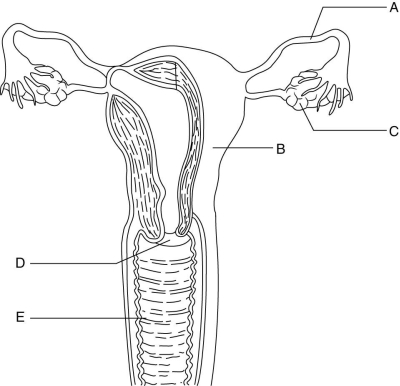 Using the figure above, identify the organs of the female reproductive system.
-The organ that releases female gametes is indicated by letter ________.
Using the figure above, identify the organs of the female reproductive system.
-The organ that releases female gametes is indicated by letter ________. (Short Answer)
4.8/5 (76)
(76) If pregnancy occurs, a layer of tissue associated with the embryo secretes the hormone ________, which maintains the activity of the corpus luteum in the ovaries of the mother.
(Short Answer)
4.8/5 (85)
(85) At the beginning of each ovarian cycle, which one of the following hormones causes the development of a primary oocyte?
(Multiple Choice)
4.8/5 (89)
(89) FSH causes granulosa cells to divide and secrete a sugary coating of glycoproteins around the oocyte.
(True/False)
4.9/5 (80)
(80) Match each hormone to its function.
-stimulates release of FSH and LH from the anterior pituitary gland
(Multiple Choice)
4.7/5 (67)
(67) Of the 3 phases of the menstrual cycle, menstrual, proliferative, and secretory, ovulation occurs during the ________ stage of the menstrual cycle.
(Short Answer)
4.8/5 (90)
(90) Using the figure above, identify the organs of the female reproductive system.
-The oviduct is indicated by letter ________.
Using the figure above, identify the organs of the female reproductive system.
-The oviduct is indicated by letter ________. (Short Answer)
4.9/5 (86)
(86) Endometrial tissue sometimes migrates out of the uterus and attaches to other abdominal organs.
(True/False)
4.8/5 (74)
(74) The head of a sperm is covered by the ________, which contains enzymes that help penetrate the layers of cells surrounding the egg.
(Short Answer)
4.8/5 (77)
(77) During ejaculation, smooth muscle in the ejaculatory duct, seminal vesicles, epididymis, prostate, and bulbourethral glands are stimulated by
(Multiple Choice)
4.9/5 (84)
(84) FSH in males targets ________ cells, which indirectly enhances sperm formation.
(Short Answer)
4.8/5 (84)
(84) Which one of the following sexually transmitted diseases is caused by bacteria?
(Multiple Choice)
4.7/5 (82)
(82) LH is released by the anterior pituitary gland to stimulate Sertoli cells to produce sperm.
(True/False)
4.7/5 (78)
(78) The only completely effective method of birth control is ________.
(Short Answer)
4.9/5 (88)
(88) Trichomoniasis is a bacterial infection that is sexually transmitted; chronic infection often results in blindness, damage to the nervous system, and eventually death.
(True/False)
4.8/5 (74)
(74) 
Filters
- Essay(0)
- Multiple Choice(0)
- Short Answer(0)
- True False(0)
- Matching(0)