



 Chat with AI
Exam 10: How Do We Hear, Speak, and Make Music

Exam 1: What Are the Origins of Brain and Behavior 136 Questions
Exam 2: What Is the Nervous Systems Functional Anatomy145 Questions
Exam 3: What Are the Nervous Systems Functional Units134 Questions
Exam 4: How Do Neurons Use Electrical Signals to Transmit Information 135 Questions
Exam 5: How Do Neurons Communicate and Adapt130 Questions
Exam 6: How Do Drugs and Hormones Influence the Brain and Behavior 137 Questions
Exam 7: How Do We Study the Brains Structures and Functions 141 Questions
Exam 8: How Does the Nervous System Develop and Adapt 145 Questions
Exam 9: How Do We Sense, Perceive, and See the World 144 Questions
Exam 10: How Do We Hear, Speak, and Make Music 141 Questions
Exam 11: How Does the Nervous System Respond to Stimulation and Produce Movement 145 Questions
Exam 12: What Causes Emotional and Motivated Behavior 142 Questions
Exam 13: Why Do We Sleep and Dream 142 Questions
Exam 14: How Do We Learn and Remember 140 Questions
Exam 15: How Does the Brain Think 142 Questions
Exam 16: What Happens When the Brain Misbehaves 143 Questions
Select questions type


What is the name for the inner ear structure that contains the auditory receptor cells?
(Multiple Choice)
4.8/5  (70)
(70) Differentiate between the dorsal and ventral streams of auditory processing.
(Essay)
4.8/5 (79)
(79) Which of the following frequencies is likely to be coded closest to the apex of the cochlea?
(Multiple Choice)
4.8/5 (70)
(70) In the human cochlea, there are approximately _____ inner hair cells.
(Multiple Choice)
4.8/5 (73)
(73) Match the letter to the appropriate structure of the ear. 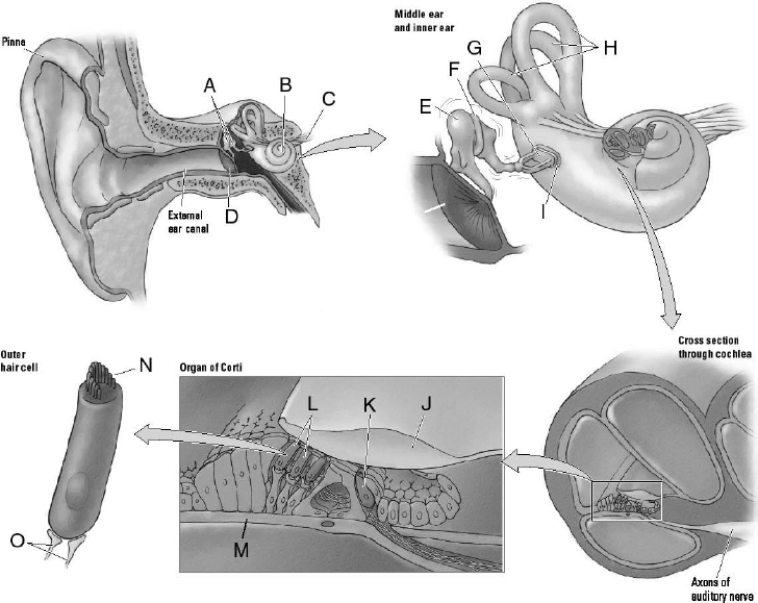 _____ 1. auditory nerve
_____ 2. semicircular canals
_____ 3. outer hair cells
_____ 4. inner hair cells
_____ 5. oval window
_____ 6. cochlea
_____ 7. ossicles
_____ 8. cilia
_____ 9. tectorial membrane
_____ 10. nerve fibers
_____ 11. eardrum
_____ 12. hammer
_____ 13. basilar membrane
_____ 14. anvil
_____ 15. stirrup
_____ 1. auditory nerve
_____ 2. semicircular canals
_____ 3. outer hair cells
_____ 4. inner hair cells
_____ 5. oval window
_____ 6. cochlea
_____ 7. ossicles
_____ 8. cilia
_____ 9. tectorial membrane
_____ 10. nerve fibers
_____ 11. eardrum
_____ 12. hammer
_____ 13. basilar membrane
_____ 14. anvil
_____ 15. stirrup (Short Answer)
4.7/5 (67)
(67) In water, _____ are limited, while _____ travels faster than in air.
(Multiple Choice)
4.7/5 (78)
(78) The development of a new language from what was formerly a rudimentary language is described as:
(Multiple Choice)
4.9/5 (81)
(81) It is likely that speech and music perception are located in the:
(Multiple Choice)
4.8/5 (83)
(83) Briefly describe the language acquisition process in children. What is the most critical time period for language acquisition?
(Essay)
5.0/5 (86)
(86) How do humans localize the sources of high-frequency and low-frequency sounds in the environment? Which brain regions are involved?
(Short Answer)
4.9/5 (87)
(87) About 4 percent of the population has amusia, meaning that they:
(Multiple Choice)
5.0/5 (91)
(91) Susan is able to distinguish between a French horn and a trombone even when they are playing the same note at the same loudness. This is accomplished through using the differences in:
(Multiple Choice)
4.9/5 (79)
(79) Which of the following is NOT evidence supporting Chomsky's theory about language?
(Multiple Choice)
4.8/5 (57)
(57) Studies with humans have shown that if two sounds presented through earphones are separated by as little as _____ microseconds, the sound will be perceived as being on the side of the leading ear.
(Multiple Choice)
4.9/5 (80)
(80) Which of the following structures is NOT part of the organ of Corti?
(Multiple Choice)
4.9/5 (97)
(97) 
Filters
- Essay(0)
- Multiple Choice(0)
- Short Answer(0)
- True False(0)
- Matching(0)