



 Chat with AI
Exam 13: Why Do We Sleep and Dream

Exam 1: What Are the Origins of Brain and Behavior 136 Questions
Exam 2: What Is the Nervous Systems Functional Anatomy145 Questions
Exam 3: What Are the Nervous Systems Functional Units134 Questions
Exam 4: How Do Neurons Use Electrical Signals to Transmit Information 135 Questions
Exam 5: How Do Neurons Communicate and Adapt130 Questions
Exam 6: How Do Drugs and Hormones Influence the Brain and Behavior 137 Questions
Exam 7: How Do We Study the Brains Structures and Functions 141 Questions
Exam 8: How Does the Nervous System Develop and Adapt 145 Questions
Exam 9: How Do We Sense, Perceive, and See the World 144 Questions
Exam 10: How Do We Hear, Speak, and Make Music 141 Questions
Exam 11: How Does the Nervous System Respond to Stimulation and Produce Movement 145 Questions
Exam 12: What Causes Emotional and Motivated Behavior 142 Questions
Exam 13: Why Do We Sleep and Dream 142 Questions
Exam 14: How Do We Learn and Remember 140 Questions
Exam 15: How Does the Brain Think 142 Questions
Exam 16: What Happens When the Brain Misbehaves 143 Questions
Select questions type


John is participating in a sleep study. While examining John's EEG pattern, the researcher notices that the waves are extremely regular, with a frequency of 7 to 11 Hz. Based on this observation, the researcher can conclude that John is:
(Multiple Choice)
4.7/5  (71)
(71) What is the reticular activating system? How does it contribute to sleeping and waking behavior?
(Essay)
4.7/5 (70)
(70) What is the role of the suprachiasmatic nucleus in biological rhythms? What role do core and shell neurons play in biological rhythms?
(Essay)
5.0/5 (80)
(80) The suprachiasmatic nucleus does NOT entrain slave oscillators via connection(s) with the:
(Multiple Choice)
4.9/5 (71)
(71) Poppy was recently diagnosed with seasonal affective disorder. What symptoms is she likely experiencing? What treatment options would you recommend to Poppy?
(Essay)
4.7/5 (96)
(96) Which of the following structures does NOT send inputs to the suprachiasmatic nucleus?
(Multiple Choice)
4.8/5 (75)
(75) In the textbook, J. S. would frequently fall asleep for short periods of time, lasting only 5 to 10 minutes. To treat his condition, J. S. was given a prescription for:
(Multiple Choice)
4.8/5 (74)
(74) Sadie was diagnosed with restless legs syndrome. What symptoms does she likely experience? What treatment options would be recommended for Sadie?
(Essay)
4.8/5 (87)
(87) Match the letter to the appropriate structure of the brainstem. 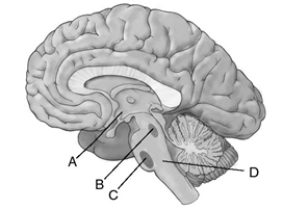 _____ 1. medial pontine reticular formation
_____ 2. reticular activating system
_____ 3. hypothalamus
_____ 4. peribrachial area
_____ 1. medial pontine reticular formation
_____ 2. reticular activating system
_____ 3. hypothalamus
_____ 4. peribrachial area (Short Answer)
4.9/5 (80)
(80) For humans, the basic rest-activity cycle is approximately:
(Multiple Choice)
4.8/5 (90)
(90) Which of the following would describe the electrical activity of neurons in a rat's suprachiasmatic nucleus if it were removed and placed in a dish?
(Multiple Choice)
4.8/5 (76)
(76) Does one have to be unconscious to experience the visual components of R-sleep? Support your argument using evidence from the textbook.
(Short Answer)
4.8/5 (66)
(66) 
Filters
- Essay(0)
- Multiple Choice(0)
- Short Answer(0)
- True False(0)
- Matching(0)