



 Chat with AI
Exam 11: Cranium

Exam 1: Preliminary Steps in Radiography32 Questions
Exam 2: General Anatomy and Radiographic Positioning Terminology119 Questions
Exam 3: Thoracic Viscera: Chest and Upper Airway79 Questions
Exam 4: Abdomen25 Questions
Exam 5: Upper Extremity136 Questions
Exam 6: Shoulder Girdle94 Questions
Exam 7: Lower Extremity154 Questions
Exam 8: Pelvis and Hip53 Questions
Exam 9: Vertebral Column179 Questions
Exam 10: Bony Thorax59 Questions
Exam 11: Cranium185 Questions
Exam 12: Trauma Radiography11 Questions
Exam 13: Contrast Arthrography3 Questions
Exam 14: Myelography and Other Central Nervous System Imaging13 Questions
Exam 15: Digestive System: Salivary Glands, alimentary Canal, and Biliary System125 Questions
Exam 16: Urinary System and Venipuncture81 Questions
Exam 17: Reproductive System9 Questions
Exam 18: Mammography27 Questions
Exam 19: Bone Densitometry16 Questions
Exam 20: Mobile Radiography12 Questions
Exam 21: Surgical Radiography11 Questions
Exam 22: Pediatric Imaging16 Questions
Exam 23: Geriatric Radiography14 Questions
Exam 24: Sectional Anatomy for Radiographers29 Questions
Exam 25: Computed Tomography14 Questions
Exam 26: Magnetic Resonance Imaging14 Questions
Exam 27: Vascular,cardiac,and Interventional Radiography37 Questions
Exam 28: Diagnostic Medical Sonography15 Questions
Exam 29: Nuclear Medicine and Molecular Imaging18 Questions
Exam 30: Radiation Oncology17 Questions
Select questions type


Which line is placed perpendicular to the plane of the image receptor for the AP axial projection of the zygomatic arches?
(Multiple Choice)
4.7/5  (85)
(85) What is the central-ray angulation for the axiolateral oblique projection of the TMJ?
(Multiple Choice)
4.8/5 (83)
(83) The letter G in the image below of the paranasal sinuses labels the: 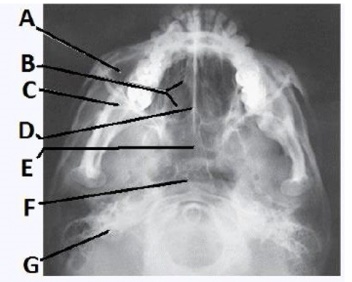
(Multiple Choice)
4.7/5 (81)
(81) Which two must occur to successfully demonstrate the ethmoidal and sphenoidal sinuses on the SMV projection? (Select all that apply.)
(Multiple Choice)
4.8/5 (89)
(89) 
Which two facial bones form the roof of the mouth? (Select all that apply.)
(Multiple Choice)
4.7/5 (66)
(66) The central-ray angulation for the reverse Waters method when OML is properly positioned is:
(Multiple Choice)
4.9/5 (75)
(75) The ethmoidal sinuses are located within which portion of the bone?
(Multiple Choice)
5.0/5 (78)
(78) Which of the following is placed perpendicular to the front edge of the IR for a lateral projection of the facial bones?
(Multiple Choice)
4.9/5 (74)
(74) The superior aspect of the sphenoid bone contains a deep depression that contains the:
(Multiple Choice)
4.9/5 (77)
(77) The letter B in the image below of the paranasal sinuses labels the _____ sinuses. 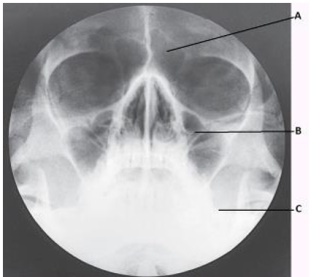
(Multiple Choice)
4.8/5 (87)
(87) Which drawing in the figure below demonstrates the correct head position for the Waters method? 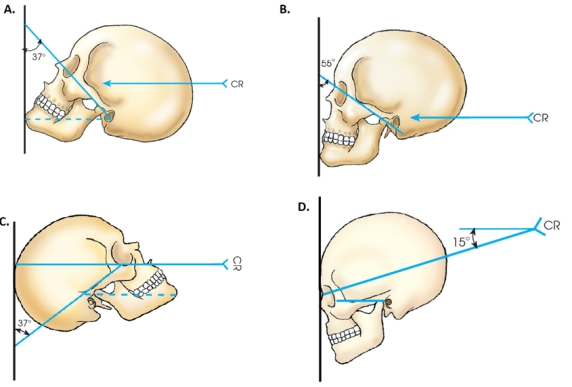
(Multiple Choice)
4.8/5 (84)
(84) Which two bones are contained in the floor of the cranium? (Select all that apply.)
(Multiple Choice)
4.9/5 (76)
(76) What is the central-ray angulation for demonstration of the entire foramen magnum during an AP axial (Towne)projection?
(Multiple Choice)
4.8/5 (83)
(83) What projection (method)of the facial bones is demonstrated in the image below? 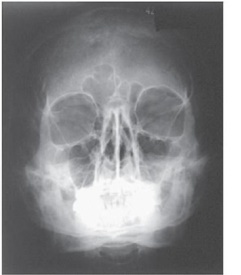
(Multiple Choice)
4.9/5 (83)
(83) Which plane of the head is placed parallel to the plane of the image receptor for a lateral projection of the skull?
(Multiple Choice)
4.8/5 (79)
(79) The central ray is directed perpendicular to which reference line for the SMV projection of the sinuses?
(Multiple Choice)
4.8/5 (96)
(96) For an SMV projection of the cranial base,the central ray should always be perpendicular to the _____ line.
(Multiple Choice)
4.8/5 (74)
(74) The lateral projection of the facial bones clearly demonstrates:
(Multiple Choice)
5.0/5 (97)
(97) 
Filters
- Essay(0)
- Multiple Choice(0)
- Short Answer(0)
- True False(0)
- Matching(0)