



 Chat with AI
Exam 3: Thoracic Viscera: Chest and Upper Airway

Exam 1: Preliminary Steps in Radiography32 Questions
Exam 2: General Anatomy and Radiographic Positioning Terminology119 Questions
Exam 3: Thoracic Viscera: Chest and Upper Airway79 Questions
Exam 4: Abdomen25 Questions
Exam 5: Upper Extremity136 Questions
Exam 6: Shoulder Girdle94 Questions
Exam 7: Lower Extremity154 Questions
Exam 8: Pelvis and Hip53 Questions
Exam 9: Vertebral Column179 Questions
Exam 10: Bony Thorax59 Questions
Exam 11: Cranium185 Questions
Exam 12: Trauma Radiography11 Questions
Exam 13: Contrast Arthrography3 Questions
Exam 14: Myelography and Other Central Nervous System Imaging13 Questions
Exam 15: Digestive System: Salivary Glands, alimentary Canal, and Biliary System125 Questions
Exam 16: Urinary System and Venipuncture81 Questions
Exam 17: Reproductive System9 Questions
Exam 18: Mammography27 Questions
Exam 19: Bone Densitometry16 Questions
Exam 20: Mobile Radiography12 Questions
Exam 21: Surgical Radiography11 Questions
Exam 22: Pediatric Imaging16 Questions
Exam 23: Geriatric Radiography14 Questions
Exam 24: Sectional Anatomy for Radiographers29 Questions
Exam 25: Computed Tomography14 Questions
Exam 26: Magnetic Resonance Imaging14 Questions
Exam 27: Vascular,cardiac,and Interventional Radiography37 Questions
Exam 28: Diagnostic Medical Sonography15 Questions
Exam 29: Nuclear Medicine and Molecular Imaging18 Questions
Exam 30: Radiation Oncology17 Questions
Select questions type


For AP oblique projections of the chest,the side of interest is generally the side _____ the IR.
(Multiple Choice)
5.0/5  (78)
(78) Which positioning maneuver moves the scapulae out of the lateral aspects of the lungs?
(Multiple Choice)
4.9/5 (66)
(66) Which two of the following radiographs are usually taken on a patient who is suspected of having a small amount of free air in the pleural cavity?
(Multiple Choice)
4.9/5 (89)
(89) The presence of gas or air in the pleural cavity is termed:
(Multiple Choice)
4.9/5 (74)
(74) How far above the top of the shoulders should the IR be positioned for any decubitus position of the chest?
(Multiple Choice)
4.7/5 (95)
(95) How far above the shoulders should the IR be positioned for PA and lateral chest radiographs?
(Multiple Choice)
4.9/5 (70)
(70) If the patient cannot be placed in the lordotic position for radiography of the pulmonary apices,what is the central-ray angle that can be used to project the clavicles above the apices?
(Multiple Choice)
4.9/5 (66)
(66) How is the central ray positioned for an x-ray projection done with the patient placed in a decubitus position?
(Multiple Choice)
4.9/5 (76)
(76) Which of the following best describes the position of the thymus gland?
(Multiple Choice)
4.9/5 (76)
(76) If the lateral decubitus position is used to demonstrate free air in the pleural cavity,on which side must the patient lie?
(Multiple Choice)
4.8/5 (72)
(72) Which two of the following will be observed on a supine AP chest radiograph? (Select all that apply.)
(Multiple Choice)
4.8/5 (88)
(88) Where should the top of the IR be positioned for an AP oblique projection of the lungs?
(Multiple Choice)
4.8/5 (87)
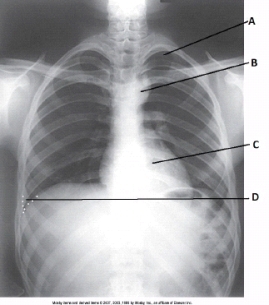
(87) 
Why is the upright left lateral position the most commonly used for lateral radiographs of the chest?
(Multiple Choice)
4.9/5 (81)
(81) Which side of the patient's chest is placed against the vertical IR for a ventral or dorsal decubitus lateral projection?
(Multiple Choice)
4.7/5 (89)
(89) What is the name of the hooklike process on the last tracheal cartilage?
(Multiple Choice)
4.9/5 (79)
(79) 
Filters
- Essay(0)
- Multiple Choice(0)
- Short Answer(0)
- True False(0)
- Matching(0)