



 Chat with AI
Exam 6: Shoulder Girdle

Exam 1: Preliminary Steps in Radiography32 Questions
Exam 2: General Anatomy and Radiographic Positioning Terminology119 Questions
Exam 3: Thoracic Viscera: Chest and Upper Airway79 Questions
Exam 4: Abdomen25 Questions
Exam 5: Upper Extremity136 Questions
Exam 6: Shoulder Girdle94 Questions
Exam 7: Lower Extremity154 Questions
Exam 8: Pelvis and Hip53 Questions
Exam 9: Vertebral Column179 Questions
Exam 10: Bony Thorax59 Questions
Exam 11: Cranium185 Questions
Exam 12: Trauma Radiography11 Questions
Exam 13: Contrast Arthrography3 Questions
Exam 14: Myelography and Other Central Nervous System Imaging13 Questions
Exam 15: Digestive System: Salivary Glands, alimentary Canal, and Biliary System125 Questions
Exam 16: Urinary System and Venipuncture81 Questions
Exam 17: Reproductive System9 Questions
Exam 18: Mammography27 Questions
Exam 19: Bone Densitometry16 Questions
Exam 20: Mobile Radiography12 Questions
Exam 21: Surgical Radiography11 Questions
Exam 22: Pediatric Imaging16 Questions
Exam 23: Geriatric Radiography14 Questions
Exam 24: Sectional Anatomy for Radiographers29 Questions
Exam 25: Computed Tomography14 Questions
Exam 26: Magnetic Resonance Imaging14 Questions
Exam 27: Vascular,cardiac,and Interventional Radiography37 Questions
Exam 28: Diagnostic Medical Sonography15 Questions
Exam 29: Nuclear Medicine and Molecular Imaging18 Questions
Exam 30: Radiation Oncology17 Questions
Select questions type


Patients often arrive in the radiology department with trauma to the shoulder.Which of the following positions is recommended for x-ray examination of the shoulder on these patients?
(Multiple Choice)
4.9/5  (66)
(66) How far (approximately)should the head,shoulders,and elbow be elevated for the inferosuperior axial projection (Lawrence)of the shoulder?
(Multiple Choice)
4.8/5 (70)
(70) How is the central ray directed for an inferosuperior axial projection (Lawrence)of the shoulder joint?
(Multiple Choice)
4.8/5 (79)
(79) Two exposures are commonly made of the AC joints-one without weights and one with weights.How are the weights applied?
(Multiple Choice)
4.9/5 (87)
(87) When the tangential projection of the intertubercular groove is performed with the patient supine,the position of the hand is:
(Multiple Choice)
4.7/5 (80)
(80) The use of compensating filters is particularly useful when using:
(Multiple Choice)
4.7/5 (77)
(77) To elevate the clavicle above the ribs and scapula for the AP axial projection,the phase of respiration should be:
(Multiple Choice)
4.7/5 (80)
(80) The small,rounded,elevated process identified by the arrow in this figure is the: 
(Multiple Choice)
5.0/5 (90)
(90) All of the following positions of the humerus are commonly used when performing an AP projection of the shoulder,except:
(Multiple Choice)
5.0/5 (77)
(77) The rounded head of the humerus fits into an oval depression on the lateral aspect of the scapula called the:
(Multiple Choice)
4.8/5 (78)
(78) The projection in the image below was obtained with the arm positioned in: 
(Multiple Choice)
5.0/5 (85)
(85) The large,rounded,elevated process prominently located on the lateral surface of the proximal humerus is the:
(Multiple Choice)
5.0/5 (67)
(67) 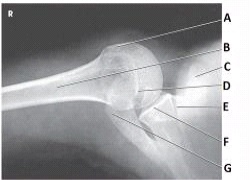
Which two are achieved when the transthoracic lateral projection (Lawrence method)of the shoulder is done on full inspiration? (Select all that apply.)
(Multiple Choice)
4.8/5 (72)
(72) Where should the center of the IR be positioned for a lateral projection of the shoulder?
(Multiple Choice)
4.8/5 (98)
(98) How many degrees is the body rotated for the AP oblique projection (Grashey method)of the shoulder joint?
(Multiple Choice)
4.8/5 (79)
(79) The small,synovial fluid-filled sacs,which relieve pressure and reduce friction in joint tissues,are called:
(Multiple Choice)
4.9/5 (67)
(67) The respiration phase for an AP projection of the shoulder should be:
(Multiple Choice)
4.8/5 (81)
(81) 
Filters
- Essay(0)
- Multiple Choice(0)
- Short Answer(0)
- True False(0)
- Matching(0)