



 Chat with AI
Exam 4: Logical Database Design and the Relational Model

Exam 1: The Database Environment and Development Process119 Questions
Exam 2: Modeling Data in the Organization102 Questions
Exam 3: The Enhanced E-R Model102 Questions
Exam 4: Logical Database Design and the Relational Model101 Questions
Exam 5: Introduction to SQL102 Questions
Exam 6: Advanced SQL95 Questions
Exam 7: Databases in Applications93 Questions
Exam 8: Physical Database Design and Database Infrastructure167 Questions
Exam 9: Data Warehousing and Data Integration150 Questions
Exam 10: Big Data Technologies69 Questions
Exam 11: Analytics and Its Implications32 Questions
Exam 12: Data and Database Administration With Focus on Data Quality66 Questions
Exam 13: Distributed Databases100 Questions
Exam 14: Object-Oriented Data Modeling104 Questions
Select questions type


A transversal dependency is a functional dependency between two or more nonkey attributes.
(True/False)
4.8/5  (72)
(72) A relation is in first normal form if it has no more than one multivalued attribute.
(True/False)
4.9/5 (88)
(88) The attribute on the left-hand side of the arrow in a functional dependency is the:
(Multiple Choice)
4.8/5 (90)
(90) The allowable range of values for a given attribute is part of the domain constraint.
(True/False)
4.9/5 (88)
(88) A form of database design which maps conceptual requirements is called:
(Multiple Choice)
4.8/5 (76)
(76) CASE tools can model more complex data relationships, such as ternary relationships.
(True/False)
5.0/5 (87)
(87) The columns of a relation can be interchanged without changing the meaning or use of the relation.
(True/False)
4.8/5 (76)
(76) Sample data are useful for developing prototype applications and for testing queries.
(True/False)
4.9/5 (78)
(78) A partial functional dependency is a functional dependency in which one or more nonkey attributes are functionally dependent on part (but not all) of the primary key.
(True/False)
4.8/5 (93)
(93) A functional dependency between two or more nonkey attributes is called a:
(Multiple Choice)
4.8/5 (83)
(83) A well-structured relation contains minimal redundancy and allows users to manipulate the relation without errors or inconsistencies.
(True/False)
4.9/5 (73)
(73) A relation that contains no multivalued attributes and has nonkey attributes solely dependent on the primary key but contains transitive dependencies is in which normal form?
(Multiple Choice)
4.9/5 (79)
(79) In the figure below, what type of relationship do the relations depict? 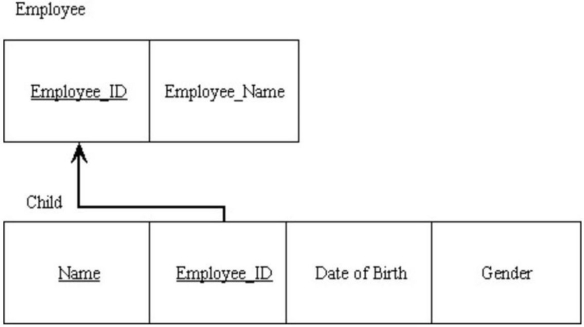
(Multiple Choice)
4.9/5 (76)
(76) When a regular entity type contains a multivalued attribute, one must:
(Multiple Choice)
4.8/5 (85)
(85) Which of the following is NOT a reason to create an instance of a relational schema with sample data?
(Multiple Choice)
4.9/5 (82)
(82) Which of the following violates the atomic property of relations?
(Multiple Choice)
4.7/5 (71)
(71) ________ problems are encountered when removing data with transitive dependencies.
(Multiple Choice)
4.8/5 (80)
(80) 
Filters
- Essay(0)
- Multiple Choice(0)
- Short Answer(0)
- True False(0)
- Matching(0)