



 Chat with AI
Exam 6: The Economics of Political Action

Exam 1: The Economic Approach164 Questions
Exam 2: Some Tools of the Economist200 Questions
Exam 3: Demand, Supply, and the Market Process336 Questions
Exam 4: Supply and Demand: Applications and Extensions254 Questions
Exam 5: Difficult Cases for the Market, and the Role of Government130 Questions
Exam 6: The Economics of Political Action154 Questions
Exam 7: Taking the Nations Economic Pulse214 Questions
Exam 8: Economic Fluctuations, Unemployment, and Inflation174 Questions
Exam 9: An Introduction to Basic Macroeconomic Markets219 Questions
Exam 10: Dynamic Change, Economic Fluctuations, and the Ad-As Model189 Questions
Exam 11: Fiscal Policy: the Keynesian View and the Historical Development of Macroeconomics109 Questions
Exam 12: Fiscal Policy, Incentives, and Secondary Effects146 Questions
Exam 13: Money and the Banking System209 Questions
Exam 14: Modern Macroeconomics and Monetary Policy192 Questions
Exam 15: Stabilization Policy, Output, and Employment148 Questions
Exam 16: Creating an Environment for Growth and Prosperity120 Questions
Exam 17: Institutions, Policies, and Cross-Country Differences in Income and Growth111 Questions
Exam 18: Gaining From International Trade170 Questions
Exam 19: International Finance and the Foreign Exchange Market148 Questions
Select questions type


Which one of the following economists has played a central role in the development of the "economics of collective decision making," better known as public choice analysis?
(Multiple Choice)
4.9/5  (87)
(87) If new regulations make it illegal to sell older model electrical appliances, then
(Multiple Choice)
4.9/5 (95)
(95) Use the figure below to answer the following question(s).
Figure 6-1 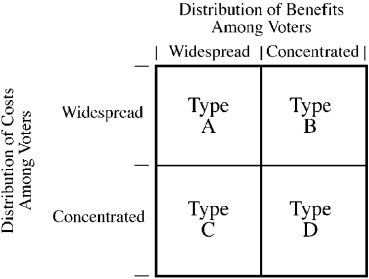 -Figure 6-1 illustrates the four possibilities of the distribution of costs and benefits among voters for a government project. For which types of projects would government action most likely work well, undertaking only efficient projects and rejecting inefficient ones?
 (Multiple Choice)
4.8/5 (66)
(66) Legislation that offers immediate and easily recognized benefits, at the expense of costs that are observable only in the distant future, is often enacted, even when economic inefficiency results. In economics this is referred to as the
(Multiple Choice)
4.9/5 (79)
(79) When analyzing public sector decision making, economic theory assumes voters, politicians, and government officials will
(Multiple Choice)
4.8/5 (71)
(71) Which of the following explains why elected representatives will find borrowing to be an attractive method of financing current government programs?
(Multiple Choice)
4.8/5 (88)
(88) Madison is a third-grade public school teacher who doesn't own a car and uses public transportation. According to public choice theory, which of the following four politicians for a public office would Madison be most likely to vote for in the upcoming election?
(Multiple Choice)
4.9/5 (68)
(68) As methods of economic organization, the market and the public sector are similar in which of the following ways?
(Multiple Choice)
4.7/5 (81)
(81) As more politically directed spending leads to more rent-seeking activity,
(Multiple Choice)
4.9/5 (76)
(76) Which of the following factors weakens the case for private-sector provision of goods and services relative to public-sector provision?
(Multiple Choice)
4.9/5 (74)
(74) Congressman Localstuff always votes for a balanced budget amendment to the U.S. Constitution. He also always votes for spending bills supported by the leadership of his political party. Is this rational?
(Essay)
4.8/5 (66)
(66) In 2012, the combined expenditures of federal, state, and local governments in the United States were approximately
(Multiple Choice)
5.0/5 (91)
(91) John Smith is a typical citizen. Economic theory suggests that he is likely to make a more informed choice when he buys a personal computer than when he votes for a congressional candidate. This view is
(Multiple Choice)
4.8/5 (86)
(86) Pork-barrel legislation typically bundles the pet projects of several special interest groups. Such legislation
(Multiple Choice)
4.8/5 (83)
(83) In 2012, the combined expenditures of federal, state, and local governments in the United States were approximately 38 percent of gross domestic product (GDP). Approximately what percentage of GDP were government expenditures in 1930?
(Multiple Choice)
4.8/5 (72)
(72) Government decisions tend to be biased against actions that have
(Multiple Choice)
4.8/5 (74)
(74) Is calling a voter rationally ignorant the same as calling her irrational? Explain.
(Essay)
4.8/5 (82)
(82) 
Filters
- Essay(0)
- Multiple Choice(0)
- Short Answer(0)
- True False(0)
- Matching(0)