



 Chat with AI
Exam 7: Taking the Nations Economic Pulse

Exam 1: The Economic Approach164 Questions
Exam 2: Some Tools of the Economist200 Questions
Exam 3: Demand, Supply, and the Market Process336 Questions
Exam 4: Supply and Demand: Applications and Extensions254 Questions
Exam 5: Difficult Cases for the Market, and the Role of Government130 Questions
Exam 6: The Economics of Political Action154 Questions
Exam 7: Taking the Nations Economic Pulse214 Questions
Exam 8: Economic Fluctuations, Unemployment, and Inflation174 Questions
Exam 9: An Introduction to Basic Macroeconomic Markets219 Questions
Exam 10: Dynamic Change, Economic Fluctuations, and the Ad-As Model189 Questions
Exam 11: Fiscal Policy: the Keynesian View and the Historical Development of Macroeconomics109 Questions
Exam 12: Fiscal Policy, Incentives, and Secondary Effects146 Questions
Exam 13: Money and the Banking System209 Questions
Exam 14: Modern Macroeconomics and Monetary Policy192 Questions
Exam 15: Stabilization Policy, Output, and Employment148 Questions
Exam 16: Creating an Environment for Growth and Prosperity120 Questions
Exam 17: Institutions, Policies, and Cross-Country Differences in Income and Growth111 Questions
Exam 18: Gaining From International Trade170 Questions
Exam 19: International Finance and the Foreign Exchange Market148 Questions
Select questions type


Answer the following questions:
a.What is the difference between gross domestic product and gross national product?
b.Give an example of a transaction that would be counted in GDP but not in GNP.
c.Give an example of a transaction that would be counted in GNP but not GDP.
(Essay)
5.0/5  (76)
(76) Given the following figures, by approximately what percentage did Michael's real income increase between 2008 and 2009? Michael's 2008 money income = $60,000
Michael's 2009 money income = $72,000
2008 CPI = 120.0
2009 CPI = 128.0
(Multiple Choice)
4.7/5 (67)
(67) Table 7-6
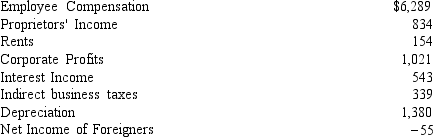 -Refer to Table 7-6. What was the value of national income?
 (Multiple Choice)
4.8/5 (71)
(71) Suppose that the nominal value of GDP increased by approximately 2 percent during a given year, but real GDP decreased by 3 percent. Which of the following best explains these events?
(Multiple Choice)
4.9/5 (76)
(76) Suppose a country had $3.5 billion of net exports and bought $6.8 billion of goods and services from foreign countries. This country would have
(Multiple Choice)
4.8/5 (81)
(81) Suppose you received a 3 percent increase in your nominal wage. Over the year, inflation ran about 6 percent. Which of the following is true?
(Multiple Choice)
4.9/5 (87)
(87) Which one of the following would count as investment in the national income accounts?
(Multiple Choice)
4.9/5 (82)
(82) Which of the following about inventory changes and GDP is true?
(Multiple Choice)
4.9/5 (84)
(84) The dollar value of GDP increased approximately 4 percent during the year, but real GDP fell 2 percent. Which of the following best explains this data?
(Multiple Choice)
4.8/5 (75)
(75) The GDP deflator is designed to adjust nominal GDP for changes in
(Multiple Choice)
4.9/5 (73)
(73) The consumer price index is designed to measure the extent to which
(Multiple Choice)
4.9/5 (76)
(76) Last year the Jones family earned $40,000. This year their income is $42,000. In an economy with an inflation rate of 10 percent, which of the following is correct?
(Multiple Choice)
4.8/5 (74)
(74) Between 1991 and 2008, the federal minimum wage increased from $4.25 per hour to $6.55 per hour, while the CPI increased from 136.2 to 215.3. We can conclude from this that
(Multiple Choice)
4.8/5 (76)
(76) 
Filters
- Essay(0)
- Multiple Choice(0)
- Short Answer(0)
- True False(0)
- Matching(0)