



 Chat with AI
Exam 8: Potential Energy and Conservation of Energy

Exam 1: Measurement37 Questions
Exam 2: Motion Along a Straight Line90 Questions
Exam 3: Vector32 Questions
Exam 4: Motion in Two and Three Dimensions53 Questions
Exam 5: Force and Motion I73 Questions
Exam 6: Force and Motion II74 Questions
Exam 7: Kinetic Energy and Work72 Questions
Exam 8: Potential Energy and Conservation of Energy62 Questions
Exam 9: Center of Mass and Linear Momentum98 Questions
Exam 10: Rotation99 Questions
Exam 11: Rolling, Torque, and Angular Momentum65 Questions
Exam 12: Equilibrium and Elasticity57 Questions
Exam 13: Gravitation54 Questions
Exam 14: Fluids87 Questions
Exam 15: Oscillations75 Questions
Exam 16: Waves I80 Questions
Exam 17: Waves II70 Questions
Exam 18: Temperature, Heat, and the First Law of Thermodynamics96 Questions
Exam 19: The Kinetic Theory of Gases111 Questions
Exam 20: Entropy and the Second Law of Thermodynamics61 Questions
Exam 21: Electric Charge51 Questions
Exam 22: Electric Fields52 Questions
Exam 23: Gauss Law39 Questions
Exam 24: Electric Potential50 Questions
Exam 25: Capacitance59 Questions
Exam 26: Current and Resistance54 Questions
Exam 27: Circuits73 Questions
Exam 28: Magnetic Fields51 Questions
Exam 29: Magnetic Fields Due to Currents48 Questions
Exam 30: Induction and Inductance90 Questions
Exam 31: Electromagnetic Oscillations and Alternating Current86 Questions
Exam 32: Maxwells Equations; Magnetism of Matter81 Questions
Exam 33: Electromagnetic Waves81 Questions
Exam 34: Images78 Questions
Exam 35: Interference45 Questions
Exam 36: Diffraction77 Questions
Exam 37: Relativity68 Questions
Exam 38: Photons and Matter Waves57 Questions
Exam 39: More About Matter Waves41 Questions
Exam 40: All About Atoms76 Questions
Exam 41: Conduction of Electricity in Solids49 Questions
Exam 42: Nuclear Physics68 Questions
Exam 43: Energy From the Nucleus50 Questions
Exam 44: Quarks, Leptons, and the Big Bang55 Questions
Select questions type


The long pendulum shown is drawn aside until the ball has risen 0.5 m.It is then given an initial speed of 3.0 m/s.The speed of the ball at its lowest position is: 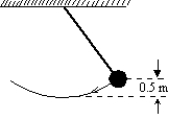
(Multiple Choice)
4.8/5  (82)
(82) An ideal spring is used to fire a 15.0-g block horizontally.The spring has a spring constant of 20 N/m and is initially compressed by 7.0 cm.The kinetic energy of the block as it leaves the spring is:
(Multiple Choice)
4.7/5 (97)
(97) Two objects interact with each other and with no other objects.Initially object A has a speed of 5 m/s and object B has a speed of 10 m/s.In the course of their motion they return to their initial positions.Then A has a speed of 4 m/s and B has a speed of 7 m/s.We can conclude:
(Multiple Choice)
4.8/5 (79)
(79) A projectile of mass 0.50 kg is fired with an initial speed of 10 m/s at an angle of 60 above the horizontal.The potential energy of the projectile-Earth system when the projectile is at its highest point (relative to the potential energy when the projectile is at ground level)is:
(Multiple Choice)
4.7/5 (76)
(76) A 2-kg block is thrown upward from a point 20 m above the Earth's surface.At what height above Earth's surface will the gravitational potential energy of the Earth-block system have increased by 500 J?
(Multiple Choice)
4.7/5 (67)
(67) Which one of the following five quantities CANNOT be used as a unit of potential energy?
(Multiple Choice)
4.9/5 (85)
(85) A 2.2-kg block starts from rest on a rough inclined plane that makes an angle of 25 with the horizontal.The coefficient of kinetic friction is 0.25.As the block goes 2.0 m down the plane, the mechanical energy of the Earth-block system changes by:
(Multiple Choice)
4.7/5 (77)
(77) Which of the five graphs correctly shows the potential energy of a spring as a function of its elongation x? 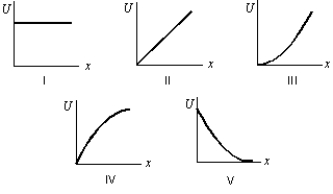
(Multiple Choice)
4.9/5 (63)
(63) The diagram shows a plot of the potential energy as a function of x for a particle moving along the x axis.The points of neutral equilibrium are: 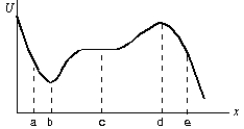
(Multiple Choice)
4.8/5 (82)
(82) As a particle moves along the x axis it is acted by a conservative force.The potential energy is shown below as a function of the coordinate x of the particle.Rank the labeled regions according to the magnitude of the force, least to greatest. 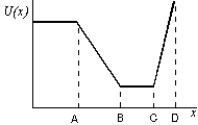
(Multiple Choice)
4.9/5 (84)
(84) Suppose that the fundamental dimensions are taken to be: force (F), velocity (V)and time (T).The dimensions of potential energy are then:
(Multiple Choice)
4.8/5 (89)
(89) A ball is held at a height H above a floor.It is then released and falls to the floor.If air resistance can be ignored, which of the five graphs below correctly gives the mechanical energy E of the Earth-ball system as a function of the altitude y of the ball? 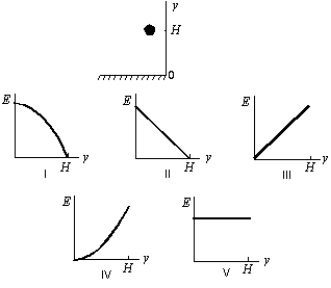
(Multiple Choice)
4.9/5 (80)
(80) Given a potential energy function U(x), the corresponding force is in the positive x direction if:
(Multiple Choice)
4.7/5 (87)
(87) The sum of the kinetic and potential energies of a system of objects is conserved:
(Multiple Choice)
5.0/5 (78)
(78) The potential energy of a body of mass m is given by U = -mgx + 1/2kx2.The corresponding force is:
(Multiple Choice)
4.8/5 (93)
(93) 
Filters
- Essay(0)
- Multiple Choice(0)
- Short Answer(0)
- True False(0)
- Matching(0)