



 Chat with AI
Exam 13: Gravitation

Exam 1: Measurement37 Questions
Exam 2: Motion Along a Straight Line90 Questions
Exam 3: Vector32 Questions
Exam 4: Motion in Two and Three Dimensions53 Questions
Exam 5: Force and Motion I73 Questions
Exam 6: Force and Motion II74 Questions
Exam 7: Kinetic Energy and Work72 Questions
Exam 8: Potential Energy and Conservation of Energy62 Questions
Exam 9: Center of Mass and Linear Momentum98 Questions
Exam 10: Rotation99 Questions
Exam 11: Rolling, Torque, and Angular Momentum65 Questions
Exam 12: Equilibrium and Elasticity57 Questions
Exam 13: Gravitation54 Questions
Exam 14: Fluids87 Questions
Exam 15: Oscillations75 Questions
Exam 16: Waves I80 Questions
Exam 17: Waves II70 Questions
Exam 18: Temperature, Heat, and the First Law of Thermodynamics96 Questions
Exam 19: The Kinetic Theory of Gases111 Questions
Exam 20: Entropy and the Second Law of Thermodynamics61 Questions
Exam 21: Electric Charge51 Questions
Exam 22: Electric Fields52 Questions
Exam 23: Gauss Law39 Questions
Exam 24: Electric Potential50 Questions
Exam 25: Capacitance59 Questions
Exam 26: Current and Resistance54 Questions
Exam 27: Circuits73 Questions
Exam 28: Magnetic Fields51 Questions
Exam 29: Magnetic Fields Due to Currents48 Questions
Exam 30: Induction and Inductance90 Questions
Exam 31: Electromagnetic Oscillations and Alternating Current86 Questions
Exam 32: Maxwells Equations; Magnetism of Matter81 Questions
Exam 33: Electromagnetic Waves81 Questions
Exam 34: Images78 Questions
Exam 35: Interference45 Questions
Exam 36: Diffraction77 Questions
Exam 37: Relativity68 Questions
Exam 38: Photons and Matter Waves57 Questions
Exam 39: More About Matter Waves41 Questions
Exam 40: All About Atoms76 Questions
Exam 41: Conduction of Electricity in Solids49 Questions
Exam 42: Nuclear Physics68 Questions
Exam 43: Energy From the Nucleus50 Questions
Exam 44: Quarks, Leptons, and the Big Bang55 Questions
Select questions type


An astronaut on the Moon simultaneously drops a feather and a hammer.The fact that they land together shows that:
(Multiple Choice)
4.7/5  (80)
(80) Mars has a mass of about 0.1075 times the mass of Earth and a diameter of about 0.533 times the diameter of Earth.The acceleration of a body falling near the surface of Mars is about:
(Multiple Choice)
4.7/5 (87)
(87) A spring scale, calibrated in newtons, is used to weigh sugar.If it were possible to weigh sugar at the following locations, where will the buyer get the most sugar to a newton?
(Multiple Choice)
4.9/5 (83)
(83) An object at the surface of Earth (at a distance R from the center of Earth)weighs 90 N.Its weight at a distance 3R from the center of Earth is:
(Multiple Choice)
4.8/5 (74)
(74) A small satellite is in elliptical orbit around Earth as shown.If L denotes the magnitude of its angular momentum and K denotes kinetic energy: 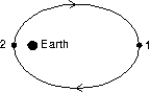
(Multiple Choice)
4.9/5 (86)
(86) An artificial Earth satellite of mass m is moved from a circular orbit with radius R to a circular orbit with radius 2R.If the mass of the Earth is ME, the work done by the gravitational force is:
(Multiple Choice)
4.9/5 (85)
(85) The approximate value of g at an altitude above Earth equal to one Earth diameter is:
(Multiple Choice)
4.9/5 (75)
(75) A particle might be placed  Rank these situations according to the magnitude of the gravitational force on the particle, least to greatest.
 (Multiple Choice)
4.9/5 (79)
(79) Three particles, two with mass m and one mass M, might be arranged in any of the four configurations known below.Rank the configurations according to the magnitude of the gravitational force on M, least to greatest. 
(Multiple Choice)
4.9/5 (75)
(75) The mass density of a certain planet has spherical symmetry but varies in such a way that the mass inside every spherical surface with center at the center of the planet is proportional to the radius of the surface.If r is the distance from the center of the planet to a point mass inside the planet, the gravitational force on the mass is:
(Multiple Choice)
4.8/5 (76)
(76) An astronaut finishes some work on the outside of his satellite, which is in circular orbit around the Earth.He leaves his wrench outside the satellite.If there is no air resistance, the wrench will:
(Multiple Choice)
4.9/5 (76)
(76) Neglecting air resistance, the escape speed from a certain planet for an empty space vehicle is 1.12 *104 m/s.What is the corresponding escape speed for the fully loaded vehicle which has triple the mass of the empty one?
(Multiple Choice)
5.0/5 (83)
(83) A rocket ship is coasting toward a planet.Its captain wishes to know the value of g at the surface of the planet.This may be inferred by:
(Multiple Choice)
5.0/5 (87)
(87) Let M denote the mass of Earth and let R denote its radius.The ratio g/G at Earth's surface is:
(Multiple Choice)
4.8/5 (84)
(84) An astronaut in an orbiting space-craft feels "weightless" because she:
(Multiple Choice)
5.0/5 (68)
(68) Suppose you have a pendulum clock which keeps correct time on Earth (acceleration due to gravity = 9.8 m/s2).Without changing the clock, you take it to the Moon (acceleration due to gravity = 1.6 m/s2).For every hour interval (on Earth)the Moon clock will record:
(Multiple Choice)
4.8/5 (72)
(72) Consider the statement: "Earth moves in a stable orbit around the Sun and is therefore in equilibrium".The statement is:
(Multiple Choice)
4.9/5 (68)
(68) A projectile is fired straight upward from Earth's surface with a speed that is half the escape speed.If R is the radius of Earth, the highest altitude reached, measured from the surface, is:
(Multiple Choice)
4.8/5 (78)
(78) Two planets are orbiting a star in a distant galaxy.The first has a semimajor axis of 150*106 km, an eccentricity of 0.20, and a period of 1.0 Earth years.The second has a semimajor axis of 250 * 106 km, an eccentricity of 0.30, and a period of:
(Multiple Choice)
4.7/5 (80)
(80) 
Filters
- Essay(0)
- Multiple Choice(0)
- Short Answer(0)
- True False(0)
- Matching(0)