



 Chat with AI
Exam 17: Waves II

Exam 1: Measurement37 Questions
Exam 2: Motion Along a Straight Line90 Questions
Exam 3: Vector32 Questions
Exam 4: Motion in Two and Three Dimensions53 Questions
Exam 5: Force and Motion I73 Questions
Exam 6: Force and Motion II74 Questions
Exam 7: Kinetic Energy and Work72 Questions
Exam 8: Potential Energy and Conservation of Energy62 Questions
Exam 9: Center of Mass and Linear Momentum98 Questions
Exam 10: Rotation99 Questions
Exam 11: Rolling, Torque, and Angular Momentum65 Questions
Exam 12: Equilibrium and Elasticity57 Questions
Exam 13: Gravitation54 Questions
Exam 14: Fluids87 Questions
Exam 15: Oscillations75 Questions
Exam 16: Waves I80 Questions
Exam 17: Waves II70 Questions
Exam 18: Temperature, Heat, and the First Law of Thermodynamics96 Questions
Exam 19: The Kinetic Theory of Gases111 Questions
Exam 20: Entropy and the Second Law of Thermodynamics61 Questions
Exam 21: Electric Charge51 Questions
Exam 22: Electric Fields52 Questions
Exam 23: Gauss Law39 Questions
Exam 24: Electric Potential50 Questions
Exam 25: Capacitance59 Questions
Exam 26: Current and Resistance54 Questions
Exam 27: Circuits73 Questions
Exam 28: Magnetic Fields51 Questions
Exam 29: Magnetic Fields Due to Currents48 Questions
Exam 30: Induction and Inductance90 Questions
Exam 31: Electromagnetic Oscillations and Alternating Current86 Questions
Exam 32: Maxwells Equations; Magnetism of Matter81 Questions
Exam 33: Electromagnetic Waves81 Questions
Exam 34: Images78 Questions
Exam 35: Interference45 Questions
Exam 36: Diffraction77 Questions
Exam 37: Relativity68 Questions
Exam 38: Photons and Matter Waves57 Questions
Exam 39: More About Matter Waves41 Questions
Exam 40: All About Atoms76 Questions
Exam 41: Conduction of Electricity in Solids49 Questions
Exam 42: Nuclear Physics68 Questions
Exam 43: Energy From the Nucleus50 Questions
Exam 44: Quarks, Leptons, and the Big Bang55 Questions
Select questions type


The speed of sound in air is 340 m/s, and the density of air is 1.2 kg/m3.If the displacement amplitude of a 440-Hz sound wave is 10 µm, what is the intensity of the wave?
(Multiple Choice)
4.7/5  (89)
(89) A standing wave in a pipe has nodes that are 1.2 m apart.What is the wavelength of the wave?
(Multiple Choice)
4.8/5 (87)
(87) A stationary source S generates circular outgoing waves on a lake.The wave speed is 5.0 m/s and the crest-to-crest distance is 2.0 m.A person in a motor boat heads directly toward S at 3.0 m/s.To this person, the frequency of these waves is:
(Multiple Choice)
4.8/5 (79)
(79) If the speed of sound is 340 m/s a plane flying at 400 m/s has a Mach number of:
(Multiple Choice)
4.9/5 (86)
(86) Two pipes are each open at one end and closed at the other.Pipe A has length L and pipe B has length 2L.Which harmonic of pipe B matches in frequency the fundamental of pipe A?
(Multiple Choice)
4.9/5 (78)
(78) The "A" on a trumpet and a clarinet have the same pitch, but the two are clearly distinguishable.Which property is most important in enabling one to distinguish between these two instruments?
(Multiple Choice)
4.7/5 (78)
(78) A source emits sound with a frequency of 1000 Hz.It and an observer are moving toward each other, each with a speed of 100 m/s.If the speed of sound is 340 m/s, the observer hears sound with a frequency of:
(Multiple Choice)
4.9/5 (78)
(78) A 1024 Hz tuning fork is used to obtain a series of resonance levels in a gas column of variable length, with one end closed and the other open.The length of the column changes by 20 cm from resonance to resonance.From this data, the speed of sound in this gas is:
(Multiple Choice)
4.9/5 (84)
(84) The lowest tone produced by a certain organ comes from a 3.0-m pipe with both ends open.If the speed of sound is 340 m/s, the frequency of this tone is approximately:
(Multiple Choice)
5.0/5 (77)
(77) Organ pipe Y (open at both ends)is twice as long as organ pipe X (open at one end)as shown.The ratio of their fundamental frequencies fX::fY is: 
(Multiple Choice)
4.9/5 (82)
(82) The valves of a trumpet and the slide of a trombone are for the purpose of:
(Multiple Choice)
4.8/5 (79)
(79) This graph shows the position of an element of air as a function of time as a sound wave passes through it.Which letter corresponds to the amplitude of the wave? 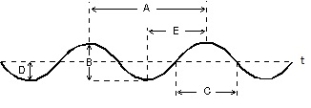
(Multiple Choice)
4.9/5 (68)
(68) In each of the following two situations a source emits sound with a frequency of 1000 Hz.In situation I the source is moving at 100 m/s toward an observer at rest.In situation II the observer is moving at 100 m/s toward the source, which is stationary.The speed of sound is 340 m/s.The frequencies heard by the observers in the two situations are:
(Multiple Choice)
5.0/5 (87)
(87) Two waves are out of phase by half a wavelength.What is this in degrees?
(Multiple Choice)
4.8/5 (80)
(80) The intensity of a certain sound wave is 6 W/cm2.If its intensity is raised by 10 decibels, the new intensity is:
(Multiple Choice)
4.8/5 (70)
(70) A microphone of surface area 2.0 cm2 absorbs 1.1 mW of sound.What is the intensity of sound hitting the microphone?
(Multiple Choice)
4.8/5 (73)
(73) An organ pipe with one end open and the other closed is operating at one of its resonant frequencies.The open and closed ends are respectively:
(Multiple Choice)
4.8/5 (68)
(68) Two small identical speakers are connected (in phase)to the same source.The speakers are 3 m apart and at ear level.An observer stands at X, 4 m in front of one speaker as shown.If the amplitudes are not changed, the sound he hears will be least intense if the wavelength is: 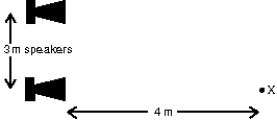
(Multiple Choice)
4.9/5 (82)
(82) 
Filters
- Essay(0)
- Multiple Choice(0)
- Short Answer(0)
- True False(0)
- Matching(0)