



 Chat with AI
Exam 20: Entropy and the Second Law of Thermodynamics

Exam 1: Measurement37 Questions
Exam 2: Motion Along a Straight Line90 Questions
Exam 3: Vector32 Questions
Exam 4: Motion in Two and Three Dimensions53 Questions
Exam 5: Force and Motion I73 Questions
Exam 6: Force and Motion II74 Questions
Exam 7: Kinetic Energy and Work72 Questions
Exam 8: Potential Energy and Conservation of Energy62 Questions
Exam 9: Center of Mass and Linear Momentum98 Questions
Exam 10: Rotation99 Questions
Exam 11: Rolling, Torque, and Angular Momentum65 Questions
Exam 12: Equilibrium and Elasticity57 Questions
Exam 13: Gravitation54 Questions
Exam 14: Fluids87 Questions
Exam 15: Oscillations75 Questions
Exam 16: Waves I80 Questions
Exam 17: Waves II70 Questions
Exam 18: Temperature, Heat, and the First Law of Thermodynamics96 Questions
Exam 19: The Kinetic Theory of Gases111 Questions
Exam 20: Entropy and the Second Law of Thermodynamics61 Questions
Exam 21: Electric Charge51 Questions
Exam 22: Electric Fields52 Questions
Exam 23: Gauss Law39 Questions
Exam 24: Electric Potential50 Questions
Exam 25: Capacitance59 Questions
Exam 26: Current and Resistance54 Questions
Exam 27: Circuits73 Questions
Exam 28: Magnetic Fields51 Questions
Exam 29: Magnetic Fields Due to Currents48 Questions
Exam 30: Induction and Inductance90 Questions
Exam 31: Electromagnetic Oscillations and Alternating Current86 Questions
Exam 32: Maxwells Equations; Magnetism of Matter81 Questions
Exam 33: Electromagnetic Waves81 Questions
Exam 34: Images78 Questions
Exam 35: Interference45 Questions
Exam 36: Diffraction77 Questions
Exam 37: Relativity68 Questions
Exam 38: Photons and Matter Waves57 Questions
Exam 39: More About Matter Waves41 Questions
Exam 40: All About Atoms76 Questions
Exam 41: Conduction of Electricity in Solids49 Questions
Exam 42: Nuclear Physics68 Questions
Exam 43: Energy From the Nucleus50 Questions
Exam 44: Quarks, Leptons, and the Big Bang55 Questions
Select questions type


Rank from smallest to largest, the changes in entropy of a pan of water on a hot plate, as the temperature of the water 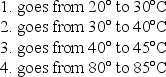
(Multiple Choice)
4.9/5  (85)
(85) A Carnot heat engine operates between a hot reservoir at absolute temperature TH and a cold reservoir at absolute temperature TL.Its efficiency is:
(Multiple Choice)
4.9/5 (81)
(81) Consider the following processes: The temperatures of two identical gases are increased from the same initial temperature to the same final temperature.Reversible processes are used.For gas A the process is carried out at constant volume while for gas B it is carried out at constant pressure.The change in entropy:
(Multiple Choice)
4.9/5 (89)
(89) The temperature of n moles of a gas is increased from Ti to Tf at constant pressure.If the molar specific heat at constant pressure is Cp and is independent of temperature, then change in the entropy of the gas is:
(Multiple Choice)
4.8/5 (86)
(86) A heat engine operates between a high temperature reservoir at TH and a low temperature reservoir at TL.Its efficiency is given by 1 - TL/TH:
(Multiple Choice)
4.7/5 (88)
(88) A heat engine operates between 200 K and 100 K.In each cycle it takes 100 J from the hot reservoir, loses 25 J to the cold reservoir, and does 75 J of work.This heat engine violates:
(Multiple Choice)
4.9/5 (91)
(91) Let SI denote the change in entropy of a sample for an irreversible process from state A to state B.Let SR denote the change in entropy of the same sample for a reversible process from state A to state B.Then:
(Multiple Choice)
4.8/5 (86)
(86) A refrigerator absorbs energy of magnitude QL as heat from a low temperature reservoir and rejects energy of magnitude QH as heat to a high temperature reservoir.Work W is done on the working substance.The coefficient of performance is given by:
(Multiple Choice)
4.8/5 (70)
(70) In a thermally insulated kitchen, an ordinary refrigerator is turned on and its door is left open.The temperature of the room:
(Multiple Choice)
4.9/5 (89)
(89) A reversible refrigerator operates between a low temperature reservoir at TL and a high temperature reservoir at TH.Its coefficient of performance is given by:
(Multiple Choice)
4.9/5 (65)
(65) An ideal gas, consisting of n moles, undergoes an irreversible process in which the temperature has the same value at the beginning and end.If the volume changes from Vi to Vf, the change in entropy is given by:
(Multiple Choice)
4.8/5 (73)
(73) One mole of an ideal gas expands reversibly and isothermally at temperature T until its volume is doubled.The change of entropy of this gas for this process is:
(Multiple Choice)
5.0/5 (87)
(87) A Carnot engine operates between 200 C and 20 C.Its maximum possible efficiency is:
(Multiple Choice)
4.8/5 (81)
(81) An inventor suggests that a house might be heated by using a refrigerator to draw energy as heat from the ground and reject energy as heat into the house.He claims that the energy supplied to the house can exceed the work required to run the refrigerator.This:
(Multiple Choice)
4.9/5 (91)
(91) Consider the following processes:  Which are never found to occur?
 (Multiple Choice)
4.8/5 (72)
(72) A heat engine that in each cycle does positive work and loses energy as heat, with no heat energy input, would violate:
(Multiple Choice)
4.9/5 (76)
(76) A Carnot engine operates with a cold reservoir at a temperature of TL = 400 K and a hot reservoir at a temperature of TH = 500 K.What is the net entropy change as it goes through a complete cycle?
(Multiple Choice)
4.8/5 (79)
(79) A cyclical process that transfers energy as heat from a high temperature reservoir to a low temperature reservoir with no other change would violate:
(Multiple Choice)
4.9/5 (73)
(73) 
Filters
- Essay(0)
- Multiple Choice(0)
- Short Answer(0)
- True False(0)
- Matching(0)