



 Chat with AI
Exam 24: Electric Potential

Exam 1: Measurement37 Questions
Exam 2: Motion Along a Straight Line90 Questions
Exam 3: Vector32 Questions
Exam 4: Motion in Two and Three Dimensions53 Questions
Exam 5: Force and Motion I73 Questions
Exam 6: Force and Motion II74 Questions
Exam 7: Kinetic Energy and Work72 Questions
Exam 8: Potential Energy and Conservation of Energy62 Questions
Exam 9: Center of Mass and Linear Momentum98 Questions
Exam 10: Rotation99 Questions
Exam 11: Rolling, Torque, and Angular Momentum65 Questions
Exam 12: Equilibrium and Elasticity57 Questions
Exam 13: Gravitation54 Questions
Exam 14: Fluids87 Questions
Exam 15: Oscillations75 Questions
Exam 16: Waves I80 Questions
Exam 17: Waves II70 Questions
Exam 18: Temperature, Heat, and the First Law of Thermodynamics96 Questions
Exam 19: The Kinetic Theory of Gases111 Questions
Exam 20: Entropy and the Second Law of Thermodynamics61 Questions
Exam 21: Electric Charge51 Questions
Exam 22: Electric Fields52 Questions
Exam 23: Gauss Law39 Questions
Exam 24: Electric Potential50 Questions
Exam 25: Capacitance59 Questions
Exam 26: Current and Resistance54 Questions
Exam 27: Circuits73 Questions
Exam 28: Magnetic Fields51 Questions
Exam 29: Magnetic Fields Due to Currents48 Questions
Exam 30: Induction and Inductance90 Questions
Exam 31: Electromagnetic Oscillations and Alternating Current86 Questions
Exam 32: Maxwells Equations; Magnetism of Matter81 Questions
Exam 33: Electromagnetic Waves81 Questions
Exam 34: Images78 Questions
Exam 35: Interference45 Questions
Exam 36: Diffraction77 Questions
Exam 37: Relativity68 Questions
Exam 38: Photons and Matter Waves57 Questions
Exam 39: More About Matter Waves41 Questions
Exam 40: All About Atoms76 Questions
Exam 41: Conduction of Electricity in Solids49 Questions
Exam 42: Nuclear Physics68 Questions
Exam 43: Energy From the Nucleus50 Questions
Exam 44: Quarks, Leptons, and the Big Bang55 Questions
Select questions type


The equipotential surfaces associated with a charged point particle are:
(Multiple Choice)
4.9/5  (81)
(81) The potential difference between the ends of a 2-meter stick that is parallel to a uniform electric field is 400 V.The magnitude of the electric field is:
(Multiple Choice)
4.7/5 (70)
(70) The diagram shows four pairs of large parallel conducting plates.The value of the electric potential is given for each plate.Rank the pairs according to the magnitude of the electric field between the plates, least to greatest. 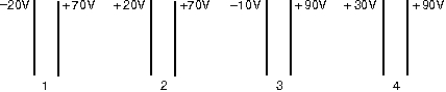
(Multiple Choice)
4.8/5 (88)
(88) An electron goes from one equipotential surface to another along one of the four paths shown below.Rank the paths according to the work done by the electric field, from least to greatest. 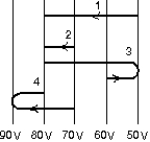
(Multiple Choice)
4.9/5 (85)
(85) Positive charge is distributed uniformly throughout a non-conducting sphere.The highest electric potential occurs:
(Multiple Choice)
4.8/5 (68)
(68) An electron has charge -e and mass me.A proton has charge e and mass 1840me.A "proton volt" is equal to:
(Multiple Choice)
4.9/5 (83)
(83) If the electric field is in the positive x direction and has a magnitude given by E = Cx2, where C is a constant, then the electric potential is given by V =
(Multiple Choice)
4.8/5 (85)
(85) A solid metal sphere carries a charge of 5 *10-9 C and is at a potential of 400 V, relative to the potential far away.The potential at the center of the sphere is:
(Multiple Choice)
4.7/5 (85)
(85) Two conducting spheres are far apart.The smaller sphere carries a total charge of Q.The larger sphere has a radius that is twice that of the smaller and is neutral.After the two spheres are connected by a conducting wire, the charges on the smaller and larger spheres, respectively, are:
(Multiple Choice)
4.8/5 (74)
(74) An electron moves from point i to point f, in the direction of a uniform electric field.During this motion: 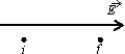
(Multiple Choice)
4.8/5 (87)
(87) 
Filters
- Essay(0)
- Multiple Choice(0)
- Short Answer(0)
- True False(0)
- Matching(0)