



 Chat with AI
Exam 26: Current and Resistance

Exam 1: Measurement37 Questions
Exam 2: Motion Along a Straight Line90 Questions
Exam 3: Vector32 Questions
Exam 4: Motion in Two and Three Dimensions53 Questions
Exam 5: Force and Motion I73 Questions
Exam 6: Force and Motion II74 Questions
Exam 7: Kinetic Energy and Work72 Questions
Exam 8: Potential Energy and Conservation of Energy62 Questions
Exam 9: Center of Mass and Linear Momentum98 Questions
Exam 10: Rotation99 Questions
Exam 11: Rolling, Torque, and Angular Momentum65 Questions
Exam 12: Equilibrium and Elasticity57 Questions
Exam 13: Gravitation54 Questions
Exam 14: Fluids87 Questions
Exam 15: Oscillations75 Questions
Exam 16: Waves I80 Questions
Exam 17: Waves II70 Questions
Exam 18: Temperature, Heat, and the First Law of Thermodynamics96 Questions
Exam 19: The Kinetic Theory of Gases111 Questions
Exam 20: Entropy and the Second Law of Thermodynamics61 Questions
Exam 21: Electric Charge51 Questions
Exam 22: Electric Fields52 Questions
Exam 23: Gauss Law39 Questions
Exam 24: Electric Potential50 Questions
Exam 25: Capacitance59 Questions
Exam 26: Current and Resistance54 Questions
Exam 27: Circuits73 Questions
Exam 28: Magnetic Fields51 Questions
Exam 29: Magnetic Fields Due to Currents48 Questions
Exam 30: Induction and Inductance90 Questions
Exam 31: Electromagnetic Oscillations and Alternating Current86 Questions
Exam 32: Maxwells Equations; Magnetism of Matter81 Questions
Exam 33: Electromagnetic Waves81 Questions
Exam 34: Images78 Questions
Exam 35: Interference45 Questions
Exam 36: Diffraction77 Questions
Exam 37: Relativity68 Questions
Exam 38: Photons and Matter Waves57 Questions
Exam 39: More About Matter Waves41 Questions
Exam 40: All About Atoms76 Questions
Exam 41: Conduction of Electricity in Solids49 Questions
Exam 42: Nuclear Physics68 Questions
Exam 43: Energy From the Nucleus50 Questions
Exam 44: Quarks, Leptons, and the Big Bang55 Questions
Select questions type


In schematic diagrams, currents are indicated using arrows.What do the arrows indicate?
(Multiple Choice)
4.9/5  (88)
(88) Copper contains 8.4 * 1028 free electrons per cubic meter.A copper wire of cross-sectional area 7.4 * 10-7 m2 carries a current of 1 A.The electron drift speed is approximately:
(Multiple Choice)
4.7/5 (96)
(96) A student kept her 60-watt, 120-volt study lamp turned on from 2:00 PM until 2:00 AM.How much charge went through it?
(Multiple Choice)
4.7/5 (80)
(80) In a conductor carrying a current we expect the electron drift speed to be:
(Multiple Choice)
4.8/5 (81)
(81) A car battery is rated at 80 A.h.An ampere-hour is a unit of:
(Multiple Choice)
4.9/5 (87)
(87) The current is zero in a conductor when no potential difference is applied because:
(Multiple Choice)
4.8/5 (80)
(80) A wire is 1 m long and 1 * 10-6 m2 in cross-sectional area.When connected to a potential difference of 2 V, a current of 4 A exists in the wire.The resistivity of this wire is:
(Multiple Choice)
4.9/5 (77)
(77) Five cylindrical wires are made of the same material.Their lengths and radii are 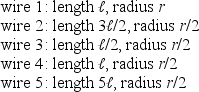 Rank the wires according to their resistances, least to greatest.
 (Multiple Choice)
4.7/5 (74)
(74) The mechanical equivalent of heat is 1 cal = 4.18 J.A heating coil, connected to a 120-V source, develops 60,000 calories in 10 minutes.The current in the coil is:
(Multiple Choice)
5.0/5 (76)
(76) The current density is the same in two wires.Wire A has twice the free electron concentration of wire B.The drift speed of electrons in A is:
(Multiple Choice)
4.7/5 (68)
(68) 
Filters
- Essay(0)
- Multiple Choice(0)
- Short Answer(0)
- True False(0)
- Matching(0)