



 Chat with AI
Exam 28: Magnetic Fields

Exam 1: Measurement37 Questions
Exam 2: Motion Along a Straight Line90 Questions
Exam 3: Vector32 Questions
Exam 4: Motion in Two and Three Dimensions53 Questions
Exam 5: Force and Motion I73 Questions
Exam 6: Force and Motion II74 Questions
Exam 7: Kinetic Energy and Work72 Questions
Exam 8: Potential Energy and Conservation of Energy62 Questions
Exam 9: Center of Mass and Linear Momentum98 Questions
Exam 10: Rotation99 Questions
Exam 11: Rolling, Torque, and Angular Momentum65 Questions
Exam 12: Equilibrium and Elasticity57 Questions
Exam 13: Gravitation54 Questions
Exam 14: Fluids87 Questions
Exam 15: Oscillations75 Questions
Exam 16: Waves I80 Questions
Exam 17: Waves II70 Questions
Exam 18: Temperature, Heat, and the First Law of Thermodynamics96 Questions
Exam 19: The Kinetic Theory of Gases111 Questions
Exam 20: Entropy and the Second Law of Thermodynamics61 Questions
Exam 21: Electric Charge51 Questions
Exam 22: Electric Fields52 Questions
Exam 23: Gauss Law39 Questions
Exam 24: Electric Potential50 Questions
Exam 25: Capacitance59 Questions
Exam 26: Current and Resistance54 Questions
Exam 27: Circuits73 Questions
Exam 28: Magnetic Fields51 Questions
Exam 29: Magnetic Fields Due to Currents48 Questions
Exam 30: Induction and Inductance90 Questions
Exam 31: Electromagnetic Oscillations and Alternating Current86 Questions
Exam 32: Maxwells Equations; Magnetism of Matter81 Questions
Exam 33: Electromagnetic Waves81 Questions
Exam 34: Images78 Questions
Exam 35: Interference45 Questions
Exam 36: Diffraction77 Questions
Exam 37: Relativity68 Questions
Exam 38: Photons and Matter Waves57 Questions
Exam 39: More About Matter Waves41 Questions
Exam 40: All About Atoms76 Questions
Exam 41: Conduction of Electricity in Solids49 Questions
Exam 42: Nuclear Physics68 Questions
Exam 43: Energy From the Nucleus50 Questions
Exam 44: Quarks, Leptons, and the Big Bang55 Questions
Select questions type


A cyclotron operates with a given magnetic field and at a given frequency.If R denotes the radius of the final orbit, the final particle energy is proportional to:
(Multiple Choice)
4.9/5  (74)
(74) The Hall effect can be used to calculate the charge-carrier number density in a conductor.If a conductor carrying a current of 2.0 A is 0.5 mm thick, and the Hall effect voltage is 4.5 µV when it is in a uniform magnetic field of 1.2 T, what is the density of charge carriers in the conductor?
(Multiple Choice)
4.7/5 (88)
(88) The diagram shows a straight wire carrying a flow of electrons into the page.The wire is between the poles of a permanent magnet.The direction of the magnetic force exerted on the wire is: 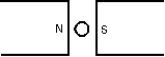
(Multiple Choice)
5.0/5 (87)
(87) J.J.Thomson's experiment, involving the motion of an electron beam in mutually perpendicular and fields, gave the value of:
(Multiple Choice)
4.7/5 (65)
(65) The figure shows the motion of electrons in a wire which is near the N pole of a magnet.The wire will be pushed: 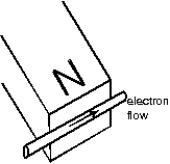
(Multiple Choice)
4.7/5 (76)
(76) A square loop of wire lies in the plane of the page and carries a current I as shown.There is a uniform magnetic field directed towards the top of the page, as indicated.The loop will tend to rotate: 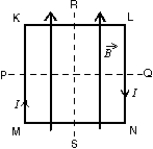
(Multiple Choice)
4.8/5 (76)
(76) An electron travels due north through a vacuum in a region of uniform magnetic field that is also directed due north.It will:
(Multiple Choice)
4.8/5 (79)
(79) The diagram shows a straight wire carrying current i in a uniform magnetic field.The magnetic force on the wire is indicated by an arrow but the magnetic field is not shown.Of the following possibilities, the direction of the magnetic field is: 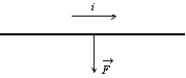
(Multiple Choice)
4.8/5 (78)
(78) At any point the magnetic field lines are in the direction of:
(Multiple Choice)
4.8/5 (83)
(83) A uniform magnetic field is directed into the page.A charged particle, moving in the plane of the page, follows a clockwise spiral of decreasing radius as shown.A reasonable explanation is: 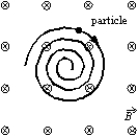
(Multiple Choice)
4.8/5 (74)
(74) A uniform magnetic field is in the positive z direction.A positively charged particle is moving in the positive x direction through the field.The net force on the particle can be made zero by applying an electric field in what direction?
(Multiple Choice)
4.8/5 (87)
(87) An electron and a proton are both initially moving with the same speed and in the same direction at 90˚ to the same uniform magnetic field.They experience magnetic forces, which are initially:
(Multiple Choice)
4.8/5 (79)
(79) A loop of wire carrying a current of 2.0 A is in the shape of a right triangle with two equal sides, each 15 cm long.A 0.7 T uniform magnetic field is in the plane of the triangle and is perpendicular to the hypotenuse.The resultant magnetic force on the two equal sides has a magnitude of:
(Multiple Choice)
4.8/5 (72)
(72) An electron is moving north in a region where the magnetic field is south.The magnetic force exerted on the electron is:
(Multiple Choice)
4.9/5 (77)
(77) A circular loop of wire with a radius of 20 cm lies in the xy plane and carries a current of 2 A, counterclockwise when viewed from a point on the positive z axis.Its magnetic dipole moment is:
(Multiple Choice)
4.9/5 (93)
(93) You are facing a loop of wire which carries a clockwise current of 3.0 A and which surrounds an area of 5.8 x 10⁻²m2.The magnetic dipole moment of the loop is:
(Multiple Choice)
4.9/5 (88)
(88) The magnetic force on a charged particle is in the direction of its velocity if:
(Multiple Choice)
4.9/5 (81)
(81) For a loop of current-carrying wire in a uniform magnetic field the potential energy is a minimum if the magnetic dipole moment of the loop is:
(Multiple Choice)
4.9/5 (74)
(74) The current is from left to right in the conductor shown.The magnetic field is into the page and point S is at a higher potential than point T.The charge carriers are: 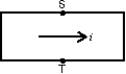
(Multiple Choice)
5.0/5 (77)
(77) 
Filters
- Essay(0)
- Multiple Choice(0)
- Short Answer(0)
- True False(0)
- Matching(0)