



 Chat with AI
Exam 35: Interference

Exam 1: Measurement37 Questions
Exam 2: Motion Along a Straight Line90 Questions
Exam 3: Vector32 Questions
Exam 4: Motion in Two and Three Dimensions53 Questions
Exam 5: Force and Motion I73 Questions
Exam 6: Force and Motion II74 Questions
Exam 7: Kinetic Energy and Work72 Questions
Exam 8: Potential Energy and Conservation of Energy62 Questions
Exam 9: Center of Mass and Linear Momentum98 Questions
Exam 10: Rotation99 Questions
Exam 11: Rolling, Torque, and Angular Momentum65 Questions
Exam 12: Equilibrium and Elasticity57 Questions
Exam 13: Gravitation54 Questions
Exam 14: Fluids87 Questions
Exam 15: Oscillations75 Questions
Exam 16: Waves I80 Questions
Exam 17: Waves II70 Questions
Exam 18: Temperature, Heat, and the First Law of Thermodynamics96 Questions
Exam 19: The Kinetic Theory of Gases111 Questions
Exam 20: Entropy and the Second Law of Thermodynamics61 Questions
Exam 21: Electric Charge51 Questions
Exam 22: Electric Fields52 Questions
Exam 23: Gauss Law39 Questions
Exam 24: Electric Potential50 Questions
Exam 25: Capacitance59 Questions
Exam 26: Current and Resistance54 Questions
Exam 27: Circuits73 Questions
Exam 28: Magnetic Fields51 Questions
Exam 29: Magnetic Fields Due to Currents48 Questions
Exam 30: Induction and Inductance90 Questions
Exam 31: Electromagnetic Oscillations and Alternating Current86 Questions
Exam 32: Maxwells Equations; Magnetism of Matter81 Questions
Exam 33: Electromagnetic Waves81 Questions
Exam 34: Images78 Questions
Exam 35: Interference45 Questions
Exam 36: Diffraction77 Questions
Exam 37: Relativity68 Questions
Exam 38: Photons and Matter Waves57 Questions
Exam 39: More About Matter Waves41 Questions
Exam 40: All About Atoms76 Questions
Exam 41: Conduction of Electricity in Solids49 Questions
Exam 42: Nuclear Physics68 Questions
Exam 43: Energy From the Nucleus50 Questions
Exam 44: Quarks, Leptons, and the Big Bang55 Questions
Select questions type


In a Michelson interferometer, in order to shift the pattern by half a fringe, one of the mirrors at the end of an arm must be moved by:
(Multiple Choice)
5.0/5  (81)
(81) In a Young's double-slit experiment, the separation between slits is d and the screen is a distance D from the slits.D is much greater than d and is the wavelength of the light.The number of bright fringes per unit length on the screen is:
(Multiple Choice)
4.9/5 (79)
(79) A thin film with an index of refraction of 1.60 is placed in one of the beams of a Michelson interferometer.If this causes a shift of 8 bright fringes in the pattern produced by light of wavelength 580 nm, what is the thickness of the film?
(Multiple Choice)
4.8/5 (83)
(83) The reason there are two slits, rather than one, in a Young's experiment is:
(Multiple Choice)
4.8/5 (85)
(85) The phase difference between the two waves which give rise to a dark spot in a Young's double-slit experiment is (where m = integer):
(Multiple Choice)
4.9/5 (83)
(83) In a Young's experiment, it is essential that the two beams:
(Multiple Choice)
4.9/5 (77)
(77) The three factors that determine the interference of reflected waves from a thin film are:
(Multiple Choice)
4.9/5 (66)
(66) Three experiments involving a thin film (in air)are shown.If t denotes the film thickness and denotes the wavelength of the light in the film, which experiments will produce constructive interference as seen by the observer? 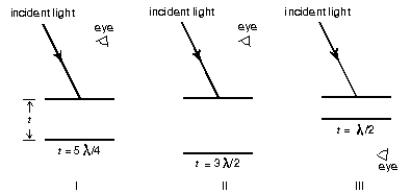
(Multiple Choice)
4.9/5 (82)
(82) In a Young's double-slit experiment, a thin sheet of mica is placed over one of the two slits.As a result, the center of the fringe pattern (on the screen)shifts so that the center is now occupied by what was the 30th dark band.The wavelength of the light in this experiment is 480 nm and the index of the mica is 1.60.The mica thickness is:
(Multiple Choice)
4.8/5 (68)
(68) In a Young's double-slit experiment the center of a bright fringe occurs wherever waves from the slits differ in phase by a multiple of:
(Multiple Choice)
4.8/5 (85)
(85) One of the two slits in a Young's experiment is painted over so that it transmits only one-half the intensity of the other slit.As a result:
(Multiple Choice)
4.7/5 (72)
(72) Two light waves are initially in phase and have the same wavelength, 470 nm.They enter two different media of identical lengths of 2.50 µm.If n1 = 1.2 and n2 = 1.5, what is the effective phase difference of the waves when they exit the media? 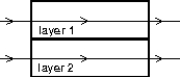
(Multiple Choice)
4.8/5 (80)
(80) In an experiment to measure the wavelength of light using a double slit, it is found that the fringes are too close together to easily count them.To spread out the fringe pattern, one could:
(Multiple Choice)
4.9/5 (89)
(89) A light wave with an electric field amplitude of 2E0 and a phase constant of zero is to be combined with one of the following waves.Which of these combinations produces the least intensity?
(Multiple Choice)
4.9/5 (93)
(93) In a thin film experiment, a wedge of air is used between two glass plates.If the wavelength of the incident light in air is 480 nm, how much thicker is the air wedge at the 16th dark fringe than it is at the 6th?
(Multiple Choice)
4.9/5 (84)
(84) Light from a small region of an ordinary incandescent bulb is passed through a yellow filter and then serves as the source for a Young's double-slit experiment.Which of the following changes would cause the interference pattern to be more closely spaced?
(Multiple Choice)
4.8/5 (70)
(70) Two point sources, vibrating in phase, produce an interference pattern in a ripple tank.If the frequency is increased by 20%, the number of nodal lines:
(Multiple Choice)
4.7/5 (79)
(79) A lens with a refractive index of 1.5 is coated with a material of refractive index 1.2 in order to minimize reflection.If denotes the wavelength of the incident light in air, what is the thinnest possible such coating? 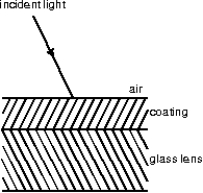
(Multiple Choice)
4.9/5 (72)
(72) 
Filters
- Essay(0)
- Multiple Choice(0)
- Short Answer(0)
- True False(0)
- Matching(0)