



 Chat with AI
Exam 38: Photons and Matter Waves

Exam 1: Measurement37 Questions
Exam 2: Motion Along a Straight Line90 Questions
Exam 3: Vector32 Questions
Exam 4: Motion in Two and Three Dimensions53 Questions
Exam 5: Force and Motion I73 Questions
Exam 6: Force and Motion II74 Questions
Exam 7: Kinetic Energy and Work72 Questions
Exam 8: Potential Energy and Conservation of Energy62 Questions
Exam 9: Center of Mass and Linear Momentum98 Questions
Exam 10: Rotation99 Questions
Exam 11: Rolling, Torque, and Angular Momentum65 Questions
Exam 12: Equilibrium and Elasticity57 Questions
Exam 13: Gravitation54 Questions
Exam 14: Fluids87 Questions
Exam 15: Oscillations75 Questions
Exam 16: Waves I80 Questions
Exam 17: Waves II70 Questions
Exam 18: Temperature, Heat, and the First Law of Thermodynamics96 Questions
Exam 19: The Kinetic Theory of Gases111 Questions
Exam 20: Entropy and the Second Law of Thermodynamics61 Questions
Exam 21: Electric Charge51 Questions
Exam 22: Electric Fields52 Questions
Exam 23: Gauss Law39 Questions
Exam 24: Electric Potential50 Questions
Exam 25: Capacitance59 Questions
Exam 26: Current and Resistance54 Questions
Exam 27: Circuits73 Questions
Exam 28: Magnetic Fields51 Questions
Exam 29: Magnetic Fields Due to Currents48 Questions
Exam 30: Induction and Inductance90 Questions
Exam 31: Electromagnetic Oscillations and Alternating Current86 Questions
Exam 32: Maxwells Equations; Magnetism of Matter81 Questions
Exam 33: Electromagnetic Waves81 Questions
Exam 34: Images78 Questions
Exam 35: Interference45 Questions
Exam 36: Diffraction77 Questions
Exam 37: Relativity68 Questions
Exam 38: Photons and Matter Waves57 Questions
Exam 39: More About Matter Waves41 Questions
Exam 40: All About Atoms76 Questions
Exam 41: Conduction of Electricity in Solids49 Questions
Exam 42: Nuclear Physics68 Questions
Exam 43: Energy From the Nucleus50 Questions
Exam 44: Quarks, Leptons, and the Big Bang55 Questions
Select questions type


The intensity of a light beam with a wavelength of 500 nm is 2000 W/m2.The photon flux is about:
(Multiple Choice)
4.9/5  (72)
(72) The diagram shows the graphs of the stopping potential as a function of the frequency of the incident light for photoelectric experiments performed on three different materials.Rank the materials according to the values of their work functions, from least to greatest. 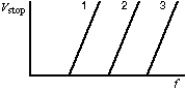
(Multiple Choice)
4.8/5 (73)
(73) Separate Compton effect experiments are carried out using visible light and x rays.The scattered radiation is observed at the same scattering angle.For these experiments:
(Multiple Choice)
4.7/5 (89)
(89) A free electron and a free proton have the same momentum.This means that, compared to the matter wave associated with the proton, the matter wave associated with the electron has:
(Multiple Choice)
4.9/5 (73)
(73) A photon in light beam A has twice the energy of a photon in light beam B.The ratio pA/pB of their momenta is:
(Multiple Choice)
4.8/5 (82)
(82) The reflection coefficient R for a certain barrier tunneling problem is 0.80.The corresponding transmission coefficient T is:
(Multiple Choice)
4.8/5 (80)
(80) Which of the following is NOT evidence for the wave nature of matter?
(Multiple Choice)
4.8/5 (76)
(76) Consider the following three particles: 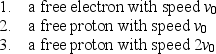 Rank them according to the wavelengths of their matter waves, least to greatest.
 (Multiple Choice)
4.7/5 (79)
(79) Which of the following electromagnetic radiations has photons with the greatest energy?
(Multiple Choice)
4.9/5 (78)
(78) The wavelength of light beam B is twice the wavelength of light beam B.The energy of a photon in beam A is:
(Multiple Choice)
4.9/5 (72)
(72) In a photoelectric effect experiment no electrons are ejected if the frequency of the incident light is less than A/h, where h is the Planck constant and A is:
(Multiple Choice)
5.0/5 (76)
(76) In Compton scattering from stationary electrons the frequency of the emitted light is independent of:
(Multiple Choice)
4.8/5 (82)
(82) Of the following which is the best evidence for the wave nature of matter?
(Multiple Choice)
4.9/5 (88)
(88) An electron with energy E is incident on a potential energy barrier of height Epot and thickness L.The probability of tunneling increases if:
(Multiple Choice)
4.9/5 (77)
(77) Electromagnetic radiation with a wavelength of 3.5 * 10-12 m is scattered from stationary electrons, and photons that have been scattered through 50 are detected.After a scattering event the magnitude of the photon's momentum is:
(Multiple Choice)
4.8/5 (89)
(89) Of the following, Compton scattering from electrons is most easily observed for:
(Multiple Choice)
4.9/5 (77)
(77) In a photoelectric effect experiment at a frequency above cut off, the stopping potential is proportional to:
(Multiple Choice)
4.9/5 (89)
(89) The frequency and wavelength of the matter wave associated with a 10-eV free electron are:
(Multiple Choice)
4.8/5 (71)
(71) 
Filters
- Essay(0)
- Multiple Choice(0)
- Short Answer(0)
- True False(0)
- Matching(0)