



 Chat with AI
Exam 42: Nuclear Physics

Exam 1: Measurement37 Questions
Exam 2: Motion Along a Straight Line90 Questions
Exam 3: Vector32 Questions
Exam 4: Motion in Two and Three Dimensions53 Questions
Exam 5: Force and Motion I73 Questions
Exam 6: Force and Motion II74 Questions
Exam 7: Kinetic Energy and Work72 Questions
Exam 8: Potential Energy and Conservation of Energy62 Questions
Exam 9: Center of Mass and Linear Momentum98 Questions
Exam 10: Rotation99 Questions
Exam 11: Rolling, Torque, and Angular Momentum65 Questions
Exam 12: Equilibrium and Elasticity57 Questions
Exam 13: Gravitation54 Questions
Exam 14: Fluids87 Questions
Exam 15: Oscillations75 Questions
Exam 16: Waves I80 Questions
Exam 17: Waves II70 Questions
Exam 18: Temperature, Heat, and the First Law of Thermodynamics96 Questions
Exam 19: The Kinetic Theory of Gases111 Questions
Exam 20: Entropy and the Second Law of Thermodynamics61 Questions
Exam 21: Electric Charge51 Questions
Exam 22: Electric Fields52 Questions
Exam 23: Gauss Law39 Questions
Exam 24: Electric Potential50 Questions
Exam 25: Capacitance59 Questions
Exam 26: Current and Resistance54 Questions
Exam 27: Circuits73 Questions
Exam 28: Magnetic Fields51 Questions
Exam 29: Magnetic Fields Due to Currents48 Questions
Exam 30: Induction and Inductance90 Questions
Exam 31: Electromagnetic Oscillations and Alternating Current86 Questions
Exam 32: Maxwells Equations; Magnetism of Matter81 Questions
Exam 33: Electromagnetic Waves81 Questions
Exam 34: Images78 Questions
Exam 35: Interference45 Questions
Exam 36: Diffraction77 Questions
Exam 37: Relativity68 Questions
Exam 38: Photons and Matter Waves57 Questions
Exam 39: More About Matter Waves41 Questions
Exam 40: All About Atoms76 Questions
Exam 41: Conduction of Electricity in Solids49 Questions
Exam 42: Nuclear Physics68 Questions
Exam 43: Energy From the Nucleus50 Questions
Exam 44: Quarks, Leptons, and the Big Bang55 Questions
Select questions type


A certain nucleus, after absorbing a neutron, emits a - and then splits into two alpha particles.The (A, Z)of the original nucleus must have been:
(Multiple Choice)
4.8/5  (80)
(80) Bombardment of 28Si (Z = 14)with alpha particles may produce:
(Multiple Choice)
4.9/5 (71)
(71) A radioactive atom X emits a - particle.The resulting atom:
(Multiple Choice)
4.8/5 (71)
(71) The binding energy of a nucleus is the energy that must be supplied to:
(Multiple Choice)
4.9/5 (69)
(69) The becquerel is the correct unit to use in reporting the measurement of:
(Multiple Choice)
4.8/5 (76)
(76) At the end of 14 min, 1/16 of a sample of radioactive polonium remains.The corresponding half-life is:
(Multiple Choice)
4.9/5 (82)
(82) Rank the following collections of particles according to the total binding energy of all the particles in each collection, least to greatest. 
(Multiple Choice)
4.9/5 (101)
(101) A fly caught in amber is thought to be 3 million years old.Why would it not be useful to confirm its age using radiocarbon dating?
(Multiple Choice)
4.9/5 (92)
(92) The half-life of radium is about 1600 years.If a rock initially contains 1 g of radium, the amount left after 8000 years will be about:
(Multiple Choice)
4.7/5 (59)
(59) Radioactive element A decays to the stable element B with a half-life T.Starting with a sample of pure A and no B, which graph below most correctly shows the number of A atoms, NA, as a function of time t? 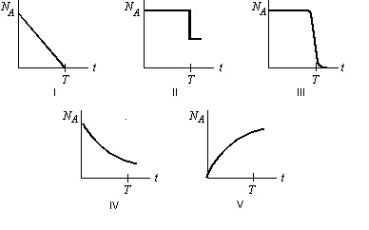
(Multiple Choice)
4.9/5 (87)
(87) Two protons are about 10-10 m apart.Their relative motion is chiefly determined by:
(Multiple Choice)
4.9/5 (69)
(69) The gray is the correct unit to use in reporting the measurement of:
(Multiple Choice)
4.9/5 (74)
(74) Bromine, with atomic mass 79.942 u, is composed of nearly equal amounts of two isotopes, one of which contains 79 nucleons per atom.The mass number of the other isotope is:
(Multiple Choice)
4.8/5 (93)
(93) The 66Cu (Z = 29)produced in a nuclear bombardment is unstable, changing to 66Zn (Z = 30)by the emission of:
(Multiple Choice)
4.8/5 (76)
(76) 
Filters
- Essay(0)
- Multiple Choice(0)
- Short Answer(0)
- True False(0)
- Matching(0)