



 Chat with AI
Exam 11: Sex: Causes and Consequences

Exam 1: The Whale and the Virus: How Scientists Study Evolution37 Questions
Exam 2: From Natural Philosophy to Darwin: a Brief History of Evolutionary Ideas42 Questions
Exam 3: What the Rocks Say: How Geology and Paleontology Reveal the History of Life84 Questions
Exam 4: The Tree of Life: How Biologists Use Phylogeny to Reconstruct the Deep Past42 Questions
Exam 5: Raw Material: Heritable Variation Among Individuals51 Questions
Exam 6: The Ways of Change: Drift and Selection71 Questions
Exam 7: Beyond Alleles: Quantitative Genetics and the Evolution of Phenotypes42 Questions
Exam 8: The History in Our Genes65 Questions
Exam 9: From Genes to Traits: the Evolution of Genetic Networks and Development67 Questions
Exam 10: Natural Selection: Empirical Studies in the Wild40 Questions
Exam 11: Sex: Causes and Consequences43 Questions
Exam 12: After Conception: the Evolution of Life History and Parental Care43 Questions
Exam 13: The Origin of Species48 Questions
Exam 14: Macroevolution: the Long Run57 Questions
Exam 15: Intimate Partnerships: How Species Adapt to Each Other39 Questions
Exam 16: Brains and Behavior60 Questions
Exam 17: Human Evolution: a New Kind of Ape70 Questions
Exam 18: Evolutionary Medicine70 Questions
Select questions type


Which of the following is not considered a potential benefit of sexual reproduction?
(Multiple Choice)
4.9/5  (88)
(88) The trees below present a hypothetical situation where "T" represents the evolution of a male trait that is attractive to females, and "P" represents where the preference in females evolved. Which tree below is consistent with the sensory bias hypothesis? 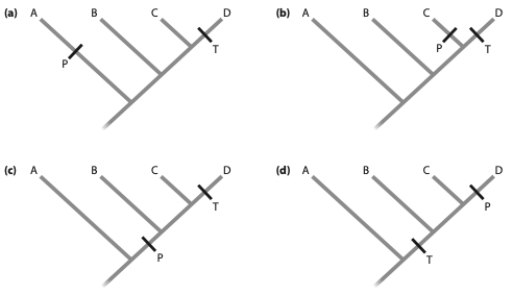
(Multiple Choice)
4.7/5 (78)
(78) In an experiment on mutations in asexual versus sexual yeast populations, Michael McDonald and colleagues found that
(Multiple Choice)
4.8/5 (85)
(85) You perform an experiment to test whether female birds prefer males with longer tail feathers. You find that they do, and, in fact, they prefer even longer tail feathers than you ever see on males in the population. Assuming that this trait has had enough time to evolve to an optimum, what is the most likely explanation for why tail feathers are not even longer in the population?
(Essay)
4.8/5 (75)
(75) Which of the following statements is true regarding monogamy?
(Multiple Choice)
4.9/5 (77)
(77) Phalaropes are shore birds with brightly colored females and dull colored males. Females are larger than males and compete with each other for access to males. Considering sexual selection theory, which idea(s) below seem(s) most plausible in light of the pattern of sexual dimorphism?
(Multiple Choice)
4.9/5 (80)
(80) Which of the following is not an example of a direct food benefit that results from female choice?
(Multiple Choice)
4.9/5 (91)
(91) Define each of the following terms and explain how they influence sexual selection.
(a) anisogamy
(b) operational sex ratio
(c) opportunity for selection
(Essay)
4.8/5 (68)
(68) Which of the following is true regarding the operational sex ratio (OSR)?
(Multiple Choice)
4.8/5 (76)
(76) Given the mating systems outlined below, which is most likely to produce sexual conflict?
(Multiple Choice)
4.8/5 (77)
(77) In the dung beetle Onthophagus acuminatus, weapons are shown to be honest signals because
(Multiple Choice)
4.8/5 (81)
(81) An example of sexually selected ornaments that result from female choice is
(Multiple Choice)
5.0/5 (92)
(92) Female sticklebacks prefer males with brighter red coloration on their belly. Given the results depicted in the graph below, what do females that choose redder males benefit from? 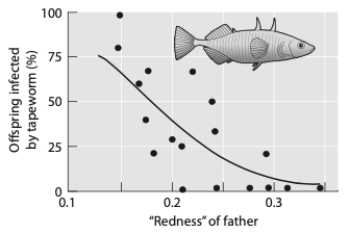
(Multiple Choice)
4.9/5 (75)
(75) 
Filters
- Essay(0)
- Multiple Choice(0)
- Short Answer(0)
- True False(0)
- Matching(0)