



 Chat with AI
Exam 18: Evolutionary Medicine

Exam 1: The Whale and the Virus: How Scientists Study Evolution37 Questions
Exam 2: From Natural Philosophy to Darwin: a Brief History of Evolutionary Ideas42 Questions
Exam 3: What the Rocks Say: How Geology and Paleontology Reveal the History of Life84 Questions
Exam 4: The Tree of Life: How Biologists Use Phylogeny to Reconstruct the Deep Past42 Questions
Exam 5: Raw Material: Heritable Variation Among Individuals51 Questions
Exam 6: The Ways of Change: Drift and Selection71 Questions
Exam 7: Beyond Alleles: Quantitative Genetics and the Evolution of Phenotypes42 Questions
Exam 8: The History in Our Genes65 Questions
Exam 9: From Genes to Traits: the Evolution of Genetic Networks and Development67 Questions
Exam 10: Natural Selection: Empirical Studies in the Wild40 Questions
Exam 11: Sex: Causes and Consequences43 Questions
Exam 12: After Conception: the Evolution of Life History and Parental Care43 Questions
Exam 13: The Origin of Species48 Questions
Exam 14: Macroevolution: the Long Run57 Questions
Exam 15: Intimate Partnerships: How Species Adapt to Each Other39 Questions
Exam 16: Brains and Behavior60 Questions
Exam 17: Human Evolution: a New Kind of Ape70 Questions
Exam 18: Evolutionary Medicine70 Questions
Select questions type


The phenomenon that can produce high frequencies of deleterious alleles in small, isolated populations is
(Multiple Choice)
4.7/5  (90)
(90) In the following figure, what does the length of the branches show? 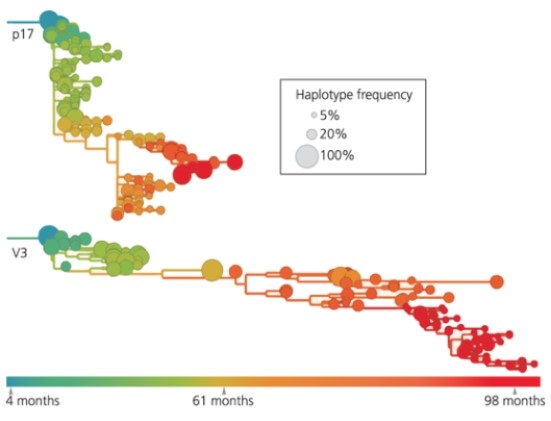
(Multiple Choice)
4.9/5 (68)
(68) Which of the following processes help(s) to explain the high incidence of certain rare genetic diseases in the Amish?
(Multiple Choice)
4.8/5 (91)
(91) There are many hypotheses about why obesity and diabetes are increasing in modern societies, many of them based on evolutionary mismatch. Describe three of these hypotheses.
(Essay)
4.9/5 (76)
(76) At present, what is the most common cause of death in developed countries?
(Multiple Choice)
4.9/5 (79)
(79) How could the movement of soldiers and unsanitary conditions during World War I have led to the evolution of a more virulent flu strain in 1918?
(Essay)
4.8/5 (75)
(75) Despite its complexity, the human eye still has its flaws. Why is the human eye a fitting example for how we can better understand the evolution of the human immune system?
(Essay)
4.9/5 (84)
(84) Which of the following diseases does not generally follow Mendelian rules of inheritance?
(Multiple Choice)
4.8/5 (69)
(69) The frequency of Huntington's disease can increase in a population because
(Multiple Choice)
4.7/5 (86)
(86) Which of the following results would provide support for the thrifty genotype hypothesis?
(Multiple Choice)
4.8/5 (93)
(93) Two copies of the HbS allele cause sickle-cell anemia, but a single HbS allele helps protect individuals from malaria. This is an example of
(Multiple Choice)
4.8/5 (78)
(78) People who have been vaccinated for the flu but still contract it are less likely to
(Multiple Choice)
4.8/5 (80)
(80) Increases in the average life span since the mid-20th century are driven by
(Multiple Choice)
5.0/5 (77)
(77) Which of the following patterns suggests that cytomegalovirus has tracked the evolution of its primate hosts for millions of years?
(Multiple Choice)
4.7/5 (81)
(81) Which of the following is a way that researchers are trying to predict the next pandemic?
(Multiple Choice)
4.7/5 (74)
(74) The figure below shows two regions (p17 and V3) of the HIV genome in the same patient. Which of the following conclusions can be drawn from the graph? 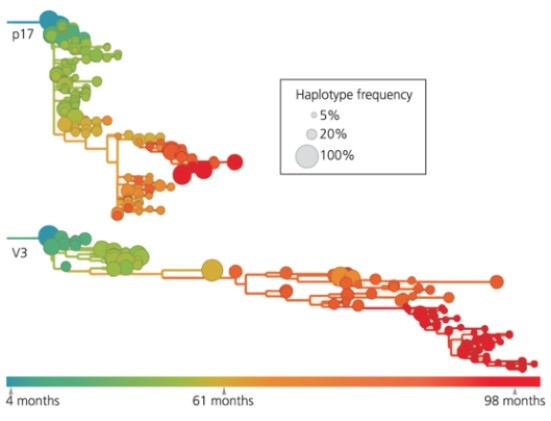
(Multiple Choice)
4.8/5 (83)
(83) What fraction of human proteins have evolved new amino acids under selection pressure from viruses?
(Multiple Choice)
4.9/5 (63)
(63) Mutations that increase the risk of breast cancer in women are also associated with higher rates of childbirth. This is an example of
(Multiple Choice)
4.8/5 (86)
(86) 
Filters
- Essay(0)
- Multiple Choice(0)
- Short Answer(0)
- True False(0)
- Matching(0)