



 Chat with AI
Exam 4: Atomic Physics and Spectra

Exam 1: Discovering the Night Sky374 Questions
Exam 2: Gravitation and the Motion of the Planets356 Questions
Exam 3: Light and Telescopes275 Questions
Exam 4: Atomic Physics and Spectra223 Questions
Exam 5: Exoplanets and the Formation of Planetary Systems98 Questions
Exam 6: Formation of the Solar System121 Questions
Exam 7: Earth and the Moon305 Questions
Exam 8: The Other Terrestrial Planets265 Questions
Exam 9: The Outer Planets360 Questions
Exam 10: Vagabonds of the Solar System198 Questions
Exam 11: The Sun: Our Extraordinary Star248 Questions
Exam 12: Characterizing Stars254 Questions
Exam 13: The Lives of Stars From Birth Through Middle Age325 Questions
Exam 14: The Death of Stars235 Questions
Exam 15: Black Holes: Matters of Gravity178 Questions
Exam 16: The Milky Way Galaxy157 Questions
Exam 17: Galaxies207 Questions
Exam 18: Quasars and Other Active Galaxies118 Questions
Exam 19: Cosmology217 Questions
Exam 20: Astrobiology71 Questions
Select questions type


Where does the Paschen series of spectral lines from hydrogen gas appear in the electromagnetic spectrum?
(Multiple Choice)
5.0/5  (95)
(95) The Stefan-Boltzmann law, which relates the energy per unit area F emitted by an object to its temperature T, F = T4, is obeyed by what kind of object?
(Multiple Choice)
5.0/5 (78)
(78) If a continuous spectrum of ultraviolet radiation passes through a tube of cool hydrogen gas, what happens to its spectrum?
(Multiple Choice)
4.8/5 (94)
(94) In his scattering experiment, Ernest Rutherford expected that the alpha particles he was using as bullets would easily penetrate his gold foil target with no backscatter. What was the actual result of the experiment?
(Multiple Choice)
4.7/5 (72)
(72) Figure 4-2 in the text shows that a blackbody with a temperature of 3000 K emits radiation that peaks at a wavelength much longer than wavelengths in the visible part of the spectrum. This means that the object 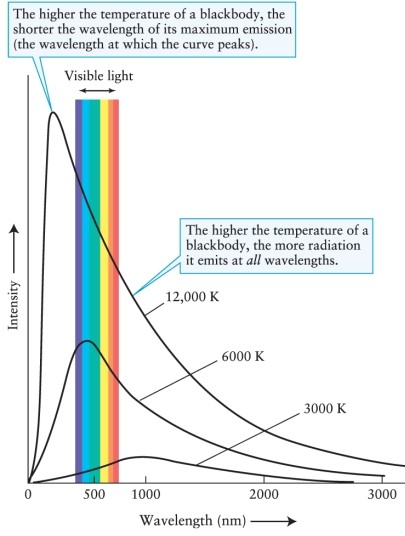
(Multiple Choice)
4.8/5 (74)
(74) The normal temperature of the melting point of water ice is
(Multiple Choice)
4.9/5 (76)
(76) The amount of radiation emitted by a blackbody depends on all of these properties of the blackbody EXCEPT
(Multiple Choice)
4.7/5 (96)
(96) Which of these equations represents the dependence of the total energy flux F of radiation emitted per unit area by a blackbody (e.g., star) on its temperature T with a constant?
(Multiple Choice)
4.8/5 (79)
(79) A police radar device bounces radio waves of wavelength 3 mm from the front of a speeding car and measures the Doppler shift in wavelength of the reflected waves. What will be the wavelength shift if the car is moving at 60 mph (80 km/h or 22.2 m/s) (in a 30 mph zone)? Note that the shift is doubled because of the reflection.
(Multiple Choice)
4.8/5 (70)
(70) Huge fluxes of X-rays are detected from the direction of Cygnus X-1 with a spectrum that looks similar to that of a blackbody with a peak wavelength of 1.45 nm (1 nm = 10-9 m). These X-rays are probably emitted by matter being heated as it falls into a black hole. What is the temperature of this gas?
(Multiple Choice)
5.0/5 (82)
(82) The proton, the nucleus of the hydrogen atom, has a mass that exceeds that of the electron by approximately what factor?
(Multiple Choice)
4.8/5 (86)
(86) A piece of iron is heated from 400 K to 800 K. The total energy emitted per second by this iron will increase by a factor of
(Multiple Choice)
4.8/5 (94)
(94) One problem with using a glass prism to produce a spectrum from white light is that
(Multiple Choice)
4.8/5 (70)
(70) The total amount of radiation emitted by a heated blackbody depends on its temperature and
(Multiple Choice)
5.0/5 (77)
(77) An ideal blackbody in physics and astronomy is an object that
(Multiple Choice)
4.9/5 (71)
(71) The total radiant energy emitted from the entire surface of a blackbody is proportional to what power of the blackbody's Kelvin temperature?
(Multiple Choice)
4.9/5 (91)
(91) A blackbody is an idealized object in physics and astronomy that
(Multiple Choice)
4.9/5 (79)
(79) A star whose surface temperature is 100,000 K will emit a spectrum whose peak wavelength is at
(Multiple Choice)
4.8/5 (89)
(89) Two different isotopes of the element selenium will have the same number of
(Multiple Choice)
4.8/5 (89)
(89) When astronomers look for evidence of hydrogen gas in the spectra of the Sun, the planets, or the nearby stars, the positions of the spectral features or "lines" due to hydrogen are in
(Multiple Choice)
4.8/5 (85)
(85) 
Filters
- Essay(0)
- Multiple Choice(0)
- Short Answer(0)
- True False(0)
- Matching(0)