



 Chat with AI
Exam 6: Formation of the Solar System

Exam 1: Discovering the Night Sky374 Questions
Exam 2: Gravitation and the Motion of the Planets356 Questions
Exam 3: Light and Telescopes275 Questions
Exam 4: Atomic Physics and Spectra223 Questions
Exam 5: Exoplanets and the Formation of Planetary Systems98 Questions
Exam 6: Formation of the Solar System121 Questions
Exam 7: Earth and the Moon305 Questions
Exam 8: The Other Terrestrial Planets265 Questions
Exam 9: The Outer Planets360 Questions
Exam 10: Vagabonds of the Solar System198 Questions
Exam 11: The Sun: Our Extraordinary Star248 Questions
Exam 12: Characterizing Stars254 Questions
Exam 13: The Lives of Stars From Birth Through Middle Age325 Questions
Exam 14: The Death of Stars235 Questions
Exam 15: Black Holes: Matters of Gravity178 Questions
Exam 16: The Milky Way Galaxy157 Questions
Exam 17: Galaxies207 Questions
Exam 18: Quasars and Other Active Galaxies118 Questions
Exam 19: Cosmology217 Questions
Exam 20: Astrobiology71 Questions
Select questions type


In which of these ways is our solar system typical of exoplanet systems so far discovered?
(Multiple Choice)
4.8/5  (71)
(71) Which planet in our solar system has the lowest average density?
(Multiple Choice)
4.8/5 (92)
(92) What name is given to the concentration of mass that formed at the center of the solar nebula and eventually became the Sun?
(Multiple Choice)
5.0/5 (71)
(71) At what point in time is it said that the protosun became the Sun?
(Multiple Choice)
4.9/5 (89)
(89) Which of these is true of our solar system in comparison to exoplanet systems so far discovered?
(Multiple Choice)
5.0/5 (76)
(76) The asteroid Gaspra (see Figure 6-4) is typical of MOST asteroids in that it is 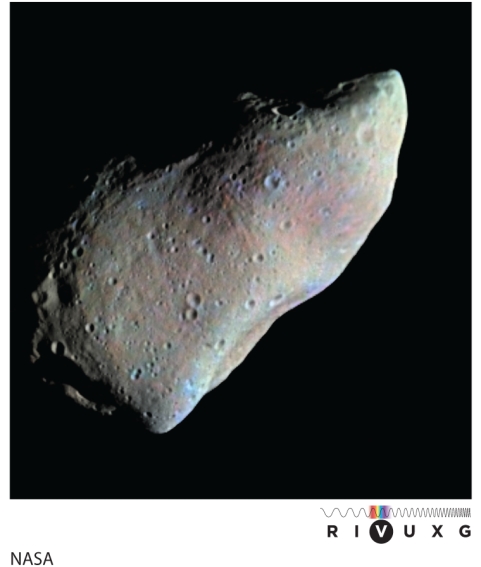
(Multiple Choice)
4.7/5 (83)
(83) Cratering is common on all of the inner solar system bodies EXCEPT
(Multiple Choice)
4.9/5 (81)
(81) In our solar system, which of these planets is a member of the terrestrial group?
(Multiple Choice)
4.8/5 (80)
(80) Suppose that observers using the Hubble Space Telescope detect around several solar-type stars the presence of planets with these characteristics: a density comparable to water; radii about 75,000 km; fluid surfaces; and rapid rotation. How would these planets be classified in terms of our solar system?
(Multiple Choice)
4.9/5 (74)
(74) As the forming planet Jupiter moved through the early outer solar system, it collided with huge numbers of gas and dust particles there. What effect did this have?
(Multiple Choice)
4.9/5 (74)
(74) Suppose the Hubble Space Telescope discovers a series of planets with these characteristics moving around a star that resembles our Sun: spherical, solid surfaces; mean densities about 4 times that of water; radii about 4000 km; and low-density atmospheres. How would these planets be classified in comparison with our solar system?
(Multiple Choice)
4.7/5 (89)
(89) There is very little hydrogen or helium in the inner part of the solar system today. Astronomers believe the reason for this is that
(Multiple Choice)
4.8/5 (89)
(89) Suppose Earth existed in a solar system containing two stars, relatively close together. What major change would result from such an arrangement compared to the situation at present?
(Multiple Choice)
4.8/5 (90)
(90) Meteorites are useful for studying the earliest history of the solar system because
(Multiple Choice)
4.7/5 (90)
(90) What is the origin of many of the bodies in the Kuiper belt and the Oort cloud?
(Multiple Choice)
4.8/5 (91)
(91) 
Filters
- Essay(0)
- Multiple Choice(0)
- Short Answer(0)
- True False(0)
- Matching(0)