



 Chat with AI
Exam 15: Monopolistic Competition

Exam 1: The Scope and Method of Economics241 Questions
Exam 2: The Economic Problem: Scarcity and Choice218 Questions
Exam 3: Demand, Supply, and Market Equilibrium309 Questions
Exam 4: Demand and Supply Applications173 Questions
Exam 5: Elasticity188 Questions
Exam 6: Household Behavior and Consumer Choice272 Questions
Exam 7: The Production Process: the Behavior of Profit-Maximizing Firms287 Questions
Exam 8: Short-Run Costs and Output Decisions386 Questions
Exam 9: Long-Run Costs and Output Decisions363 Questions
Exam 10: Input Demand: the Labor and Land Markets200 Questions
Exam 11: Input Demand: the Capital Market and the Investment Decision218 Questions
Exam 12: General Equilibrium and the Efficiency of Perfect Competition202 Questions
Exam 13: Monopoly and Antitrust Policy394 Questions
Exam 14: Oligopoly219 Questions
Exam 15: Monopolistic Competition235 Questions
Exam 16: Externalities, Public Goods, and Common Resources275 Questions
Exam 17: Uncertainty and Asymmetric Information134 Questions
Exam 18: Income Distribution and Poverty197 Questions
Exam 19: Public Finance: the Economics of Taxation281 Questions
Exam 20: International Trade, Comparative Advantage, and Protectionism287 Questions
Exam 21: Economic Growth in Developing Economies133 Questions
Exam 22: Critical Thinking About Research104 Questions
Select questions type


Refer to the information provided in Figure 15.4 below to answer the question(s) that follow. 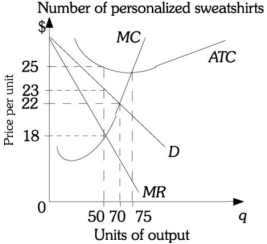 Figure 15.4
-Refer to Figure 15.4. Assume The Hand Made Shirt Shop has fixed costs of $90 and is a monopolistically competitive firm. To maximize profits in the short run, the firm should produce ________ personalized sweatshirts.
Figure 15.4
-Refer to Figure 15.4. Assume The Hand Made Shirt Shop has fixed costs of $90 and is a monopolistically competitive firm. To maximize profits in the short run, the firm should produce ________ personalized sweatshirts. (Multiple Choice)
4.8/5  (76)
(76) Refer to the information provided in Figure 15.3 below to answer the question(s) that follow.  Figure 15.3
-Refer to Figure 15.3. Gwen's Country Curtains is currently manufacturing 1,000 pairs of curtains per month. This firm
Figure 15.3
-Refer to Figure 15.3. Gwen's Country Curtains is currently manufacturing 1,000 pairs of curtains per month. This firm (Multiple Choice)
4.9/5 (91)
(91) Refer to the information provided in Figure 15.5 below to answer the question(s) that follow.  Figure 15.5
-Refer to Figure 15.5. In the long run in this monopolistically competitive industry,
Figure 15.5
-Refer to Figure 15.5. In the long run in this monopolistically competitive industry, (Multiple Choice)
4.9/5 (78)
(78) Advertising serves no productive purpose and is thus welfare decreasing.
(True/False)
4.9/5 (78)
(78) Refer to the information provided in Figure 15.4 below to answer the question(s) that follow. Figure 15.4
-Refer to Figure 15.4. Assume The Hand Made Shirt Shop has fixed costs of $150 and is a monopolistically competitive firm. To maximize profits in the short run, this firm should produce ________ personalized sweatshirts.
Figure 15.4
-Refer to Figure 15.4. Assume The Hand Made Shirt Shop has fixed costs of $150 and is a monopolistically competitive firm. To maximize profits in the short run, this firm should produce ________ personalized sweatshirts. (Multiple Choice)
4.9/5 (74)
(74) Refer to the information provided in Figure 15.6 below to answer the question(s) that follow.  Figure 15.6
-Refer to Figure 15.6. If Trollio's T-shirts is in long-run equilibrium, it is producing ________ silk-screened T-shirts and selling each T-shirt at a price of ________.
Figure 15.6
-Refer to Figure 15.6. If Trollio's T-shirts is in long-run equilibrium, it is producing ________ silk-screened T-shirts and selling each T-shirt at a price of ________. (Multiple Choice)
5.0/5 (72)
(72) A monopolistically competitive firm that is incurring a loss will produce in the short run as long as the revenue the firm receives is sufficient to cover
(Multiple Choice)
4.9/5 (68)
(68) Pie-Oh-My, a monopolistically competitive firm, is baking 80 gourmet pies per day and selling each pie for $25. At that production level ATC is $40, AVC is $30, AFC is $10, and both MR and MC are $16. This firm should
(Multiple Choice)
4.7/5 (83)
(83) When some firms exit a monopolistic competitive industry, the demand curves of the remaining firms in the industry
(Multiple Choice)
4.8/5 (79)
(79) Compared to a perfectly competitive firm having the same cost curves, a monopolistically competitive firm ________ output and ________ prices.
(Multiple Choice)
4.8/5 (86)
(86) ________ firms use a product differentiation strategy to achieve market power.
(Multiple Choice)
4.7/5 (73)
(73) In general, the demand curve facing the monopolistically competitive firm is more elastic than the demand curve facing the monopoly.
(True/False)
4.8/5 (75)
(75) Firms will ________ a monopolistically competitive market until ________ are eliminated.
(Multiple Choice)
4.9/5 (77)
(77) A monopolistically competitive firm that is incurring a loss will ________ as long as its revenue covers variable costs.
(Multiple Choice)
4.9/5 (90)
(90) Refer to the information provided in Figure 15.5 below to answer the question(s) that follow. Figure 15.5
-Refer to Figure 15.5. In the long run in this monopolistically competitive industry,
Figure 15.5
-Refer to Figure 15.5. In the long run in this monopolistically competitive industry, (Multiple Choice)
4.8/5 (74)
(74) Behavioral economics uses insights from both psychology and economics.
(True/False)
5.0/5 (75)
(75) Refer to the information provided in Figure 15.2 below to answer the question(s) that follow.  Figure 15.2
-Refer to Figure 15.2. In this monopolistically competitive industry, in the long run
Figure 15.2
-Refer to Figure 15.2. In this monopolistically competitive industry, in the long run (Multiple Choice)
4.9/5 (77)
(77) In the long run, a monopolistically competitive firm that is incurring a loss will ________ if total revenue is less than variable costs.
(Multiple Choice)
4.8/5 (91)
(91) Product differentiation that makes the product ________ is horizontal differentiation.
(Multiple Choice)
4.7/5 (68)
(68) Refer to the information provided in Figure 15.1 below to answer the question(s) that follow. Below are cost curves for Dom's Barber Shop, a monopolistically competitive firm.  Figure 15.1
-Refer to Figure 15.1. From society's point of view, the ________ level is 25 haircuts.
Figure 15.1
-Refer to Figure 15.1. From society's point of view, the ________ level is 25 haircuts. (Multiple Choice)
4.9/5 (83)
(83) 
Filters
- Essay(0)
- Multiple Choice(0)
- Short Answer(0)
- True False(0)
- Matching(0)