



 Chat with AI
Exam 18: Income Distribution and Poverty

Exam 1: The Scope and Method of Economics241 Questions
Exam 2: The Economic Problem: Scarcity and Choice218 Questions
Exam 3: Demand, Supply, and Market Equilibrium309 Questions
Exam 4: Demand and Supply Applications173 Questions
Exam 5: Elasticity188 Questions
Exam 6: Household Behavior and Consumer Choice272 Questions
Exam 7: The Production Process: the Behavior of Profit-Maximizing Firms287 Questions
Exam 8: Short-Run Costs and Output Decisions386 Questions
Exam 9: Long-Run Costs and Output Decisions363 Questions
Exam 10: Input Demand: the Labor and Land Markets200 Questions
Exam 11: Input Demand: the Capital Market and the Investment Decision218 Questions
Exam 12: General Equilibrium and the Efficiency of Perfect Competition202 Questions
Exam 13: Monopoly and Antitrust Policy394 Questions
Exam 14: Oligopoly219 Questions
Exam 15: Monopolistic Competition235 Questions
Exam 16: Externalities, Public Goods, and Common Resources275 Questions
Exam 17: Uncertainty and Asymmetric Information134 Questions
Exam 18: Income Distribution and Poverty197 Questions
Exam 19: Public Finance: the Economics of Taxation281 Questions
Exam 20: International Trade, Comparative Advantage, and Protectionism287 Questions
Exam 21: Economic Growth in Developing Economies133 Questions
Exam 22: Critical Thinking About Research104 Questions
Select questions type


Recent data suggests that the percentage of the population in poverty for African-American families is approximately five times that of white families.
(True/False)
4.8/5  (96)
(96) According to ________, the redistribution of income from the rich to the poor causes an increase in total utility because of the law of decreasing marginal utility.
(Multiple Choice)
4.9/5 (84)
(84) A Gini coefficient of ________ means that the income is equally distributed.
(Multiple Choice)
5.0/5 (85)
(85) Refer to the information provided in Figure 18.1 below to answer the question(s) that follow. 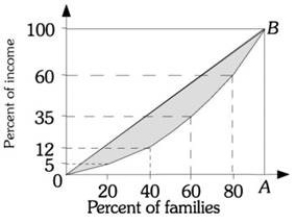 Figure 18.1
-Refer to Figure 18.1. The second poorest fifth of families earned ________% of income in Outland.
Figure 18.1
-Refer to Figure 18.1. The second poorest fifth of families earned ________% of income in Outland. (Multiple Choice)
4.8/5 (79)
(79) All of the following are programs in the Social Security system except
(Multiple Choice)
4.9/5 (74)
(74) Refer to the information provided in Figure 18.1 below to answer the question(s) that follow. Figure 18.1
-Refer to Figure 18.1. The wealthiest fifth of families earned ________% of income in Outland.
Figure 18.1
-Refer to Figure 18.1. The wealthiest fifth of families earned ________% of income in Outland. (Multiple Choice)
4.9/5 (78)
(78) The idea that individuals who work for companies should receive at least an equitable hourly income is known as
(Multiple Choice)
4.7/5 (82)
(82) The idea that a dollar in the hand of a rich person is worth less than a dollar in the hand of a poor person is a consequence of ________ justice.
(Multiple Choice)
4.8/5 (83)
(83) Of the following countries, which has the highest level of inequality with respect to disposable income?
(Multiple Choice)
4.9/5 (71)
(71) The primary function of the SNAP program has been to provide subsidies for grocery purchases for low-income families.
(True/False)
4.8/5 (80)
(80) If all individuals have identical utility functions and the marginal utility of income decreases as income increases, transferring income ________ will ________ total utility.
(Multiple Choice)
4.9/5 (85)
(85) Property income generally takes the form of all of the following except
(Multiple Choice)
4.9/5 (93)
(93) Employees with less experience tend to earn less than employees with more experience, because
(Multiple Choice)
5.0/5 (71)
(71) Poverty rates among the elderly have risen in the past few decades.
(True/False)
4.8/5 (86)
(86) You and your sister are splitting a pizza. You cut it in half and your sister selects her half first. Thus, you cut it into two equally sized pieces. This is an example of
(Multiple Choice)
4.7/5 (77)
(77) The primary assumption made in ________ justice is that people are risk ________.
(Multiple Choice)
4.8/5 (84)
(84) 
Filters
- Essay(0)
- Multiple Choice(0)
- Short Answer(0)
- True False(0)
- Matching(0)