



 Chat with AI
Exam 3: Demand, Supply, and Market Equilibrium

Exam 1: The Scope and Method of Economics241 Questions
Exam 2: The Economic Problem: Scarcity and Choice218 Questions
Exam 3: Demand, Supply, and Market Equilibrium309 Questions
Exam 4: Demand and Supply Applications173 Questions
Exam 5: Elasticity188 Questions
Exam 6: Household Behavior and Consumer Choice272 Questions
Exam 7: The Production Process: the Behavior of Profit-Maximizing Firms287 Questions
Exam 8: Short-Run Costs and Output Decisions386 Questions
Exam 9: Long-Run Costs and Output Decisions363 Questions
Exam 10: Input Demand: the Labor and Land Markets200 Questions
Exam 11: Input Demand: the Capital Market and the Investment Decision218 Questions
Exam 12: General Equilibrium and the Efficiency of Perfect Competition202 Questions
Exam 13: Monopoly and Antitrust Policy394 Questions
Exam 14: Oligopoly219 Questions
Exam 15: Monopolistic Competition235 Questions
Exam 16: Externalities, Public Goods, and Common Resources275 Questions
Exam 17: Uncertainty and Asymmetric Information134 Questions
Exam 18: Income Distribution and Poverty197 Questions
Exam 19: Public Finance: the Economics of Taxation281 Questions
Exam 20: International Trade, Comparative Advantage, and Protectionism287 Questions
Exam 21: Economic Growth in Developing Economies133 Questions
Exam 22: Critical Thinking About Research104 Questions
Select questions type


Refer to the information provided in Figure 3.14 below to answer the question(s) that follow. 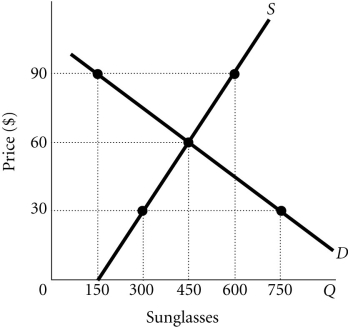 Figure 3.14
-Refer to Figure 3.14. At a price of $60, there is an excess
Figure 3.14
-Refer to Figure 3.14. At a price of $60, there is an excess (Multiple Choice)
4.8/5  (76)
(76) If price is above the equilibrium, then quantity supplied will be greater than quantity demanded, putting downward pressure on price.
(True/False)
4.8/5 (76)
(76) According to the law of demand, as prices rise, ceteris paribus
(Multiple Choice)
4.7/5 (88)
(88) Refer to Scenario 3.1 below to answer the question(s) that follow.
SCENARIO 3.1
-Streaming movies and movies shown in theaters are substitutes.
-Streaming movies and OLED TVs are complements.
-OLED TVs and movies shown in theaters are normal goods.
-People watch streaming movies more often in the winter than in the summer.
-Refer to Scenario 3.1. To raise additional revenues, the government imposes an entertainment tax on movie tickets, but there are no new additional taxes levied on streaming movies. This would lead to
(Multiple Choice)
4.8/5 (84)
(84) Refer to the information provided in Table 3.2 below to answer the question(s) that follow.
Table 3.2
Price per Cheeseburger Quantity Demanded (Cheeseburgers per Month) Quantity Supplied (Cheeseburgers per Month) \ 5 1,500 500 6 1,200 700 7 900 900 8 600 1,100 9 300 1,300
-Refer to Table 3.2. This market will be in equilibrium if the quantity of cheeseburgers demanded is
(Multiple Choice)
4.8/5 (77)
(77) Refer to the information provided in Figure 3.11 below to answer the following question(s).  Figure 3.11
-Refer to Figure 3.11. A decrease in supply is represented by the movement from
Figure 3.11
-Refer to Figure 3.11. A decrease in supply is represented by the movement from (Multiple Choice)
4.9/5 (75)
(75) Refer to the information provided in Figure 3.18 below to answer the question(s) that follow. 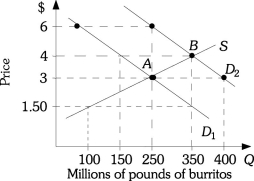 Figure 3.18
-Refer to Figure 3.18 The market is initially in equilibrium at Point B. If demand shifts from D2 to D1 and the price of burritos remains constant at $4.00, there will be
Figure 3.18
-Refer to Figure 3.18 The market is initially in equilibrium at Point B. If demand shifts from D2 to D1 and the price of burritos remains constant at $4.00, there will be (Multiple Choice)
4.8/5 (86)
(86) Related to the Economics in Practice on page 51: The Amazon Kindle and the electronic textbooks available for the Kindle are complementary goods. Electronic textbooks and traditional, hard-copy textbooks are substitute products. If the price of electronic textbooks for the Kindle decreases,
(Multiple Choice)
4.9/5 (76)
(76) The change in the price of a good leads to a change in ________, which leads to a ________.
(Multiple Choice)
4.8/5 (78)
(78) Refer to the information provided in Figure 3.16 below to answer the question(s) that follow. 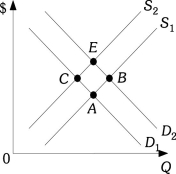 Figure 3.16
-Refer to Figure 3.16. When the economy moves from Point C to Point A, there has been
Figure 3.16
-Refer to Figure 3.16. When the economy moves from Point C to Point A, there has been (Multiple Choice)
4.7/5 (89)
(89) Refer to the information provided in Figure 3.18 below to answer the question(s) that follow. Figure 3.18
-Refer to Figure 3.18. The market is initially in equilibrium at Point B. If demand shifts from D2 to D1, the new equilibrium price will be ________ and the new equilibrium quantity will be ________.
Figure 3.18
-Refer to Figure 3.18. The market is initially in equilibrium at Point B. If demand shifts from D2 to D1, the new equilibrium price will be ________ and the new equilibrium quantity will be ________. (Multiple Choice)
4.8/5 (88)
(88) Refer to the information provided in Figure 3.9 below to answer the following question(s). 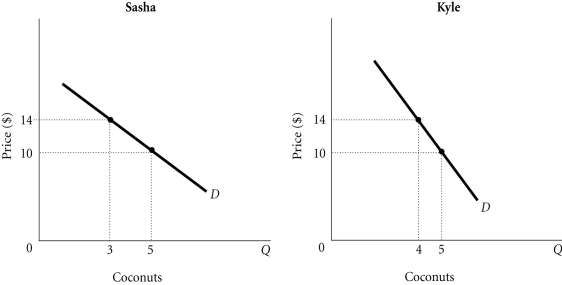 Figure 3.9
-Refer to Figure 3.9. Assume that there are only two people in the market for coconuts: Sasha and Kyle. Along the ________ for coconuts, at a price of $14, quantity demanded would be 10.
Figure 3.9
-Refer to Figure 3.9. Assume that there are only two people in the market for coconuts: Sasha and Kyle. Along the ________ for coconuts, at a price of $14, quantity demanded would be 10. (Multiple Choice)
4.8/5 (72)
(72) Related to the Economics in Practice on p. 52: It would most likely be ________ if a particular day's weather influenced the purchase of a durable good such as an automobile.
(Multiple Choice)
4.9/5 (87)
(87) Refer to the information provided in Figure 3.16 below to answer the question(s) that follow. Figure 3.16
-Refer to Figure 3.16. When the economy moves from Point A to Point B, there has been
Figure 3.16
-Refer to Figure 3.16. When the economy moves from Point A to Point B, there has been (Multiple Choice)
4.8/5 (80)
(80) Refer to the information provided in Figure 3.19 below to answer the question(s) that follow.  Figure 3.19
-Refer to Figure 3.19. The market is initially in equilibrium at Point A. If supply shifts from S1 to S2, the equilibrium price will change from ________ and the equilibrium quantity will change from ________.
Figure 3.19
-Refer to Figure 3.19. The market is initially in equilibrium at Point A. If supply shifts from S1 to S2, the equilibrium price will change from ________ and the equilibrium quantity will change from ________. (Multiple Choice)
4.7/5 (70)
(70) Refer to Scenario 3.1 below to answer the question(s) that follow.
SCENARIO 3.1
-Streaming movies and movies shown in theaters are substitutes.
-Streaming movies and OLED TVs are complements.
-OLED TVs and movies shown in theaters are normal goods.
-People watch streaming movies more often in the winter than in the summer.
-Refer to Scenario 3.1. You observe that the price of streaming movies is higher in the winter than in the summer. This would be explained by the fact that
(Multiple Choice)
4.8/5 (76)
(76) Refer to Scenario 3.1 below to answer the question(s) that follow.
SCENARIO 3.1
-Streaming movies and movies shown in theaters are substitutes.
-Streaming movies and OLED TVs are complements.
-OLED TVs and movies shown in theaters are normal goods.
-People watch streaming movies more often in the winter than in the summer.
-Refer to Scenario 3.1. Most OLED TVs sold in the United States are imported from Asia. If the United States government reduces the number of OLED TVs that can be imported into the United States, ceteris paribus, what would happen?
(Multiple Choice)
4.8/5 (79)
(79) Refer to the information provided in Figure 3.2 below to answer the question(s) that follow. 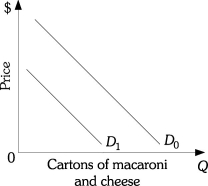 Figure 3.2
-Refer to Figure 3.2. Which of the following would be most likely to cause the demand for macaroni and cheese to shift from D1 to D0?
Figure 3.2
-Refer to Figure 3.2. Which of the following would be most likely to cause the demand for macaroni and cheese to shift from D1 to D0? (Multiple Choice)
4.8/5 (75)
(75) 
Filters
- Essay(0)
- Multiple Choice(0)
- Short Answer(0)
- True False(0)
- Matching(0)