



 Chat with AI
Exam 4: Demand and Supply Applications

Exam 1: The Scope and Method of Economics241 Questions
Exam 2: The Economic Problem: Scarcity and Choice218 Questions
Exam 3: Demand, Supply, and Market Equilibrium309 Questions
Exam 4: Demand and Supply Applications173 Questions
Exam 5: Elasticity188 Questions
Exam 6: Household Behavior and Consumer Choice272 Questions
Exam 7: The Production Process: the Behavior of Profit-Maximizing Firms287 Questions
Exam 8: Short-Run Costs and Output Decisions386 Questions
Exam 9: Long-Run Costs and Output Decisions363 Questions
Exam 10: Input Demand: the Labor and Land Markets200 Questions
Exam 11: Input Demand: the Capital Market and the Investment Decision218 Questions
Exam 12: General Equilibrium and the Efficiency of Perfect Competition202 Questions
Exam 13: Monopoly and Antitrust Policy394 Questions
Exam 14: Oligopoly219 Questions
Exam 15: Monopolistic Competition235 Questions
Exam 16: Externalities, Public Goods, and Common Resources275 Questions
Exam 17: Uncertainty and Asymmetric Information134 Questions
Exam 18: Income Distribution and Poverty197 Questions
Exam 19: Public Finance: the Economics of Taxation281 Questions
Exam 20: International Trade, Comparative Advantage, and Protectionism287 Questions
Exam 21: Economic Growth in Developing Economies133 Questions
Exam 22: Critical Thinking About Research104 Questions
Select questions type


Related to the Economics in Practice on page 83: Which of the following best explains why the people who wait for hours to acquire tickets to free performances earn less on average than the people who actually see those performances?
(Multiple Choice)
4.9/5  (90)
(90) Refer to the information provided in Figure 4.3 below to answer the question(s) that follow. 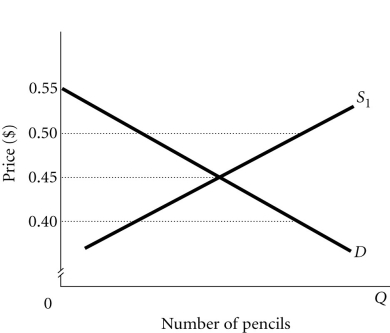 Figure 4.3
-Refer to Figure 4.3. Retailers will have an excess supply of pencils if the government will not allow retailers to charge less than ________ for a pencil.
Figure 4.3
-Refer to Figure 4.3. Retailers will have an excess supply of pencils if the government will not allow retailers to charge less than ________ for a pencil. (Multiple Choice)
4.9/5 (68)
(68) Related to the Economics in Practice on page 79: If a hurricane results in the supply of hotel rooms decreasing and the demand for hotel rooms increases, the equilibrium price for hotel rooms ________ and the equilibrium quantity of hotel rooms ________.
(Multiple Choice)
4.8/5 (75)
(75) Refer to the information provided in Figure 4.6 below to answer the question(s) that follow.
Equilibrium in this market occurs at the intersection of curves S and D.  Figure 4.6
-Refer to Figure 4.6. Producer surplus is area G if price is
Figure 4.6
-Refer to Figure 4.6. Producer surplus is area G if price is (Multiple Choice)
4.9/5 (83)
(83) In the short run, nonprice rationing will happen whenever there is excess demand in a market.
(True/False)
5.0/5 (76)
(76) A surplus will occur if a ________ is set ________ the equilibrium price.
(Multiple Choice)
4.8/5 (70)
(70) If the market price of a bowling ball is $125 and the full cost of producing it is $35, then a bowling ball producing firm gets producer surplus of
(Multiple Choice)
4.7/5 (86)
(86) When supply is ________ or the product is ________, then price is demand determined.
(Multiple Choice)
4.8/5 (66)
(66) A firm that sells a car for $30,000 gets producer surplus of $30,000.
(True/False)
4.9/5 (86)
(86) Refer to the information provided in Figure 4.6 below to answer the question(s) that follow.
Equilibrium in this market occurs at the intersection of curves S and D. Figure 4.6
-Refer to Figure 4.6. If price is P1, consumer surplus is area
Figure 4.6
-Refer to Figure 4.6. If price is P1, consumer surplus is area (Multiple Choice)
4.8/5 (75)
(75) Refer to the information provided in Figure 4.6 below to answer the question(s) that follow.
Equilibrium in this market occurs at the intersection of curves S and D. Figure 4.6
-Refer to Figure 4.6. Producer surplus changes by the area [E + F] if price goes from equilibrium to
Figure 4.6
-Refer to Figure 4.6. Producer surplus changes by the area [E + F] if price goes from equilibrium to (Multiple Choice)
4.8/5 (86)
(86) Refer to the information provided in Figure 4.1 below to answer the question(s) that follow. 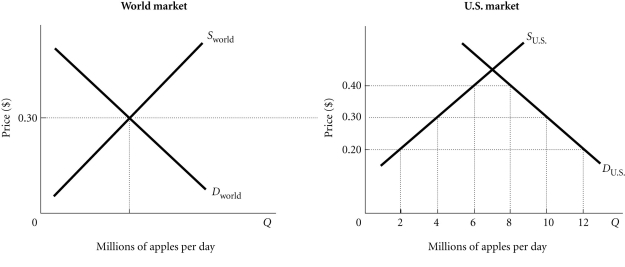 Figure 4.1
-Refer to Figure 4.1. Assume that initially there is free trade. If the United States then imposes a 10-cent tax per apple,
Figure 4.1
-Refer to Figure 4.1. Assume that initially there is free trade. If the United States then imposes a 10-cent tax per apple, (Multiple Choice)
4.8/5 (67)
(67) Refer to the information provided in Figure 4.6 below to answer the question(s) that follow.
Equilibrium in this market occurs at the intersection of curves S and D. Figure 4.6
-Refer to Figure 4.6. Consumer surplus changes by the area [E - C] if price goes from equilibrium to
Figure 4.6
-Refer to Figure 4.6. Consumer surplus changes by the area [E - C] if price goes from equilibrium to (Multiple Choice)
5.0/5 (74)
(74) A situation where illegal trading at market prices takes place is known in economics as a
(Multiple Choice)
4.9/5 (93)
(93) 
Filters
- Essay(0)
- Multiple Choice(0)
- Short Answer(0)
- True False(0)
- Matching(0)