



 Chat with AI
Exam 5: Predictive Analytics I: Trees, K-Nearest Neighbors, Naive Bayes,

Exam 1: An Introduction to Business Statistics and Analytics98 Questions
Exam 2: Descriptive Statistics and Analytics: Tabular and Graphical Methods120 Questions
Exam 3: Descriptive Statistics and Analytics: Numerical Methods145 Questions
Exam 4: Probability and Probability Models150 Questions
Exam 5: Predictive Analytics I: Trees, K-Nearest Neighbors, Naive Bayes,101 Questions
Exam 6: Discrete Random Variables150 Questions
Exam 7: Continuous Random Variables150 Questions
Exam 8: Sampling Distributions111 Questions
Exam 9: Confidence Intervals149 Questions
Exam 10: Hypothesis Testing150 Questions
Exam 11: Statistical Inferences Based on Two Samples140 Questions
Exam 12: Experimental Design and Analysis of Variance132 Questions
Exam 13: Chi-Square Tests120 Questions
Exam 14: Simple Linear Regression Analysis147 Questions
Exam 15: Multiple Regression and Model Building85 Questions
Exam 16: Predictive Analytics Ii: Logistic Regression, Discriminate Analysis,101 Questions
Exam 17: Time Series Forecasting and Index Numbers161 Questions
Exam 18: Nonparametric Methods103 Questions
Exam 19: Decision Theory90 Questions
Select questions type


An automobile finance company analyzed a sample of recent automobile loans to try to determine key factors in identifying borrowers who would be likely to default on their auto loan. The response variable Default equals 1 if the borrower defaulted during the term of the loan and 0 otherwise. The predictor variable AutoDebt% was the ratio (expressed as a percent) of the required loan payments to the borrower's take-home income at the time of purchase. JobTime was the number of years the borrower had worked at their current job at the time of purchase. CredScore was the borrower's credit score at the time of purchase. Below is part of the classification tree the finance company derived from the data collected in the study. Assume they classify those with a default probability estimate of at least .5 as Defaulters. 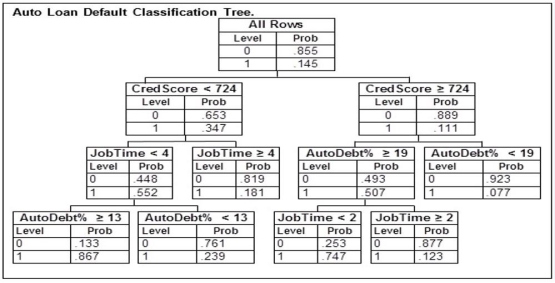 A potential borrower with a credit score of 717 who has been at their current job for 3 years is considering applying for a loan. They do not yet have a particular loan amount in mind. Based on this classification tree, the best estimate that this loan applicant would default would be ________.
 (Multiple Choice)
4.8/5  (100)
(100) A cable television company has randomly selected a sample of 222 Basic package customers for a marketing test to see which customers are more likely to upgrade to the Premium package. They monitored two predictor variables based on customer activity during the most recently billed month. Then they included a special upgrade offer for the Premium package along with their bill. The response variable Upgrade equals True if a customer accepted the offer to upgrade to the Premium package and equals False otherwise. The predictor variable ViewTime is the average daily minutes the customer had at least one TV on in their house. Network is 1 if the TV is tuned to a traditional ("over the public airwaves") broadcast network at least 50 percent of the time that it is turned on and 0 otherwise. Let the events U, Uc, HV, and NV denote the events that the randomly selected Basic customer, respectively, upgraded, did not upgrade, had a high ViewTime [a view time greater than the median amount of 507 minutes], and was primarily a traditional broadcast network viewer [i.e., spent at least 50% of time tuned to a traditional network]. The data they collected show: 1) 43 out of 222 Basic customers upgraded, or P(U) = 43/222.
2) 179 out of 222 Basic customers did not upgrade, or P(Uc) = 179/222.
3) 37 out of 43 upgraders had a high ViewTime, or P(HV|U) = 37/43.
4) 63 out of 179 non-upgraders had a high ViewTime, or P(HV|Uc) = 63/179.
"5) 7 out of 43 upgraders was primarily a traditional broadcast network viewer,
Or P(NV|U) = 7/43."
"6) 52 out of 179 non-upgraders was primarily a traditional broadcast network viewer,
Or P(NV|Uc) = 52/179.
How many upgraders did not have a ViewTime greater than the median amount of 511 minutes?"
(Multiple Choice)
4.8/5 (73)
(73) An automobile finance company analyzed a sample of recent automobile loans to try to determine key factors in identifying borrowers who would be likely to default on their auto loan. The response variable Default equals 1 if the borrower defaulted during the term of the loan and 0 otherwise. The predictor variable AutoDebt% was the ratio (expressed as a percent) of the required loan payments to the borrower's take-home income at the time of purchase. JobTime was the number of years the borrower had worked at their current job at the time of purchase. CredScore was the borrower's credit score at the time of purchase. Below is part of the classification tree the finance company derived from the data collected in the study. Assume they classify those with a default probability estimate of at least .5 as Defaulters. 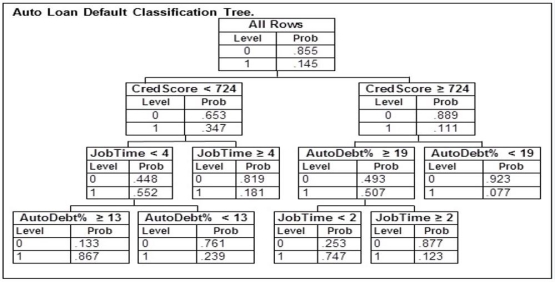 Based on this classification tree, a member of the study sample who had a credit score of 786, just started their current job, took out a loan with payments equaling 9% of their income, and defaulted would be
 (Multiple Choice)
4.9/5 (78)
(78) An MBA admissions officer wishes to predict an MBA applicant's grade point average (GPA) for the MBA program on the basis of the applicant's score on the Graduate Management Admission Test (GMAT) and their undergraduate GPA (UGPA). The admissions officer used a random sample of previously admitted applicants to build a regression tree that can be used to predict the MBA GPAs of future MBA students. Below is the final regression tree. 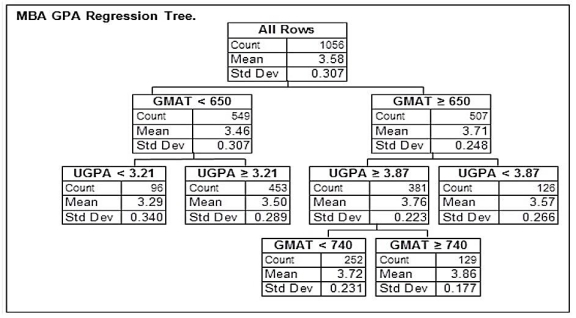 An MBA applicant has a GMAT score of 550 and an undergraduate GPA of 3.01. Based on this regression tree, which of the following is the best estimate of this applicant's MBA GPA if they are admitted into the program?
 (Multiple Choice)
4.9/5 (90)
(90) An internet service provider (ISP) has randomly selected a sample of 223 observations concerning values of the response variable Churn and several predictor variables based on customer activity during the most recently billed month. Here Churn equals Yes if a customer churned-left the internet service provider for another ISP-and equals No otherwise. The predictor variable MinutesOn is the average daily minutes the customer spent online. EmailSent is the average daily number of emails the customer sent from the email address provided by the ISP. ServCalls is the number of times the customer called for service. Below is part of the classification tree they derived from the data collected in the study. 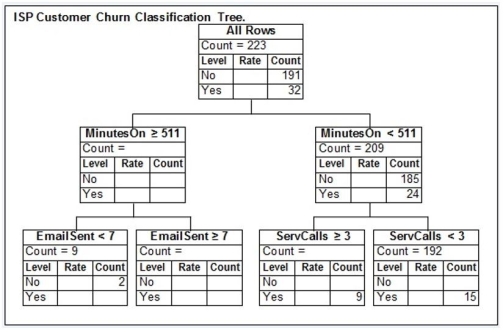 Of the sampled customers who spent an average of at least 511 minutes online per day and sent an average of at least 7 emails per day from their ISP-provided email address, what is the sample proportion of those who churned?
 (Multiple Choice)
4.8/5 (82)
(82) The confusion matrix shows the number of observed response variables which are inaccurately classified.
(True/False)
4.9/5 (74)
(74) An automobile finance company analyzed a sample of recent automobile loans to try to determine key factors in identifying borrowers who would be likely to default on their auto loan. The response variable Default equals 1 if the borrower defaulted during the term of the loan and 0 otherwise. The predictor variable AutoDebt% was the ratio (expressed as a percent) of the required loan payments to the borrower's take-home income at the time of purchase. JobTime was the number of years the borrower had worked at their current job at the time of purchase. CredScore was the borrower's credit score at the time of purchase. Below is part of the classification tree the finance company derived from the data collected in the study. Assume they classify those with a default probability estimate of at least .5 as Defaulters. 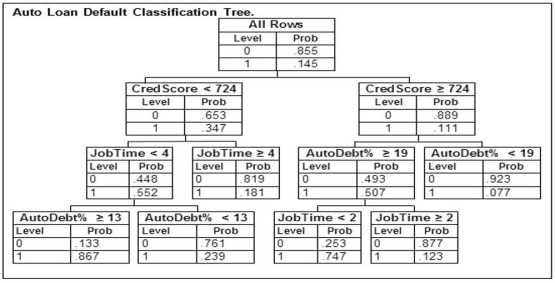 A potential borrower with a credit score of 812 and a monthly income of $4,000 would like to apply for a loan. To be approved for the loan they would need to be classified as a non-Defaulter. Of the following monthly payments, which is the highest this loan could have to be approved for this potential borrower?
 (Multiple Choice)
4.9/5 (82)
(82) An MBA admissions officer wishes to predict an MBA applicant's grade point average (GPA) for the MBA program on the basis of the applicant's score on the Graduate Management Admission Test (GMAT) and their undergraduate GPA (UGPA). The admissions officer used a random sample of previously admitted applicants to build a regression tree that can be used to predict the MBA GPAs of future MBA students. Below is the final regression tree. 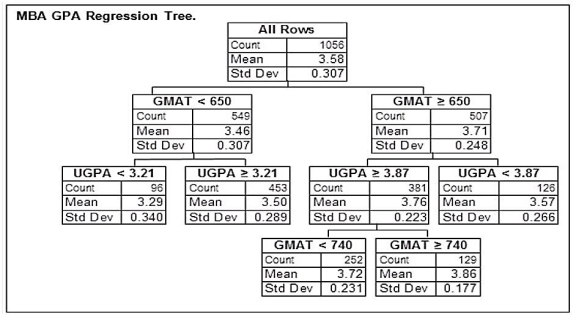 An MBA applicant has a GMAT score of 730 and an undergraduate GPA of 3.21. Based on this regression tree, which of the following is the best estimate of this applicant's MBA GPA if they are admitted into the program?
 (Multiple Choice)
4.8/5 (68)
(68) A cable television company has randomly selected a sample of 637 Basic package customers for a marketing test to see which customers are more likely to upgrade to the Premium package. They monitored several predictor variables based on customer activity during the most recently billed month. Then they included a special upgrade offer for the Premium package along with their bill. The response variable Upgrade equals Yes if a customer accepted the offer to upgrade to the Premium package and equals No otherwise. Below is the confusion matrix from the k-nearest neighbors classification analysis. 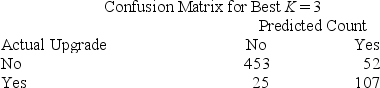 How many customers in the sample were incorrectly classified as upgraders by the k-nearest neighbors approach?
 (Multiple Choice)
4.8/5 (82)
(82) An automobile finance company analyzed a sample of recent automobile loans to try to determine key factors in identifying borrowers who would be likely to default on their auto loan. The response variable Default equals 1 if the borrower defaulted during the term of the loan and 0 otherwise. The predictor variable AutoDebt% was the ratio (expressed as a percent) of the required loan payments to the borrower's take-home income at the time of purchase. JobTime was the number of years the borrower had worked at their current job at the time of purchase. CredScore was the borrower's credit score at the time of purchase. Below is part of the classification tree the finance company derived from the data collected in the study. Assume they classify those with a default probability estimate of at least .5 as Defaulters. 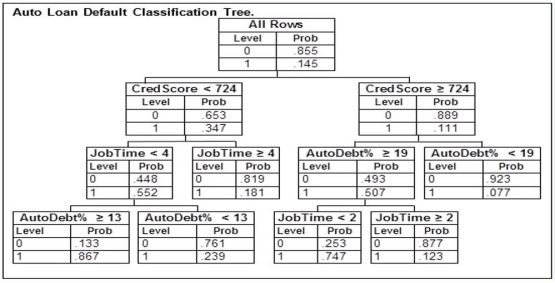 A potential borrower with a credit score of 792 who has been at their current job for 1 year and has a monthly income of $3,000 would like to apply for a loan. To be approved for the loan they would need to be classified as a non-Defaulter. Of the following monthly payments, which is the highest this loan could have to be approved for this potential borrower?
 (Multiple Choice)
4.9/5 (72)
(72) A cable television company has randomly selected a sample of 637 Basic package customers for a marketing test to see which customers are more likely to upgrade to the Premium package. They monitored several predictor variables based on customer activity during the most recently billed month. Then they included a special upgrade offer for the Premium package along with their bill. The response variable Upgrade equals Yes if a customer accepted the offer to upgrade to the Premium package and equals No otherwise. Below is the confusion matrix from the k-nearest neighbors classification analysis. 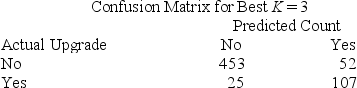 What is the overall misclassification rate for the k-nearest neighbors classification?
 (Multiple Choice)
4.9/5 (72)
(72) The best value of k to use for the k-nearest neighbors approach to classifying a qualitative response variable is the largest value of k for which all distances between neighbors is less than some prespecified distance.
(True/False)
4.8/5 (76)
(76) An MBA admissions officer wishes to predict an MBA applicant's grade point average (GPA) for the MBA program on the basis of the applicant's score on the Graduate Management Admission Test (GMAT) and their undergraduate GPA (UGPA). The admissions officer used a random sample of previously admitted applicants to build a regression tree that can be used to predict the MBA GPAs of future MBA students. Below is the final regression tree. 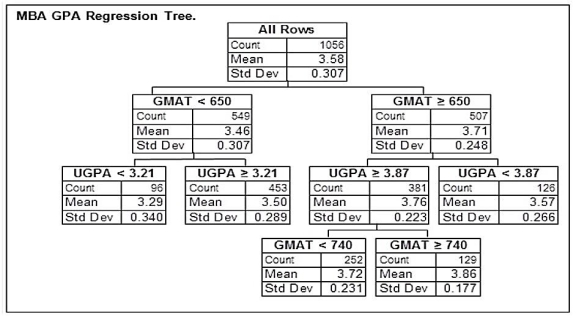 Based on this regression tree, how many of the admitted applicants in the sample had both a GMAT score of at least 740 and an undergraduate GPA of at least 3.87?
 (Multiple Choice)
4.9/5 (82)
(82) An internet service provider (ISP) has randomly selected a sample of 223 observations concerning values of the response variable Churn and several predictor variables based on customer activity during the most recently billed month. Here Churn equals Yes if a customer churned-left the internet service provider for another ISP-and equals No otherwise. The predictor variable MinutesOn is the average daily minutes the customer spent online. EmailSent is the average daily number of emails the customer sent from the email address provided by the ISP. ServCalls is the number of times the customer called for service. Below is part of the classification tree they derived from the data collected in the study. 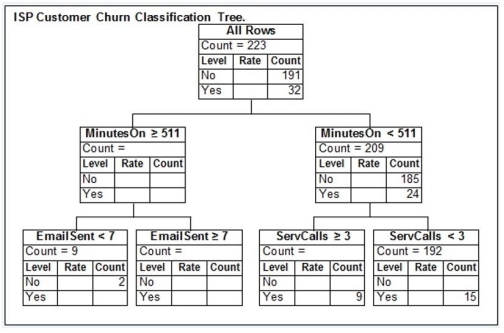 Of the sampled customers who spent an average of at least 511 minutes online per day and sent an average of at least 7 emails per day from their ISP-provided email address, how many churned?
 (Multiple Choice)
5.0/5 (91)
(91) An internet service provider (ISP) has randomly selected a sample of 223 observations concerning values of the response variable Churn and several predictor variables based on customer activity during the most recently billed month. Here Churn equals Yes if a customer churned-left the internet service provider for another ISP-and equals No otherwise. The predictor variable MinutesOn is the average daily minutes the customer spent online. EmailSent is the average daily number of emails the customer sent from the email address provided by the ISP. ServCalls is the number of times the customer called for service. Below is part of the classification tree they derived from the data collected in the study. 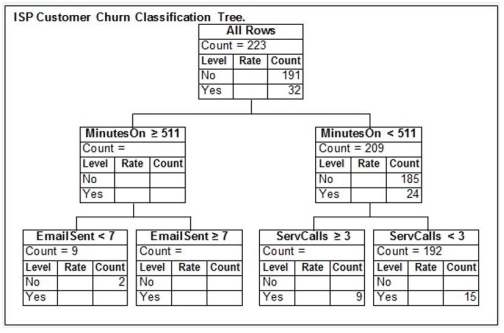 Of the sampled customers who spent an average of at least 511 minutes online per day and sent an average of fewer than 7 emails per day from their ISP-provided email address, how many churned?
 (Multiple Choice)
4.8/5 (74)
(74) To predict a quantitative response variable, we could use a regression tree.
(True/False)
4.7/5 (79)
(79) An internet service provider (ISP) has randomly selected a sample of 223 observations concerning values of the response variable Churn and several predictor variables based on customer activity during the most recently billed month. Here Churn equals Yes if a customer churned-left the internet service provider for another ISP-and equals No otherwise. The predictor variable MinutesOn is the average daily minutes the customer spent online. EmailSent is the average daily number of emails the customer sent from the email address provided by the ISP. ServCalls is the number of times the customer called for service. Below is part of the classification tree they derived from the data collected in the study. 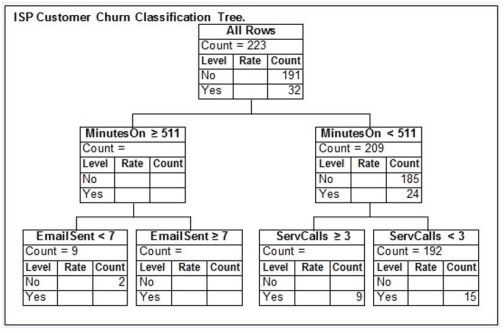 Of the sampled customers who spent an average of at least 511 minutes online per day, how many sent an average of at least 7 emails per day from their ISP-provided email address?
 (Multiple Choice)
4.8/5 (76)
(76) An automobile finance company analyzed a sample of recent automobile loans to try to determine key factors in identifying borrowers who would be likely to default on their auto loan. The response variable Default equals 1 if the borrower defaulted during the term of the loan and 0 otherwise. The predictor variable AutoDebt% was the ratio (expressed as a percent) of the required loan payments to the borrower's take-home income at the time of purchase. JobTime was the number of years the borrower had worked at their current job at the time of purchase. CredScore was the borrower's credit score at the time of purchase. Below is part of the classification tree the finance company derived from the data collected in the study. Assume they classify those with a default probability estimate of at least .5 as Defaulters. 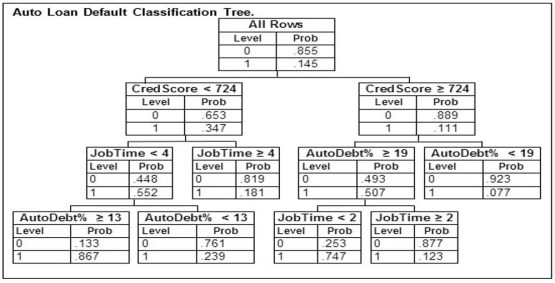 Based on this classification tree, a member of the study sample who had a credit score of 523, been at their current job for 1 year, took out a loan with payments equaling 17% of their income, and defaulted would be
 (Multiple Choice)
4.8/5 (79)
(79) Dividing the entire data set into a training data set and a validation training set is a key step in one approach to ________ the data.
(Multiple Choice)
4.8/5 (68)
(68) A quantitative variable which can have only the values of zero (0) or one (1) and which is used to represent a qualitative variable is known as a (1, 0) dummy variable.
(True/False)
4.9/5 (70)
(70) 
Filters
- Essay(0)
- Multiple Choice(0)
- Short Answer(0)
- True False(0)
- Matching(0)