



 Chat with AI
Exam 19: Decision Theory

Exam 1: An Introduction to Business Statistics and Analytics98 Questions
Exam 2: Descriptive Statistics and Analytics: Tabular and Graphical Methods120 Questions
Exam 3: Descriptive Statistics and Analytics: Numerical Methods145 Questions
Exam 4: Probability and Probability Models150 Questions
Exam 5: Predictive Analytics I: Trees, K-Nearest Neighbors, Naive Bayes,101 Questions
Exam 6: Discrete Random Variables150 Questions
Exam 7: Continuous Random Variables150 Questions
Exam 8: Sampling Distributions111 Questions
Exam 9: Confidence Intervals149 Questions
Exam 10: Hypothesis Testing150 Questions
Exam 11: Statistical Inferences Based on Two Samples140 Questions
Exam 12: Experimental Design and Analysis of Variance132 Questions
Exam 13: Chi-Square Tests120 Questions
Exam 14: Simple Linear Regression Analysis147 Questions
Exam 15: Multiple Regression and Model Building85 Questions
Exam 16: Predictive Analytics Ii: Logistic Regression, Discriminate Analysis,101 Questions
Exam 17: Time Series Forecasting and Index Numbers161 Questions
Exam 18: Nonparametric Methods103 Questions
Exam 19: Decision Theory90 Questions
Select questions type


A pharmaceutical company manufacturing flu test kits wants to determine the probability of a teenager not having the flu when the test results indicate that they do. It is estimated that the probability of positive test for flu among potential users of the kit is 10 percent. According to the company laboratory test results, 1 out of 100 noninfected teenagers tested as having the flu (false positive). On the other hand, 1 out of 200 teenagers with the flu tested as not having the active virus (false negative). A teenager has just used the flu test kit manufactured by the company and the results showed she does not have the flu. What is the probability that she has the flu?
(Short Answer)
4.8/5  (88)
(88) The quality control manager for NKA Inc. must decide whether to accept (alternative 1), further analyze (alternative 2), or reject (alternative 3) an incoming shipment (lot) of microchips. The historical data indicate that there is a 30 percent chance that the lot is poor quality (S1), 50 percent chance that the lot is fair quality (S2), and 20 percent chance that the lot is good quality (S3). Assume the following payoff table is available. The values in the payoff table are in thousands of dollars.
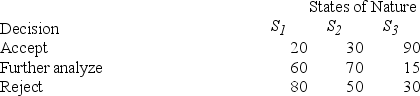 What alternative action should be selected according to the expected monetary value criterion?
 (Short Answer)
4.8/5 (88)
(88) In utility theory, a ________ decision maker is an individual who will choose the decision alternative having the highest expected profit.
(Multiple Choice)
4.9/5 (76)
(76) In utility analysis, a utility curve that shows a rapid increase in utility for initial amounts of money followed by a gradual leveling off for a larger amount of money is appropriate for a risk ________ decision maker.
(Multiple Choice)
4.8/5 (80)
(80) Maximin is a criterion used when making decisions under certainty.
(True/False)
5.0/5 (86)
(86) The utility curve given below represents the preferences of a ________ decision maker. 
(Multiple Choice)
4.8/5 (76)
(76) An investor is looking at three possible investments: growth stock, blue chip stock, or municipal bonds. The investment performance will vary depending on the investment market condition of bull (market rising), flat, or bear (market falling). The investment return for each investment for the corresponding market conditions is given below.
 Which investment would the investor select if using the maximin criterion?
 (Short Answer)
4.9/5 (80)
(80) The expected net gain of sampling equals the expected ________ minus the cost of sampling.
(Multiple Choice)
4.8/5 (81)
(81) Alternatives 1 and 2 in the following payoff table represent the two possible manufacturing strategies that the EKA manufacturing company can adopt. The level of demand affects the success of both strategies. The states of nature (SI) represent the levels of demand for the company products. S1, S2, and S3 characterize high, medium, and low demand, respectively. The payoff values are in thousands of dollars.
 The management believes that weather conditions significantly affect the level of demand. 48 monthly sales reports are randomly selected. These monthly sales reports show 15 months with high demand, 28 months with medium demand, and 5 months with low demand. 12 of the 15 months with high demand had favorable weather conditions. 14 of the 28 months with medium demand had favorable weather conditions. Only 1 of the 5 months with low demand had favorable weather conditions.
If the weather conditions are favorable, determine which manufacturing strategy the company should implement.
The management believes that weather conditions significantly affect the level of demand. 48 monthly sales reports are randomly selected. These monthly sales reports show 15 months with high demand, 28 months with medium demand, and 5 months with low demand. 12 of the 15 months with high demand had favorable weather conditions. 14 of the 28 months with medium demand had favorable weather conditions. Only 1 of the 5 months with low demand had favorable weather conditions.
If the weather conditions are favorable, determine which manufacturing strategy the company should implement. (Short Answer)
4.9/5 (79)
(79) An automobile insurance company is in the process of reviewing its policies. The company is considering increasing the premium charged to drivers under 25. According to company records, 35 percent of the insured drivers are under the age of 25. Company records also show that 280 of the 700 insured drivers under the age of 25 have been involved in at least one automobile accident. On the other hand, only 130 of the 1300 insured drivers 25 years or older have been involved in at least one automobile accident.
An accident has just been reported. What is the probability that the insured driver is under the age of 25?
(Short Answer)
5.0/5 (89)
(89) Decision makers in business organizations make most decisions in environments that involve some degree of ________.
(Multiple Choice)
4.8/5 (76)
(76) A corn farmer has categorized the weather into three possible levels. The weather conditions will affect the timing of the harvest and the associated payoff. In this situation, the weather conditions are called the ________.
(Multiple Choice)
4.9/5 (69)
(69) A person's utility is determined by the preferences he/she exhibits for decision choices involving ________.
(Multiple Choice)
4.7/5 (69)
(69) The quality control manager for NKA Inc. must decide whether to accept (alternative 1), further analyze (alternative 2), or reject (alternative 3) an incoming shipment (lot) of microchips. The historical data indicate that there is a 30 percent chance that the lot is poor quality (S1), 50 percent chance that the lot is fair quality (S2), and 20 percent chance that the lot is good quality (S3). Assume the following payoff table is available. The values in the payoff table are in thousands of dollars.
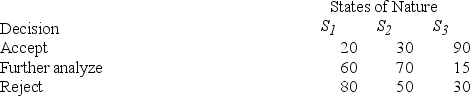 Based on historical data, if the lot is poor quality, 40 percent of the items are defective. If the lot is fair quality, 22 percent of the items are defective. If the lot is good quality, 10 percent of the items are defective. The quality control manager inspects one unit from a recent shipment. After inspecting it, he determines that the unit is defective. Based on this additional information, determine the revised (posterior) probabilities for each of the three states of nature.
 (Short Answer)
4.8/5 (84)
(84) The quality control manager for NKA Inc. must decide whether to accept (alternative 1), further analyze (alternative 2), or reject (alternative 3) an incoming shipment (lot) of microchips. The historical data indicate that there is a 30 percent chance that the lot is poor quality (S1), 50 percent chance that the lot is fair quality (S2), and 20 percent chance that the lot is good quality (S3). Assume the following payoff table is available. The values in the payoff table are in thousands of dollars.
 What alternative action should be selected according to the maximin criterion?
 (Short Answer)
4.8/5 (75)
(75) When we use the expected monetary value criterion, the expected payoff equals the actual payoff that will be realized.
(True/False)
4.8/5 (85)
(85) Alternatives 1 and 2 in the following payoff table represent the two possible manufacturing strategies that the EKA manufacturing company can adopt. The level of demand affects the success of both strategies. The states of nature (SI) represent the levels of demand for the company products. S1, S2, and S3 characterize high, medium, and low demand, respectively. The payoff values are in thousands of dollars.
 Determine the best alternative (course of action) for the EKA manufacturing company using the maximax criterion.
 (Short Answer)
4.8/5 (91)
(91) The quality control manager for NKA Inc. must decide whether to accept (alternative 1), further analyze (alternative 2), or reject (alternative 3) an incoming shipment (lot) of microchips. The historical data indicate that there is a 30 percent chance that the lot is poor quality (S1), 50 percent chance that the lot is fair quality (S2), and 20 percent chance that the lot is good quality (S3). Assume the following payoff table is available. The values in the payoff table are in thousands of dollars.
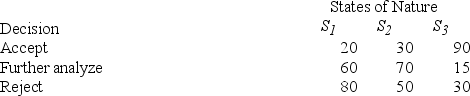 Based on historical data, if the lot is poor quality, 40 percent of the items are defective. If the lot is fair quality, 22 percent of the items are defective. If the lot is good quality, 10 percent of the items are defective. The quality control manager inspects one unit from a recent shipment. After inspecting it, he determines that the unit is not defective. Based on this additional information, determine the revised (posterior) probabilities for each of the three states of nature.
 (Short Answer)
4.7/5 (76)
(76) The ________ curve of an individual decision maker is a plot of their utilities versus the profits.
(Multiple Choice)
4.9/5 (79)
(79) A decision maker's expected utility is based upon his/her attitude toward risk.
(True/False)
4.8/5 (92)
(92) 
Filters
- Essay(0)
- Multiple Choice(0)
- Short Answer(0)
- True False(0)
- Matching(0)