



 Chat with AI
Exam 2: The Derivative

Exam 1: Limits and Continuity186 Questions
Exam 2: The Derivative198 Questions
Exam 3: Topics in Deifferentiation171 Questions
Exam 4: The Derivative in Graphing and Applications656 Questions
Exam 5: Integration323 Questions
Exam 6: Applications of the Definite Integral in Geometry, Science and Engineering314 Questions
Exam 7: Principle of Integral Evaluation269 Questions
Exam 8: Mathematical Modeling With Differential Equations77 Questions
Exam 9: Infinte Series288 Questions
Exam 10: Parametric and Polar Curves; Conic Sections199 Questions
Exam 11: Three-Dimensional Space; Vectors173 Questions
Exam 12: Vector-Valued Functions147 Questions
Exam 13: Partial Derivatives194 Questions
Exam 14: Multiple Integrals117 Questions
Exam 15: Topics in Vector Calculus149 Questions
Select questions type


A rock is dropped from a height of 400 feet and falls toward the earth in a straight line. In t seconds, the rock drops a distance of s = 16t2 feet. What is the average velocity of the rock while it is falling? Use limits to find the instantaneous velocity of the rock when it hits the ground.
(Essay)
4.8/5  (86)
(86) Let  . Find the average rate of change of y with respect to x over the interval [3, 5].
 (Essay)
4.8/5 (86)
(86)  ,

 .
Find the average rate of change of y with respect to x for 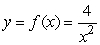 over the interval [1, 8].
 (Multiple Choice)
4.8/5 (75)
(75) Answer true or false. If f, g, and h are differentiable functions, and h 0 anywhere on its domain, then 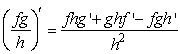 .
. (True/False)
5.0/5 (79)
(79)  .
Answer true or false. A graphing utility will show that 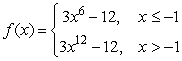 is differentiable at x = -1.
 (True/False)
4.8/5 (74)
(74) Find the instantaneous rate of change of f(x) = -2x4 - 11 at x0 = 2.
(Short Answer)
4.9/5 (73)
(73) A rock at an elevation angle of is falling in a straight line. If at a given instant it has an angle of elevation of =  and is a horizontal distance s from an observer, find the rate at which the rock is falling with respect to .
 (Multiple Choice)
4.9/5 (72)
(72)  if y =
g(x) = x4f(x). Find g'(4), given that f(4) = 3 and f '(4) = 6.
(Multiple Choice)
5.0/5 (72)
(72)  if y =
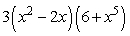 .
The surface area of a sphere is given by S = 4 r2 where r is the radius of the sphere. Use the method of Section 3.2 to find the instantaneous rate of change of S with respect to r when r = 2.
(Essay)
4.7/5 (82)
(82) Use a graphing utility to show that  does not have a derivative at x = 0.
 (Essay)
4.9/5 (86)
(86) Sketch the graph of the derivative of the function whose graph is shown. 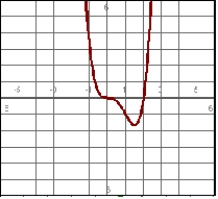
(Essay)
4.9/5 (78)
(78) 
Filters
- Essay(0)
- Multiple Choice(0)
- Short Answer(0)
- True False(0)
- Matching(0)