



 Chat with AI
Exam 11: Managing Aggregate Demand Fiscal Policy

Exam 1: What Is Economics226 Questions
Exam 2: The Economy Myth and Reality152 Questions
Exam 3: The Fundamental Economic Problem Scarcity and Choice250 Questions
Exam 4: Supply and Demand An Initial Look298 Questions
Exam 5: An Introduction To Macroeconomics215 Questions
Exam 6: The Goals Of Macroeconomic Policy211 Questions
Exam 7: Economic Growth Theory And Policy228 Questions
Exam 8: Aggregate Demand and The Powerful Consumer218 Questions
Exam 9: Demand Side Equilibrium Unemployment Or Inflation 212 Questions
Exam 10: Bringing In The Supply Side Unemployment and Inflation 228 Questions
Exam 11: Managing Aggregate Demand Fiscal Policy209 Questions
Exam 12: Money and The Banking System222 Questions
Exam 13: Monetary Policy Conventional and Unconventional204 Questions
Exam 14: The Financial Crisis and The Great Recession61 Questions
Exam 15: The Debate Over Monetary and Fiscal Policy215 Questions
Exam 16: Budget Deficits In The Short and Long Run210 Questions
Exam 17: The Trade Off Between Inflation and Unemployment219 Questions
Exam 18: International Trade and Comparative Advantage207 Questions
Exam 19: The International Monetary System Order Or Disorder 217 Questions
Exam 20: Exchange Rates and The Macroeconomy209 Questions
Select questions type


Do policy makers know the level of unemployment that is associated with "full employment"?
(Multiple Choice)
4.9/5  (64)
(64) Suppose that the U.S.personal income tax was eliminated and replaced with a fixed tax that raised the exact same amount of revenue.The multiplier would be
(Multiple Choice)
4.8/5 (75)
(75) The oversimplified formula for the multiplier is misleading because it ignores the effects of
(Multiple Choice)
4.9/5 (79)
(79) The macroeconomic policy planner's job is made difficult because of
(Multiple Choice)
4.8/5 (92)
(92) Fiscal policy is the use of taxes and spending by the government to affect aggregate demand.
(True/False)
4.9/5 (78)
(78) In 2006 and 2007 the U.S.faced an inflationary gap which would suggest the use of restrictive fiscal policy.
(True/False)
4.7/5 (79)
(79) Tax cuts associated with supply-side economics often lead to increased
(Multiple Choice)
4.7/5 (76)
(76) In order to maintain a balanced budget,Congress has decided to cut taxes and government spending both by $25 billion.What will happen to GDP?
(Multiple Choice)
4.7/5 (79)
(79) If the economy experiences an unplanned inventory accumulation at the full employment level of GDP,then the economy is in a(n)
(Multiple Choice)
4.8/5 (83)
(83) Explain how a "conservative" and a "liberal" might differ in the types of policies they advocate to counteract a recessionary gap.
(Essay)
4.8/5 (76)
(76) The president wishes to increase spending for education by $4 billion but also maintain a balanced budget.Therefore,taxes will also be increased by $4 billion.What will happen to GDP?
(Multiple Choice)
4.9/5 (65)
(65) The government's fiscal policy is its plan to influence aggregate demand by changing
(Multiple Choice)
4.8/5 (81)
(81) Figure 11-3 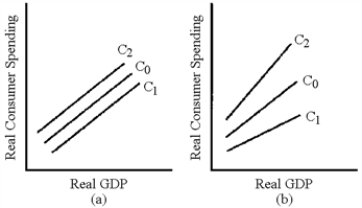 -Refer to Table 11-1.What is the level of consumption in this model?
 (Multiple Choice)
4.8/5 (75)
(75) A change in a fixed tax will cause the consumption schedule to
(Multiple Choice)
5.0/5 (86)
(86) Which of the following individuals would most likely favor an increase in government spending,as opposed to a tax cut,as the basis for expansionary fiscal policy?
(Multiple Choice)
4.8/5 (80)
(80) 
Filters
- Essay(0)
- Multiple Choice(0)
- Short Answer(0)
- True False(0)
- Matching(0)