



 Chat with AI
Exam 16: Budget Deficits In The Short and Long Run

Exam 1: What Is Economics226 Questions
Exam 2: The Economy Myth and Reality152 Questions
Exam 3: The Fundamental Economic Problem Scarcity and Choice250 Questions
Exam 4: Supply and Demand An Initial Look298 Questions
Exam 5: An Introduction To Macroeconomics215 Questions
Exam 6: The Goals Of Macroeconomic Policy211 Questions
Exam 7: Economic Growth Theory And Policy228 Questions
Exam 8: Aggregate Demand and The Powerful Consumer218 Questions
Exam 9: Demand Side Equilibrium Unemployment Or Inflation 212 Questions
Exam 10: Bringing In The Supply Side Unemployment and Inflation 228 Questions
Exam 11: Managing Aggregate Demand Fiscal Policy209 Questions
Exam 12: Money and The Banking System222 Questions
Exam 13: Monetary Policy Conventional and Unconventional204 Questions
Exam 14: The Financial Crisis and The Great Recession61 Questions
Exam 15: The Debate Over Monetary and Fiscal Policy215 Questions
Exam 16: Budget Deficits In The Short and Long Run210 Questions
Exam 17: The Trade Off Between Inflation and Unemployment219 Questions
Exam 18: International Trade and Comparative Advantage207 Questions
Exam 19: The International Monetary System Order Or Disorder 217 Questions
Exam 20: Exchange Rates and The Macroeconomy209 Questions
Select questions type


Figure 16-3 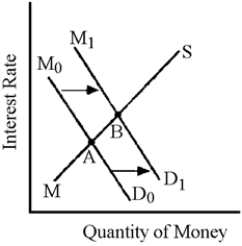 -If budget deficits shift the money demand curve as is illustrated in Figure 16-3,which component of total expenditures will be affected the most?
 (Multiple Choice)
4.7/5  (81)
(81) As GDP falls,automatic stabilizers run the federal budget in a deficit direction.
(True/False)
4.8/5 (78)
(78) In 2010,many politicians argued that the deficit should be reduced at all costs but many economists countered that deficit reduction would be problematic given the state of the economy.
(True/False)
4.9/5 (85)
(85) Which of the following is expected to increase aggregate demand in the short run?
(Multiple Choice)
4.9/5 (76)
(76) A budget deficit will be least inflationary if the aggregate
(Multiple Choice)
4.9/5 (75)
(75) If the U.S.government decides to eliminate a budget surplus by reducing taxes,the most likely effect would be
(Multiple Choice)
4.8/5 (82)
(82) Deficit spending will not cause much inflation if the economy is operating near full employment.
(True/False)
4.9/5 (87)
(87) The share of the net national debt owned by foreign individuals,businesses,and governments has steadily risen to 80%.
(True/False)
4.7/5 (82)
(82) The short-run effects of government's financial rescue program and fiscal stimulus package helped the economy increase aggregate demand curing the Great Recession.
(True/False)
4.8/5 (80)
(80) Economic principles suggest that we should focus on balancing the budget rather than balancing aggregate supply and aggregate demand.
(True/False)
5.0/5 (82)
(82) The principal difference between conventional accounting and economic analysis of inflation is that
(Multiple Choice)
4.9/5 (77)
(77) Figure 16-1  -In Figure 16-1,there are four levels of income.G is government expenditures and TT is taxes less transfers.Y3 is the full-employment level of income.At Y3
 (Multiple Choice)
4.8/5 (75)
(75) The strict crowding-out argument relies on the assumption that
(Multiple Choice)
4.8/5 (71)
(71) Figure 16-3
-Figure 16-3 shows the impact of deficit spending and the corresponding economic expansion on the demand curve for money.If the Federal Reserve does not want interest rates to rise,it will
-Figure 16-3 shows the impact of deficit spending and the corresponding economic expansion on the demand curve for money.If the Federal Reserve does not want interest rates to rise,it will (Multiple Choice)
4.8/5 (88)
(88) The federal budget went $161 billion in fiscal year 2007 to $1 trillion in the next two to three years.What are the main factors that contributed to this increase?
(Essay)
4.8/5 (89)
(89) E.Carey Brown,an MIT economist,studied government deficits during the Great Depression and found that even though actual deficits were large,the structural deficit changed very little.Which of the following statements is consistent with this finding?
(Multiple Choice)
4.8/5 (74)
(74) In 2010,the net national debt was about $9 trillion or approximately $29,000 per person.
(True/False)
4.8/5 (76)
(76) 
Filters
- Essay(0)
- Multiple Choice(0)
- Short Answer(0)
- True False(0)
- Matching(0)