



 Chat with AI
Exam 14: Energy Generation in Mitochondria and Chloroplasts

Exam 1: Cells: The Fundamental Units of Life64 Questions
Exam 2: Chemical Components of Cells74 Questions
Exam 3: Energy, Catalysis, and Biosynthesis73 Questions
Exam 4: Protein Structure and Function71 Questions
Exam 5: DNA and Chromosomes69 Questions
Exam 6: DNA Replication and Repair61 Questions
Exam 7: From DNA to Protein62 Questions
Exam 8: Control of Gene Expression68 Questions
Exam 9: How Genes and Genomes Evolve60 Questions
Exam 10: Analyzing the Structure and Function of Genes59 Questions
Exam 11: Membrane Structure57 Questions
Exam 12: Transport Across Cell Membranes67 Questions
Exam 13: How Cells Obtain Energy From Food71 Questions
Exam 14: Energy Generation in Mitochondria and Chloroplasts72 Questions
Exam 15: Intracellular Compartments and Protein Transport55 Questions
Exam 16: Cell Signaling60 Questions
Exam 17: Cytoskeleton59 Questions
Exam 18: The Cell-Division Cycle67 Questions
Exam 19: Sexual Reproduction and the Power of Genetics61 Questions
Exam 20: Cell Communities: Tissues, Stem Cells, and Cancer57 Questions
Select questions type


If you add a compound to illuminated chloroplasts that inhibits the NADP+ reductase, NADPH generation ceases, as expected.However, ferredoxin does not accumulate in the reduced form because it is able to donate its electrons not only to NADP+ (via NADP+ reductase) but also back to the cytochrome b6-f complex.Thus, in the presence of the compound, a "cyclic" form of photosynthesis occurs in which electrons flow in a circle from ferredoxin, to the cytochrome b6-f complex, to plastocyanin, to photosystem I, to ferredoxin.What will happen if you now also inhibit photosystem II?
(Multiple Choice)
5.0/5  (84)
(84) For each of the following sentences, fill in the blanks with the best word or phrase selected from the list below.Not all words or phrases will be used; each word or phrase should be used only once.
acetyl groups glucose NADPH carbon dioxide oxidative phosphorylation chemiosmosis oxygen fatty acids pyruvate
Mitochondria can use both __________ and __________ directly as fuel.__________ produced in the citric acid cycle donates electrons to the electron-transport chain.The citric acid cycle oxidizes __________ and produces __________ as a waste product.__________ acts as the final electron acceptor in the electron-transport chain.The synthesis of ATP in mitochondria is also known as __________.
(Essay)
4.7/5 (79)
(79) In 1925, David Keilin used a simple spectroscope to observe the characteristic absorption bands of the cytochromes that participate in the electron-transport chain in mitochondria.A spectroscope passes a very bright light through the sample of interest and then through a prism to display the spectrum from red to blue.If molecules in the sample absorb light of particular wavelengths, dark bands will interrupt the colors of the rainbow.His key discovery was that the absorption bands disappeared when oxygen was introduced and then reappeared when the samples became anoxic.Subsequent findings demonstrated that different cytochromes absorb light of different frequencies.When light of a characteristic wavelength shines on a mitochondrial sample, the amount of light absorbed is proportional to the amount of a particular cytochrome present in its reduced form.Thus, spectrophotometric methods can be used to measure how the amounts of reduced cytochromes change over time in response to various treatments.If isolated mitochondria are incubated with a source of electrons such as succinate, but without oxygen, electrons enter the respiratory chain, reducing each of the electron carriers almost completely.When oxygen is then introduced, the carriers oxidize at different rates, as can be seen from the decline in the amount of reduced cytochrome (see Figure 14-27).Note that cytochromes a1 and a3 cannot be distinguished and thus are listed as cytochrome (a1 + a3).How does this result allow you to order the electron carriers in the respiratory chain? What is their order? 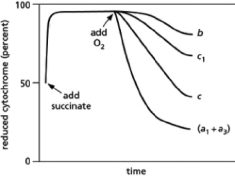 Figure 14-27
 (Essay)
4.8/5 (80)
(80) Cytochrome c oxidase is an enzyme complex that uses metal ions to help coordinate the transfer of four electrons to O2.Which metal atoms are found in the active site of this complex?
(Multiple Choice)
5.0/5 (71)
(71) Bongkrekic acid is an antibiotic that inhibits the ATP/ADP transport protein in the inner mitochondrial membrane.Which of the following will allow electron transport to occur in mitochondria treated with bongkrekic acid?
(Multiple Choice)
4.7/5 (94)
(94) Human infants have a much larger portion of brown adipose tissue than adult humans.It was found that the mitochondria in brown adipocytes (brown fat cells) have a novel protein in the inner mitochondrial membrane.This protein, called the uncoupling protein (UCP), was found to transport protons from the intermembrane space into the matrix.
A.What is the impact of UCP on oxidative phosphorylation in the mitochondria of brown fat?
B.Propose an explanation for the higher proportion of brown fat cells in infants compared to adults.
(Essay)
4.7/5 (84)
(84) Name the mitochondrial localization of each of the following macromolecules.
A.porin proteins
B.mitochondrial chromosome
C.citric acid cycle enzymes
D.electron-transport chain proteins
E.ATP synthase
F.pyruvate transporter
(Essay)
4.8/5 (74)
(74) During Stage 2 of oxidative phosphorylation, ATP synthesis is powered by movement of __________ ions through the __________.
(Multiple Choice)
4.8/5 (87)
(87) Indicate whether the following statements are TRUE or FALSE. If a statement is false, explain why it is false.
Correct Answer: Verified
Premises:
Responses:
(Matching)
4.9/5 (82)
(82) The photosystems in chloroplasts contain hundreds of chlorophyll molecules, most of which are part of
(Multiple Choice)
4.8/5 (88)
(88) Which of the following statements describes the mitochondrial inner membrane?
(Multiple Choice)
4.7/5 (74)
(74) Which of the following statements about mitochondrial division is TRUE?
(Multiple Choice)
4.7/5 (80)
(80) Porphyrin ring molecules are critical both for oxidative phosphorylation in the mitochondria and for photosynthesis in chloroplasts.Compare and contrast the role of this type of molecule in each process and explain the roles of O2 and H2O in each.
(Essay)
4.8/5 (84)
(84) Which of the following statements about cytochrome c is TRUE?
(Multiple Choice)
4.9/5 (76)
(76) The mitochondrial ATP synthase consists of several different protein subunits.Which subunit binds to ADP + Pi and catalyzes the synthesis of ATP as a result of a conformational change?
(Multiple Choice)
4.8/5 (76)
(76) In stage 1 of photosynthesis, a proton gradient is generated and ATP is synthesized.Where do protons become concentrated in the chloroplast?
(Multiple Choice)
4.7/5 (85)
(85) Which of the following statements describes the mitochondrial matrix?
(Multiple Choice)
4.9/5 (76)
(76) Describe the steps by which the F0 portion of the ATP synthase harnesses the proton-motive force to help synthesize ATP.What would you expect to observe if the proton gradient were reversed? Explain your answer.
(Essay)
4.9/5 (86)
(86) Indicate whether the following statements are TRUE or FALSE.If a statement is false, explain why it is false.
Correct Answer:Verified
VerifiedPremises:
Responses:
(Matching)
4.9/5 (76)
(76) 
Filters
- Essay(0)
- Multiple Choice(0)
- Short Answer(0)
- True False(0)
- Matching(0)