



 Chat with AI
Exam 12: Transport Across Cell Membranes

Exam 1: Cells: The Fundamental Units of Life64 Questions
Exam 2: Chemical Components of Cells74 Questions
Exam 3: Energy, Catalysis, and Biosynthesis73 Questions
Exam 4: Protein Structure and Function71 Questions
Exam 5: DNA and Chromosomes69 Questions
Exam 6: DNA Replication and Repair61 Questions
Exam 7: From DNA to Protein62 Questions
Exam 8: Control of Gene Expression68 Questions
Exam 9: How Genes and Genomes Evolve60 Questions
Exam 10: Analyzing the Structure and Function of Genes59 Questions
Exam 11: Membrane Structure57 Questions
Exam 12: Transport Across Cell Membranes67 Questions
Exam 13: How Cells Obtain Energy From Food71 Questions
Exam 14: Energy Generation in Mitochondria and Chloroplasts72 Questions
Exam 15: Intracellular Compartments and Protein Transport55 Questions
Exam 16: Cell Signaling60 Questions
Exam 17: Cytoskeleton59 Questions
Exam 18: The Cell-Division Cycle67 Questions
Exam 19: Sexual Reproduction and the Power of Genetics61 Questions
Exam 20: Cell Communities: Tissues, Stem Cells, and Cancer57 Questions
Select questions type


It is thought that the glucose transporter switches between two conformational states in a completely random fashion.How is it possible for such a system to move glucose across the membrane efficiently in a single direction?
(Essay)
5.0/5  (74)
(74) Figure 12-32 illustrates changes in membrane potential during the formation of an action potential.What membrane characteristic or measurement used to study action potentials is indicated by the arrow? 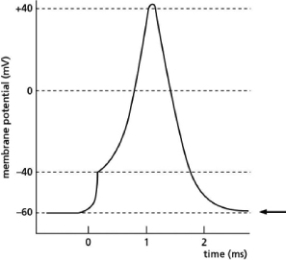 Figure 12-32
 (Multiple Choice)
4.7/5 (76)
(76) Voltage-gated channels contain charged protein domains, which are sensitive to changes in membrane potential.By responding to a threshold in the membrane potential, these voltage sensors trigger the opening of the channels.Which of the following best describes the behavior of a population of channels exposed to such a threshold?
(Multiple Choice)
5.0/5 (89)
(89) For each of the following sentences, fill in the blanks with the best word or phrase selected from the list below.Not all words or phrases will be used; each word or phrase should be used only once.
acetylcholine receptor GABA receptor postsynaptic channels channels presynaptic chemical channels synapses electrical
Neurons communicate with each other through specialized sites called __________.Many neurotransmitter receptors are ligand-gated ion channels that open transiently in the __________ cell membrane in response to neurotransmitters released by the __________ cell.Ligand-gated ion channels in nerve cell membranes convert __________ signals into __________ ones.Neurotransmitter release is stimulated by the opening of voltage-gated __________ in the nerve-terminal membrane.
(Essay)
4.8/5 (70)
(70) K+ leak channels are found in the plasma membrane.These channels open and close in an unregulated, random fashion.What do they accomplish in a resting cell?
(Multiple Choice)
4.8/5 (83)
(83) Active transport requires the input of energy into a system so as to move solutes against their electrochemical and concentration gradients.Which of the following is NOT one of the common ways to perform active transport?
(Multiple Choice)
4.9/5 (72)
(72) For each of the following sentences, fill in the blanks with the best word or phrase selected from the list below.Not all words or phrases will be used; each word or phrase should be used only once.
antiport coupled membrane potential ATP hydrolysis electrochemical symport concentration light-driven uniport
For an uncharged molecule, the direction of passive transport across a membrane is determined solely by its __________ gradient.On the other hand, for a charged molecule, the __________ must also be considered.The net driving force for a charged molecule across a membrane therefore has two components and is referred to as the __________ gradient.Active transport allows the movement of solutes against this gradient.The transporter proteins called __________ transporters use the movement of one solute down its gradient to provide the energy to drive the uphill transport of a second solute.When this transporter moves both ions in the same direction across the membrane, it is considered a/an __________; if the ions move in opposite directions, the transporter is considered a/an __________.
(Essay)
4.9/5 (75)
(75) The stimulation of a motor neuron ultimately results in the release of a neurotransmitter at the synapse between the neuron and a muscle cell.How is the chemical signal converted into an electrical signal in the postsynaptic muscle cell?
(Essay)
4.9/5 (82)
(82) You have prepared lipid vesicles (spherical lipid bilayers) that contain Na+-K+ pumps as the sole membrane protein.All of the Na+-K+ pumps are oriented in such a way that the portion of the molecule that normally faces the cytosol is on the inside of the vesicle and the portion of the molecule that normally faces the extracellular space is on the outside of the vesicle.Assume that each pump transports one Na+ ion in one direction and one K+ ion in the other direction during each pumping cycle (see Figure 12-27 for how the Na+-K+ pump normally functions in the plasma membrane). 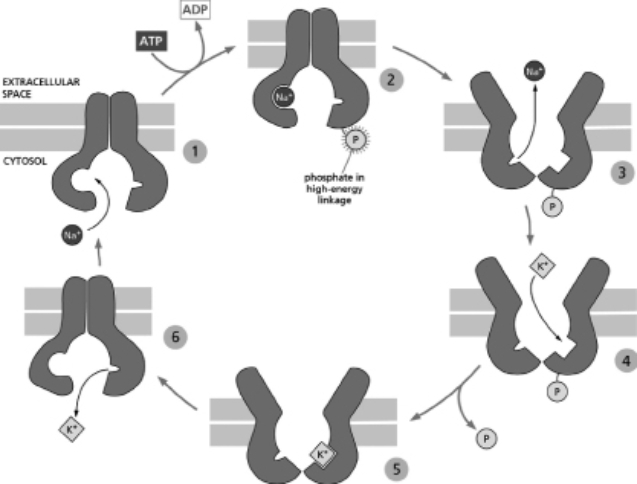 Figure 12-27
Predict what would happen in each of the following conditions:
A.The solutions inside and outside the vesicles contain both Na+ and K+ ions but no ATP.
B.The solution outside the vesicles contains both Na+ and K+ ions; the solution inside contains both Na+ and K+ ions and ATP.
C.The solution outside contains Na+; the solution inside contains Na+ and ATP.
Figure 12-27
Predict what would happen in each of the following conditions:
A.The solutions inside and outside the vesicles contain both Na+ and K+ ions but no ATP.
B.The solution outside the vesicles contains both Na+ and K+ ions; the solution inside contains both Na+ and K+ ions and ATP.
C.The solution outside contains Na+; the solution inside contains Na+ and ATP. (Essay)
4.9/5 (84)
(84) Figure 12-33 illustrates changes in membrane potential during the formation of an action potential.What membrane characteristic or measurement used to study action potentials is indicated by the arrow? 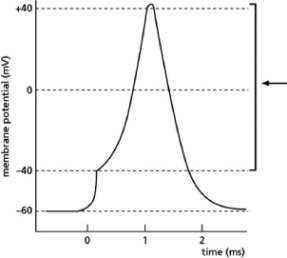 Figure 12-33
 (Multiple Choice)
4.9/5 (72)
(72) Describe the two forces that drive an ion across the plasma membrane and explain how the Nernst equation takes into account both of these forces.Use the components of the equation to support your explanation and be sure to specify the assumptions being made when using the Nernst equation to calculate membrane potential.
(Essay)
4.7/5 (83)
(83) Figure 12-31 illustrates changes in membrane potential during the formation of an action potential.What membrane characteristic or measurement used to study action potentials is indicated by the arrow? 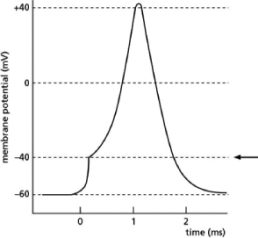 Figure 12-31
 (Multiple Choice)
4.7/5 (74)
(74) Both excitatory and inhibitory neurons form junctions with muscles.By what mechanism do inhibitory neurotransmitters prevent the postsynaptic cell from firing an action potential?
(Multiple Choice)
4.9/5 (82)
(82) Define homeostasis and illustrate your understanding of this concept by describing the mechanism of one transmembrane transport protein and how it contributes to homeostasis.
(Essay)
4.8/5 (90)
(90) For each of the following sentences, fill in the blanks with the best word or phrase selected from the list below.Not all words or phrases will be used; each word or phrase should be used only once.
anions hyperpolarization neutral axon less positive cytoskeleton ligand pressure dendrites more synaptic vesicle depolarization negative voltage
The action potential is a wave of __________ that spreads rapidly along the neuronal plasma membrane.This wave is triggered by a local change in the membrane potential to a value that is __________ negative than the resting membrane potential.The action potential is propagated by the opening of __________-gated channels.During an action potential, the membrane potential changes from __________ to __________.The action potential travels along the neuron's __________ to the nerve terminals.Neurons chiefly receive signals at their highly branched __________.
(Essay)
4.9/5 (84)
(84) Ca2+-pumps in the plasma membrane and endoplasmic reticulum are important for
(Multiple Choice)
4.8/5 (95)
(95) A hungry yeast cell lands in a vat of grape juice and begins to feast on the sugars there, producing carbon dioxide and ethanol in the process:
C6H12O6 + 2ADP + 2Pi + H+ → 2CO2 + 2CH3CH2OH + 2ATP + 2H2O
Unfortunately, the grape juice is contaminated with proteases that attack some of the transport proteins in the yeast cell membrane, and the yeast cell dies.Which of the following is the most likely cause of the yeast cell's demise?
(Multiple Choice)
4.9/5 (74)
(74) The Nernst equation can be used to calculate the membrane potential based on the ratio of the outer and inner ion concentration.In a resting cell, membrane potential is calculated taking only K+ ions into account.What is V when Co = 15 mM and Ci = 106 mM?
(Multiple Choice)
4.8/5 (91)
(91) Figure 12-34 illustrates changes in membrane potential during the formation of an action potential.What membrane characteristic or measurement used to study action potentials is indicated by the arrow? 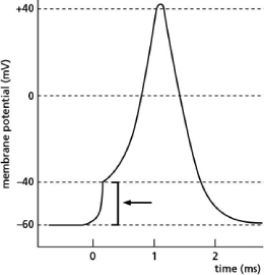 Figure 12-34
 (Multiple Choice)
4.9/5 (85)
(85) Which of the following channels would not be expected to generate a change in voltage by movement of its substrate across the membrane where it is found?
(Multiple Choice)
4.9/5 (72)
(72) 
Filters
- Essay(0)
- Multiple Choice(0)
- Short Answer(0)
- True False(0)
- Matching(0)