



 Chat with AI
Exam 11: Membrane Structure

Exam 1: Cells: The Fundamental Units of Life64 Questions
Exam 2: Chemical Components of Cells74 Questions
Exam 3: Energy, Catalysis, and Biosynthesis73 Questions
Exam 4: Protein Structure and Function71 Questions
Exam 5: DNA and Chromosomes69 Questions
Exam 6: DNA Replication and Repair61 Questions
Exam 7: From DNA to Protein62 Questions
Exam 8: Control of Gene Expression68 Questions
Exam 9: How Genes and Genomes Evolve60 Questions
Exam 10: Analyzing the Structure and Function of Genes59 Questions
Exam 11: Membrane Structure57 Questions
Exam 12: Transport Across Cell Membranes67 Questions
Exam 13: How Cells Obtain Energy From Food71 Questions
Exam 14: Energy Generation in Mitochondria and Chloroplasts72 Questions
Exam 15: Intracellular Compartments and Protein Transport55 Questions
Exam 16: Cell Signaling60 Questions
Exam 17: Cytoskeleton59 Questions
Exam 18: The Cell-Division Cycle67 Questions
Exam 19: Sexual Reproduction and the Power of Genetics61 Questions
Exam 20: Cell Communities: Tissues, Stem Cells, and Cancer57 Questions
Select questions type


Indicate whether the following statements are TRUE or FALSE.If a statement is false, explain why it is false.
Correct Answer: Verified
Premises:
Responses:
(Matching)
4.9/5  (80)
(80) Cholesterol can either make membranes more rigid or more fluid.Explain how this is possible.
(Essay)
4.8/5 (68)
(68) In the photosynthetic archaean Halobacterium halobium, a membrane transport protein called bacteriorhodopsin captures energy from sunlight and uses it to pump protons out of the cell.The resulting proton gradient serves as an energy store that can later be tapped to generate ATP.Which statement best describes how bacteriorhodopsin operates?
(Multiple Choice)
4.9/5 (88)
(88) Which of the following substances is most commonly used to help purify a membrane protein?
(Multiple Choice)
4.9/5 (71)
(71) Which of the following statements about the carbohydrate coating of the cell surface is FALSE?
(Multiple Choice)
4.9/5 (74)
(74) Consider the apical location of a particular protein expressed in epithelial cells, illustrated in part A of Figure 11-35.Which type of defect described below is the most likely to cause the redistribution of that protein around the entire cell, shown in part B of Figure 11-35 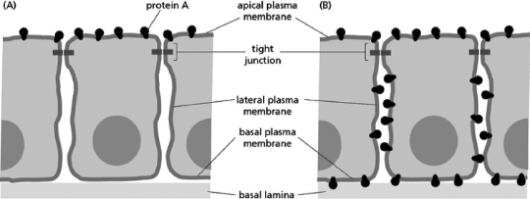 Figure 11-35
 (Multiple Choice)
4.9/5 (91)
(91) Water molecules readily form hydrogen bonds with other polar molecules, and when they encounter nonpolar molecules they must form hydrogen-bonding networks with neighboring water molecules.Which of the following molecules will cause a "cage" of water to form?
(Multiple Choice)
4.9/5 (78)
(78) For each of the following sentences, fill in the blanks with the best word or phrase selected from the list below.Not all words or phrases will be used; each word or phrase should be used only once.
amphipathic hydrophobic phosphatidylserine cholesterol lipid bilayer phospholipids fatty acid tails lipid monolayer proteins glycolipids lipids sterols hydrophilic head groups phosphatidylcholine sugars
The specialized functions of different membranes are largely determined by the __________ they contain.Membrane lipids are __________ molecules, composed of a hydrophilic portion and a hydrophobic portion.All cell membranes have the same __________ structure, with the __________ of the phospholipids facing into the interior of the membrane and the __________ on the outside.The most common lipids in most cell membranes are the __________.The head group of a glycolipid is composed of __________.
(Essay)
4.8/5 (74)
(74) Where does most new membrane synthesis take place in a eukaryotic cell?
(Multiple Choice)
4.8/5 (77)
(77) Both glycoproteins and proteoglycans contribute to the carbohydrate layer on the surface of the cell.Which of the following statements about glycoproteins is FALSE?
(Multiple Choice)
5.0/5 (86)
(86) Plasma membranes are extremely thin and fragile, requiring an extensive support network of fibrous proteins.This network is called the
(Multiple Choice)
4.8/5 (86)
(86) Which of the following membrane lipids does not contain a fatty acid tail?
(Multiple Choice)
4.9/5 (79)
(79) Indicate whether the following statements are TRUE or FALSE.If a statement is false, explain why it is false.
Correct Answer:Verified
VerifiedPremises:
Responses:
(Matching)
4.9/5 (86)
(86) Explain the reasons why membrane proteins are more difficult to isolate and purify for in vitro studies compared to cytosolic proteins.
(Essay)
4.9/5 (77)
(77) Which of the following phospholipid precursors is the most hydrophobic?
(Multiple Choice)
4.8/5 (74)
(74) A group of membrane proteins can be extracted from membranes only by using detergents.All the proteins in this group have a similar amino acid sequence at their C-terminus: -KKKKKXXC (where K stands for lysine, X stands for any amino acid, and C stands for cysteine).This sequence is essential for their attachment to the membrane.What is the most likely way in which the C-terminal sequence attaches these proteins to the membrane?
(Multiple Choice)
4.8/5 (74)
(74) Sodium dodecyl sulfate (SDS) and Triton X-100 are both detergents that can be used to lyse cells to study individual components.Your first project as a Ph.D.student is to create an in vitro model that allows you to study the mechanism of action of a novel glucose transporter protein.You use SDS to lyse the cells.Later experiments demonstrate that the transporter is not functional.Provide a possible explanation for what happened, propose a solution for your next experiment, and articulate the reasons you think the new method will be more successful.
(Essay)
4.8/5 (86)
(86) 
Filters
- Essay(0)
- Multiple Choice(0)
- Short Answer(0)
- True False(0)
- Matching(0)