



 Chat with AI
Exam 9: How Genes and Genomes Evolve

Exam 1: Cells: The Fundamental Units of Life64 Questions
Exam 2: Chemical Components of Cells74 Questions
Exam 3: Energy, Catalysis, and Biosynthesis73 Questions
Exam 4: Protein Structure and Function71 Questions
Exam 5: DNA and Chromosomes69 Questions
Exam 6: DNA Replication and Repair61 Questions
Exam 7: From DNA to Protein62 Questions
Exam 8: Control of Gene Expression68 Questions
Exam 9: How Genes and Genomes Evolve60 Questions
Exam 10: Analyzing the Structure and Function of Genes59 Questions
Exam 11: Membrane Structure57 Questions
Exam 12: Transport Across Cell Membranes67 Questions
Exam 13: How Cells Obtain Energy From Food71 Questions
Exam 14: Energy Generation in Mitochondria and Chloroplasts72 Questions
Exam 15: Intracellular Compartments and Protein Transport55 Questions
Exam 16: Cell Signaling60 Questions
Exam 17: Cytoskeleton59 Questions
Exam 18: The Cell-Division Cycle67 Questions
Exam 19: Sexual Reproduction and the Power of Genetics61 Questions
Exam 20: Cell Communities: Tissues, Stem Cells, and Cancer57 Questions
Select questions type


Transposable elements litter the genomes of primates, and a few of them are still capable of moving to new regions of the genome.If a transposable element jumped into an important gene in one of your cells when you were a baby and caused a disease, is it likely that your child would also have the disease? Explain.
(Essay)
4.7/5  (85)
(85) The spontaneous mutation rate in E.coli was determined to be 1 mistake for every 109 nucleotides copied.This was determined by measuring the frequency of a particular AT-to-GC change.This was accomplished using a strain of E.coli that started out unable to produce histidine (His-) because of an inserted UGA stop codon that disrupted the region coding for an enzyme required to produce histidine.When a spontaneous mutation arose that enabled the UGA stop codon to code for tryptophan, the E.coli cells were then able to produce the enzyme required for histidine production.
You discover that if the stop codon were to change to code for cysteine (instead of tryptophan), this change would also allow the bacteria to produce histidine.How would the previously calculated spontaneous mutation rate of 1 mistake every 109 nucleotides copied change, given this new information? Explain.(The codon table is shown in Figure 9-48 to help you answer this question.)
U C A G UUU Phe (F) UCU Ser (S) UAU Tyr (Y) UGU Cys (C) UUC - UCC - UAC - UGC - U UUA Leu (L) UCA -- UAA Stop UGA Stop UUG - UCG - UAG Stop UGG Trp (W) CUU Leu (L) CCU Pro (P) CAU His (H) CGU Arg (R) CUC - CCC - CAC - CGC - C CUA - CCA - CAA Gin (Q) CGA - CUG - CCG - CAG - CGG - AUU Ile (I) ACU Thr (T) AAU Asn (N) AGU Ser (S) AUC - ACC - AAC - AGC - A AUA - ACA - AAA Lys (K) AGA Arg (R) AUG Met (M) ACG - AAG - AGG - GUU Val (V) GCU Ala (A) GAU Asp (D) GGU Gly (G) GUC - GCC - GAC - GGC - G GUA - GCA - GAA Glu (E) GGA - GUG - GCG - GAG - GGG -
Figure 9-48
(Essay)
4.9/5 (73)
(73) Figure 9-17 shows the nucleotide sequence from a protein-coding region of a gene in humans, chimpanzees, and gorillas and the protein sequence produced from this gene.The seventeen amino acids encoded by this DNA are numbered below.The two codons that are not conserved in all three species have been boxed.These two codons code for amino acids 3 and 15.  Figure 9-17
Which of these statements is consistent with these sequence-comparison data?
Figure 9-17
Which of these statements is consistent with these sequence-comparison data? (Multiple Choice)
4.9/5 (79)
(79) Which of the following statements about homologous genes is TRUE?
(Multiple Choice)
4.9/5 (77)
(77) Which of the following is the least likely to be a selectively neutral mutation? (The codon table in Figure 9-14 will help you answer this question.)
U C A G UUU Phe (F) UCU Ser (S) UAU Tyr (Y) UGU Cys (C) UUC - UCC - UAC - UGC - U UUA Leu (L) UCA -- UAA Stop UGA Stop UUG - UCG - UAG Stop UGG Trp (W) CUU Leu (L) CCU Pro (P) CAU His (H) CGU Arg (R) CUC - CCC - CAC - CGC - C CUA - CCA - CAA Gin (Q) CGA - CUG - CCG - CAG - CGG - AUU Ile (I) ACU Thr (T) AAU Asn (N) AGU Ser (S) AUC - ACC - AAC - AGC - A AUA - ACA - AAA Lys (K) AGA Arg (R) AUG Met (M) ACG - AAG - AGG - GUU Val (V) GCU Ala (A) GAU Asp (D) GGU Gly (G) GUC - GCC - GAC - GGC - G GUA - GCA - GAA Glu (E) GGA - GUG - GCG - GAG - GGG - Table 9-14
(Multiple Choice)
4.8/5 (88)
(88) Figure 9-12 shows the evolutionary history of the globin gene family members. 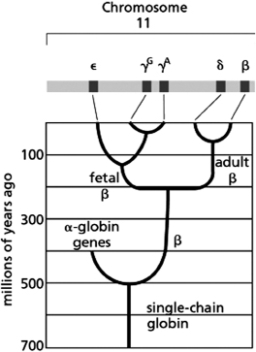 Figure 9-12
Given this information, which of the following statements is TRUE?
Figure 9-12
Given this information, which of the following statements is TRUE? (Multiple Choice)
4.8/5 (70)
(70) Which of the following DNA sequences is NOT commonly carried on a DNA-only transposon?
(Multiple Choice)
5.0/5 (87)
(87) Which of the following is true of a retrovirus, but NOT of the Alu retrotransposon?
(Multiple Choice)
4.8/5 (77)
(77) The human genome has 3.2 × 10⁹ nucleotide pairs.At its peak, the Human Genome Project was generating raw nucleotide sequences at a rate of 1000 nucleotides per second.At the rate of 1000 nucleotides per second, how long would it take to generate 3.2 × 10⁹ nucleotides of sequence?
(Essay)
4.9/5 (62)
(62) Which of the following changes is least likely to arise from a point mutation in a regulatory region of a gene?
(Multiple Choice)
4.9/5 (80)
(80) The genomes of some vertebrates are much smaller than those of others.For example, the genome of the pufferfish Fugu is much smaller than the human genome, and even much smaller than genomes of other fish, primarily because of the small size of its introns.
A.Describe a mechanism that might drive evolution toward small introns or loss of introns and could therefore account for the evolutionary loss of introns according to the "introns early" hypothesis.
B.Describe a mechanism that might drive evolution toward more or larger introns and could thereby account for the evolutionary appearance of introns according to the "introns late" hypothesis.
(Essay)
4.9/5 (86)
(86) Your friend works in a lab that is studying why a particular mutant strain of Drosophila grows an eye on its wing.Your friend discovers that this mutant strain of Drosophila is expressing a transcription factor incorrectly.In the mutant Drosophila, this transcription factor, which is normally expressed in the primordial eye tissue, is now misexpressed in the primordial wing tissue, thus turning on transcription of the set of genes required to produce an eye in the wing primordial tissue.If this hypothesis is true, which of the following types of genetic change would most likely lead to this situation?
(Multiple Choice)
5.0/5 (72)
(72) You discover that the underlying cause of a disease is a protein that is now less stable than the non-disease-causing version of the protein.This change is most likely to be due to
(Multiple Choice)
4.9/5 (80)
(80) An SNP found in the conserved sequence of the regulatory region of a gene is likely to
(Multiple Choice)
4.9/5 (84)
(84) For each statement below, indicate whether it is TRUE or FALSE, and explain why.
Correct Answer: Verified
Premises:
Responses:
(Matching)
4.9/5 (81)
(81) For each of the following sentences, fill in the blanks with the best word or phrase selected from the list below.Not all words or phrases will be used; each word or phrase should be used only once.
0.5 1.5 3 4 9 23 30 50 75
The human genome has ~3 × 10__________ nucleotide pairs that make up the sequence of __________ sets of chromosomes.We estimate that this sequence encodes approximately 1.9 × 10 __________ protein-coding genes and about 5 × 10__________ non-protein-coding genes, which include structural catalytic, and regulatory RNAs.Approximately __________% of the human genome is made up of high-copy repetitive elements, while the percentage of DNA sequence in protein-coding exons is __________%.
(Essay)
4.7/5 (77)
(77) What is the most likely explanation of why the overall mutation rates in bacteria and in humans are roughly similar?
(Multiple Choice)
4.8/5 (83)
(83) 
Filters
- Essay(0)
- Multiple Choice(0)
- Short Answer(0)
- True False(0)
- Matching(0)