



 Chat with AI
Exam 5: DNA and Chromosomes

Exam 1: Cells: The Fundamental Units of Life64 Questions
Exam 2: Chemical Components of Cells74 Questions
Exam 3: Energy, Catalysis, and Biosynthesis73 Questions
Exam 4: Protein Structure and Function71 Questions
Exam 5: DNA and Chromosomes69 Questions
Exam 6: DNA Replication and Repair61 Questions
Exam 7: From DNA to Protein62 Questions
Exam 8: Control of Gene Expression68 Questions
Exam 9: How Genes and Genomes Evolve60 Questions
Exam 10: Analyzing the Structure and Function of Genes59 Questions
Exam 11: Membrane Structure57 Questions
Exam 12: Transport Across Cell Membranes67 Questions
Exam 13: How Cells Obtain Energy From Food71 Questions
Exam 14: Energy Generation in Mitochondria and Chloroplasts72 Questions
Exam 15: Intracellular Compartments and Protein Transport55 Questions
Exam 16: Cell Signaling60 Questions
Exam 17: Cytoskeleton59 Questions
Exam 18: The Cell-Division Cycle67 Questions
Exam 19: Sexual Reproduction and the Power of Genetics61 Questions
Exam 20: Cell Communities: Tissues, Stem Cells, and Cancer57 Questions
Select questions type


A.Define a "gene."
B.Consider two different species of yeast that have similar genome sizes.Is it likely that they contain the same number of genes? A similar number of chromosomes?
(Essay)
4.9/5  (85)
(85) Indicate whether the following statements are TRUE or FALSE.If a statement is false, explain why it is false.
Correct Answer: Verified
Premises:
Responses:
(Matching)
4.8/5 (68)
(68) Avery, MacLeod, and McCarty carried out experiments to identify the class of biological molecule that carries heritable information.Explain how they identified the "transforming principle" that could convert a harmless strain of bacteria to a pathogenic one.
(Essay)
4.8/5 (80)
(80) Explain the differences between chromosome painting and the older, more traditional method of staining chromosomes being prepared for karyotyping.Highlight the way in which each method identifies chromosomes by the unique sequences they contain.
(Essay)
4.7/5 (84)
(84) Which of the following best describes the mechanism by which chromatin-remodeling complexes "loosen" the DNA wrapped around the core histones?
(Multiple Choice)
4.8/5 (62)
(62) Specific regions of eukaryotic chromosomes contain sequence elements that are absolutely required for the proper transmission of genetic information from a mother cell to each daughter cell.Which of the following is NOT known to be one of these required elements in eukaryotes?
(Multiple Choice)
4.8/5 (83)
(83) The process of sorting human chromosome pairs by size and morphology is called karyotyping.A modern method employed for karyotyping is called chromosome painting.How are individual chromosomes "painted"?
(Multiple Choice)
4.8/5 (88)
(88) Many of the breakthroughs in modern biology came after Watson and Crick published their model of DNA in 1953.However, chromosomes were identified earlier.In what decade did scientists first identify chromosomes?
(Multiple Choice)
4.9/5 (81)
(81) Evidence suggests that the replication of DNA packaged into heterochromatin occurs later than the replication of other chromosomal DNA.What is the simplest possible explanation for this phenomenon?
(Essay)
4.9/5 (86)
(86) You are a virologist interested in studying the evolution of viral genomes.You are studying two newly isolated viral strains and have sequenced their genomes.You find that the genome of strain 1 contains 25% A, 55% G, 20% C, and 10% T.You report that you have isolated a virus with a single-stranded DNA genome.Based on what evidence can you make this conclusion?
(Multiple Choice)
4.8/5 (91)
(91) The chromosomes we typically see in images are isolated from mitotic cells.These mitotic chromosomes are in the most highly condensed form.Interphase cells contain chromosomes that are less densely packed and
(Multiple Choice)
4.7/5 (81)
(81) The human genome is a diploid genome.However, when germ-line cells produce gametes, these specialized cells are haploid.What is the total number of chromosomes found in each of the gametes (egg or sperm) in your body?
(Multiple Choice)
4.9/5 (70)
(70) Interphase chromosomes are about __________ times less compact than mitotic chromosomes, but still are about __________ times more compact than a DNA molecule in its extended form.
(Multiple Choice)
4.9/5 (103)
(103) Methylation and acetylation are common changes made to histone H3, and the specific combination of these changes is sometimes referred to as the "histone code." Which of the following patterns will probably lead to gene silencing?
(Multiple Choice)
4.9/5 (67)
(67) Mitotic chromosomes are __________ times more compact than a DNA molecule in its extended form.
(Multiple Choice)
4.9/5 (73)
(73) Using the structures in Figure 5-70 as a guide, sketch the hydrogen bonds between the base pairs in DNA.Hint: The bases in the figure are all drawn with the −NH− that attaches to the sugar at the bottom of the structure. 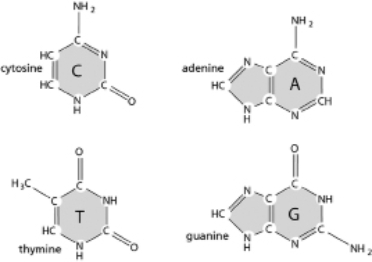 Figure 5-70
 (Essay)
4.8/5 (88)
(88) Which of the following is NOT a chemical group commonly found on core histone N-terminal tails for chromatin regulation?
(Multiple Choice)
4.8/5 (68)
(68) Indicate whether the following statements are TRUE or FALSE.If a statement is false, explain why it is false.
Correct Answer:Verified
VerifiedPremises:
Responses:
(Matching)
4.9/5 (74)
(74) The inactivation of one X chromosome is established by the directed spreading of heterochromatin.The silent state of this chromosome is __________ in the subsequent cell divisions.
(Multiple Choice)
4.7/5 (76)
(76) Consider the structure of the DNA double helix.
A.You and a friend want to split a double-stranded DNA molecule so you each have half.Is it better to cut the length of DNA in half so each person has a shorter length, or to separate the strands and each take one strand? Explain.
B.In the original 1953 publication describing the discovery of the structure of DNA, Watson and Crick wrote, "It has not escaped our notice that the specific pairings we have postulated immediately suggest a possible copying mechanism for the genetic material." What did they mean?
(Essay)
4.9/5 (80)
(80) 
Filters
- Essay(0)
- Multiple Choice(0)
- Short Answer(0)
- True False(0)
- Matching(0)