



 Chat with AI
Exam 2: Chemical Components of Cells

Exam 1: Cells: The Fundamental Units of Life64 Questions
Exam 2: Chemical Components of Cells74 Questions
Exam 3: Energy, Catalysis, and Biosynthesis73 Questions
Exam 4: Protein Structure and Function71 Questions
Exam 5: DNA and Chromosomes69 Questions
Exam 6: DNA Replication and Repair61 Questions
Exam 7: From DNA to Protein62 Questions
Exam 8: Control of Gene Expression68 Questions
Exam 9: How Genes and Genomes Evolve60 Questions
Exam 10: Analyzing the Structure and Function of Genes59 Questions
Exam 11: Membrane Structure57 Questions
Exam 12: Transport Across Cell Membranes67 Questions
Exam 13: How Cells Obtain Energy From Food71 Questions
Exam 14: Energy Generation in Mitochondria and Chloroplasts72 Questions
Exam 15: Intracellular Compartments and Protein Transport55 Questions
Exam 16: Cell Signaling60 Questions
Exam 17: Cytoskeleton59 Questions
Exam 18: The Cell-Division Cycle67 Questions
Exam 19: Sexual Reproduction and the Power of Genetics61 Questions
Exam 20: Cell Communities: Tissues, Stem Cells, and Cancer57 Questions
Select questions type


Carbon atoms can form double bonds with other carbon atoms, nitrogen atoms, and oxygen atoms.Double bonds can have important consequences for biological molecules because they are __________ compared to single covalent bonds.
(Multiple Choice)
4.8/5  (84)
(84) Both DNA and RNA are synthesized by covalently linking a nucleoside triphosphate to the previous nucleotide, constantly adding to a growing chain.In the case of DNA, the new strand becomes part of a stable helix.The two strands are complementary in sequence and antiparallel in directionality.What is the principal force that holds these two strands together?
(Multiple Choice)
5.0/5 (87)
(87) A protein chain folds into its stable and unique three-dimensional structure, or conformation, by making many noncovalent bonds between different parts of the chain.Such noncovalent bonds are also critical for interactions with other proteins and cellular molecules.From the list provided, choose the class or classes of amino acids that are most important for the interactions detailed below.
A.forming ionic bonds with negatively charged DNA
B.forming hydrogen bonds to aid solubility in water
C.binding to another water-soluble protein
D.localizing an "integral membrane" protein that spans a lipid bilayer
E.tightly packing the hydrophobic interior core of a globular protein
acidic nonpolar
basic uncharged polar
(Short Answer)
4.7/5 (66)
(66) 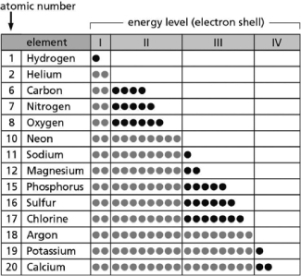 Table 2-14
-Table 2-14 indicates the number and arrangement of electrons in the first four atomic electron shells for selected elements.On the basis of the information in the chart and what you know about atomic structure, which elements will form ions with a net charge of +2 in solution?
Table 2-14
-Table 2-14 indicates the number and arrangement of electrons in the first four atomic electron shells for selected elements.On the basis of the information in the chart and what you know about atomic structure, which elements will form ions with a net charge of +2 in solution? (Multiple Choice)
4.9/5 (79)
(79) Cells require one particular monosaccharide as a starting material to synthesize nucleotide building blocks.Which of the monosaccharides below fills this important role?
(Multiple Choice)
4.9/5 (87)
(87) A.In which scientific unit is the strength of a chemical bond usually expressed?
B.If 0.5 kilocalories of energy are required to break 6 × 10²³ bonds of a particular type, what is the strength of this bond?
(Essay)
5.0/5 (80)
(80) Double covalent bonds are both shorter and stronger than single covalent bonds, but they also limit the geometry of the molecule because they
(Multiple Choice)
4.9/5 (77)
(77) There are 20100 different possible sequence combinations for a protein chain with 100 amino acids.In addition to the amino acid sequence of the protein, what other factors INCREASE the potential for diversity in these macromolecules?
(Multiple Choice)
4.9/5 (67)
(67) The variety and arrangement of chemical groups on monomer subunits contribute to the conformation, reactivity, and surface of the macromolecule into which they become incorporated.What type of chemical group is circled on the nucleotide shown in Figure 2-41? 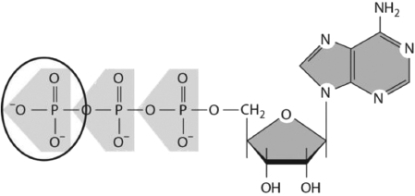 Figure 2-41
 (Multiple Choice)
4.9/5 (70)
(70) Indicate whether the statements below are TRUE or FALSE.If a statement is false, explain why it is false.
Correct Answer: Verified
Premises:
Responses:
(Matching)
4.8/5 (82)
(82) Indicate whether the statements below are TRUE or FALSE.If a statement is false, explain why it is false.
Correct Answer:Verified
VerifiedPremises:
Responses:
(Matching)
5.0/5 (65)
(65) A covalent bond between two atoms is formed as a result of the
(Multiple Choice)
4.7/5 (86)
(86) The amino acids glutamine and glutamic acid are shown in Figure 2-38.They differ only in the structure of part of their side chains (circled).At pH7, what type of interactions are possible for glutamic acid but not for glutamine? 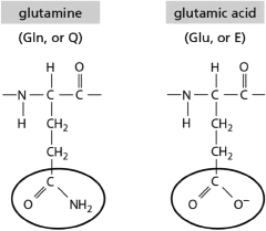 Figure 2-38
 (Multiple Choice)
4.9/5 (79)
(79) Selenium (Se) is an element required in the human body in trace amounts.Selenium is obtained through the diet and levels of selenium found in food depend greatly on the soil where it is grown.Once ingested and absorbed as selenate, it can become incorporated into a small number of polypeptides.These selenoproteins are formed when selenium replaces an element that is found in 2 of the 20 "standard" amino acids.Using your knowledge of atomic structure, the periodic table in Figure 2-7, and the structure of amino acids found in Panel 2-5, deduce which two amino acids may be converted to "seleno" amino acids and used to make selenoproteins.
(Essay)
5.0/5 (60)
(60) You are trying to make a synthetic copy of a particular protein but accidentally join the amino acids together in exactly the reverse order.One of your classmates says the two proteins must be identical, and bets you $20 that your synthetic protein will have exactly the same biological activity as the original.After having read this chapter, you have no hesitation in staking your $20 that it will not.What particular feature of a polypeptide chain makes you sure your $20 is safe and that the project must be restarted?
(Essay)
4.9/5 (78)
(78) Macromolecules in the cell can often interact transiently as a result of noncovalent interactions.These weak interactions also produce stable, highly specific interactions between molecules.Which of the factors below is the most significant in determining whether the interaction will be transient or stable?
(Multiple Choice)
4.9/5 (79)
(79) Carbon 14 is an unstable isotope of carbon that decays very slowly.Compared to the common, stable carbon 12 isotope, carbon 14 has two additional
(Multiple Choice)
4.8/5 (96)
(96) Select the answer that BEST completes the following statement: Chemical reactions in living systems occur in an __________ environment, within a narrow range of temperatures.
(Multiple Choice)
4.7/5 (88)
(88) A.Sketch three different ways in which three water molecules could be held together by hydrogen-bonding.
B.On a sketch of a single water molecule, indicate the distribution of positive and negative charge (using the symbols δ+ and δ−).
C.How many hydrogen bonds can a hydrogen atom in a water molecule form? How many hydrogen bonds can the oxygen atom in a water molecule form?
(Essay)
4.8/5 (68)
(68) 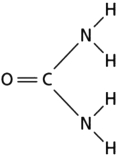 Figure 2-26
-Larger molecules have hydrogen-bonding networks that contribute to specific, high-affinity binding.Smaller molecules such as urea can also form these networks.How many hydrogen bonds can urea (Figure 2-26) form if dissolved in water?
Figure 2-26
-Larger molecules have hydrogen-bonding networks that contribute to specific, high-affinity binding.Smaller molecules such as urea can also form these networks.How many hydrogen bonds can urea (Figure 2-26) form if dissolved in water? (Multiple Choice)
4.9/5 (79)
(79) 
Filters
- Essay(0)
- Multiple Choice(0)
- Short Answer(0)
- True False(0)
- Matching(0)