



 Chat with AI
Exam 2: The Economic Problem

Exam 1: What Is Economics170 Questions
Exam 2: The Economic Problem145 Questions
Exam 3: Demand and Supply185 Questions
Exam 4: Measuring Gdp and Economic Growth126 Questions
Exam 5: Monitoring Jobs and Inflation113 Questions
Exam 6: Economic Growth95 Questions
Exam 7: Finance, Saving, and Investment138 Questions
Exam 8: Money, the Price Level, and Inflation129 Questions
Exam 9: The Exchange Rate and the Balance of Payments121 Questions
Exam 10: Aggregate Supply and Aggregate Demand129 Questions
Exam 11: Expenditure Multipliers166 Questions
Exam 12: The Business Cycle, Inflation, and Deflation105 Questions
Exam 13: Fiscal Policy96 Questions
Exam 14: Monetary Policy93 Questions
Exam 15: International Trade Policy119 Questions
Select questions type


Use the figure below to answer the following questions.
 Figure 2.1.2
-Refer to the production possibilities frontier in Figure 2.1.2.At point C, what is the opportunity cost of increasing the production of Y from 20 to 50 units?
Figure 2.1.2
-Refer to the production possibilities frontier in Figure 2.1.2.At point C, what is the opportunity cost of increasing the production of Y from 20 to 50 units? (Multiple Choice)
4.7/5  (77)
(77) Use the figure below to answer the following questions.
 Figure 2.1.1
-Refer to the production possibilities frontier in Figure 2.1.1.Which one of the following statements is true about point A?
Figure 2.1.1
-Refer to the production possibilities frontier in Figure 2.1.1.Which one of the following statements is true about point A? (Multiple Choice)
4.8/5 (90)
(90) Consider a country that has two industries.In the north, they grow wild rice, which requires plenty of rainfall. In the south, they grow wheat, which requires a moderate amount of rainfall too much rainfall is bad for wheat production).One year, there is a record rainfall.This results in
(Multiple Choice)
4.9/5 (70)
(70) Which one of the following concepts is not illustrated by a production possibilities frontier?
(Multiple Choice)
4.9/5 (89)
(89) As we increase production of X, we must give up production of larger and larger amounts of Y to produce each additional unit of X.Select the best statement.
(Multiple Choice)
4.8/5 (84)
(84) Use the information below to answer the following questions.
Fact 2.3.1
In an eight- hour day, Andy can produce either 24 loaves of bread or 8 kilograms of butter.In an eight- hour day, Rolfe can produce either 8 loaves of bread or 8 kilograms of butter.
-From Fact 2.3.1, we know that
(Multiple Choice)
5.0/5 (93)
(93) In general, if country A is accumulating capital at a faster rate than country B, then country A
(Multiple Choice)
4.9/5 (87)
(87) Use the figure below to answer the following question.
 Figure 2.1.5
-The graph in Figure 2.1.5 shows Sunland's PPF for food and sunscreen.Sunland faces _______ opportunity cost of food and _______ opportunity of sunscreen.
Figure 2.1.5
-The graph in Figure 2.1.5 shows Sunland's PPF for food and sunscreen.Sunland faces _______ opportunity cost of food and _______ opportunity of sunscreen. (Multiple Choice)
4.9/5 (84)
(84) Use the figure below to answer the following questions.
 Figure 2.1.3
-Figure 2.1.3 illustrates Mary's production possibilities frontier.If Mary wants to move from point B to point C, Mary must
Figure 2.1.3
-Figure 2.1.3 illustrates Mary's production possibilities frontier.If Mary wants to move from point B to point C, Mary must (Multiple Choice)
4.9/5 (88)
(88) Use the figure below to answer the following question.
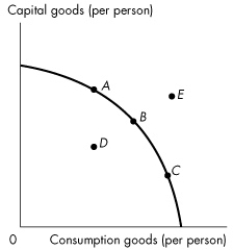 Figure 2.4.1
-Refer to the production possibilities frontier in Figure 2.4.1.The production possibilities frontier will shift rightward most rapidly if current production is at
Figure 2.4.1
-Refer to the production possibilities frontier in Figure 2.4.1.The production possibilities frontier will shift rightward most rapidly if current production is at (Multiple Choice)
4.7/5 (83)
(83) If additional units of any good can be produced at a constant opportunity cost, the production possibilities frontier is
(Multiple Choice)
5.0/5 (73)
(73) The most anyone is willing to pay for another purse is $30.Currently the price of a purse is $40, and the cost of producing another purse is $50.The marginal benefit from a purse is
(Multiple Choice)
4.9/5 (74)
(74) A medical clinic employs 10 workers.Each worker can produce a maximum of either 2 units of medical services or 5 units of administrative services a day.One day, the clinic decides to produce 16 units of medical services and 5 units of administrative services.This output level is
(Multiple Choice)
4.9/5 (79)
(79) Use the figure below to answer the following question.
 Figure 2.1.4
-Refer to the production possibilities frontier in Figure 2.1.4.Which point is unattainable?
Figure 2.1.4
-Refer to the production possibilities frontier in Figure 2.1.4.Which point is unattainable? (Multiple Choice)
4.9/5 (84)
(84) Use the figure below to answer the following questions.
Figure 2.1.2
-Refer to the production possibilities frontier in Figure 2.1.2.At point C, the opportunity cost of producing one more unit of X is
Figure 2.1.2
-Refer to the production possibilities frontier in Figure 2.1.2.At point C, the opportunity cost of producing one more unit of X is (Multiple Choice)
4.8/5 (85)
(85) Use the table below to answer the following questions.
Table 2.1.1
The following table gives points on the production possibilities frontier for goods X and Y.  -The economy illustrated by the data in Table 2.1.1 exhibits
 (Multiple Choice)
4.8/5 (78)
(78) Use the figure below to answer the following questions.
 Figure 2.2.1
-In Figure 2.2.1, when 2,000 bicycles are produced each month,
Figure 2.2.1
-In Figure 2.2.1, when 2,000 bicycles are produced each month, (Multiple Choice)
4.8/5 (68)
(68) 
Filters
- Essay(0)
- Multiple Choice(0)
- Short Answer(0)
- True False(0)
- Matching(0)