



 Chat with AI
Exam 6: Economic Growth

Exam 1: What Is Economics170 Questions
Exam 2: The Economic Problem145 Questions
Exam 3: Demand and Supply185 Questions
Exam 4: Measuring Gdp and Economic Growth126 Questions
Exam 5: Monitoring Jobs and Inflation113 Questions
Exam 6: Economic Growth95 Questions
Exam 7: Finance, Saving, and Investment138 Questions
Exam 8: Money, the Price Level, and Inflation129 Questions
Exam 9: The Exchange Rate and the Balance of Payments121 Questions
Exam 10: Aggregate Supply and Aggregate Demand129 Questions
Exam 11: Expenditure Multipliers166 Questions
Exam 12: The Business Cycle, Inflation, and Deflation105 Questions
Exam 13: Fiscal Policy96 Questions
Exam 14: Monetary Policy93 Questions
Exam 15: International Trade Policy119 Questions
Select questions type


Which theory of economic growth argues that population growth lowers the real wage rate and stops economic growth?
(Multiple Choice)
5.0/5  (83)
(83) If the current growth rate of real GDP per person is 7 percent a year, how long will it take for real GDP per person to double?
(Multiple Choice)
4.7/5 (93)
(93) Which theory of economic growth argues that growth does not automatically slow down?
(Multiple Choice)
4.8/5 (67)
(67) Ceteris paribus, an increase in labour productivity results in a
(Multiple Choice)
4.9/5 (78)
(78) Which of the following is a suggestion for increasing Canadian economic growth rates?
(Multiple Choice)
4.8/5 (75)
(75) When the quantity of labour demanded exceeds the quantity of labour supplied, the real wage rate
(Multiple Choice)
4.9/5 (67)
(67) Real GDP per person in the country of Flip is $10,000, and the growth rate is 10 percent a year.Real GDP per person in the country of Flap is $20,000 and the growth rate is 5 percent a year.When will real GDP per person be greater in Flip than in Flap?
(Multiple Choice)
4.8/5 (88)
(88) When labour productivity increases, the demand for labour curve _______ and the supply of labour curve _______.
(Multiple Choice)
4.9/5 (78)
(78) When the population increases, potential GDP _______ and potential GDP per hour of labour _______.
(Multiple Choice)
4.9/5 (82)
(82) During the last 10 years, which of the following had the lowest level of real GDP per person?
(Multiple Choice)
4.9/5 (74)
(74) In 2016, Northland had real GDP of $4.21 billion and a population of 2.98 million.In 2017, real GDP was $4.59 billion and population was 2.97 million.What was Northland's growth rate of real GDP in 2017?
(Multiple Choice)
4.8/5 (74)
(74) If the real wage rate is $10.00 an hour and the price level is 60, the money wage rate is
(Multiple Choice)
4.9/5 (79)
(79) Use the figure below to answer the following question.
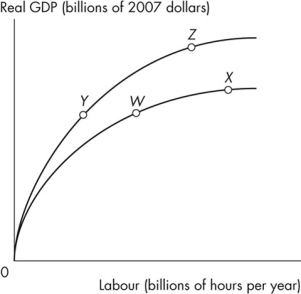 Figure 6.3.1
-Refer to Figure 6.3.1.The country of Kemper is on its aggregate production function at point W.If the population increases with no change in capital or technology, the economy
Figure 6.3.1
-Refer to Figure 6.3.1.The country of Kemper is on its aggregate production function at point W.If the population increases with no change in capital or technology, the economy (Multiple Choice)
4.9/5 (84)
(84) Use the figure below to answer the following questions.
 Figure 6.3.2
-Refer to Figure 6.3.2.The equilibrium quantity of labour is
Figure 6.3.2
-Refer to Figure 6.3.2.The equilibrium quantity of labour is (Multiple Choice)
4.8/5 (85)
(85) Between 1980 and 2016, growth rates in real GDP per person in Hong Kong, Korea, Singapore, Taiwan, and China _______ the growth rate of real GDP per person in Canada.
Korea's real GDP per person in 2016 is approximately equal to real GDP per person in Hong Kong in _______.
(Multiple Choice)
4.9/5 (81)
(81) In 2016, Northland had real GDP of $4.21 billion and a population of 2.98 million.In 2017, real GDP was $4.59 billion and population was 2.97 million.Northland's real GDP per person in 2017 was
(Multiple Choice)
5.0/5 (68)
(68) When the population increases with no change in labour productivity, employment _______ and potential GDP _______.
(Multiple Choice)
4.9/5 (70)
(70) 
Filters
- Essay(0)
- Multiple Choice(0)
- Short Answer(0)
- True False(0)
- Matching(0)