



 Chat with AI
Exam 12: Analysis of Variance

Exam 1: Introduction to Statistics24 Questions
Exam 2: Percentages, Graphs and Measures of Central Tendency69 Questions
Exam 3: Measures of Variability99 Questions
Exam 4: The Normal Curve and Z Score115 Questions
Exam 5: Z Scores, T Scores and Other Normal Curve Transformations110 Questions
Exam 6: Probability76 Questions
Exam 7: Statistics and Parameters92 Questions
Exam 8: Parameter Estimates129 Questions
Exam 9: The Fundamentals of Research Methodology173 Questions
Exam 10: The Hypothesis of Difference130 Questions
Exam 11: The Hypothesis of Association: Correlation131 Questions
Exam 12: Analysis of Variance108 Questions
Exam 13: Nominal Categorical Data and the Chi Square89 Questions
Exam 14: Regression Analysis122 Questions
Exam 15: Repeated-Measures and Matched-Subjects Designs Interval Data113 Questions
Exam 16: Non-Parametrics Revisited: the Ordinal Case113 Questions
Exam 17: Tests and Measurements69 Questions
Select questions type


On a factorial ANOVA, the number of different variations in treatment conditions, determines the number of
(Multiple Choice)
4.8/5  (77)
(77) Calculate the F ratio on the following sets of scores. Group 1 Group 2 Group 3 5 8 10 4 6 10 1 6 12 1 5 8
(Short Answer)
4.8/5 (85)
(85) Questions below are based on the following: (This is similar to an item in the text at the back of chapter 12 but WITH A DIFFERENT DATA SET). A researcher is interested in whether a certain amphetamine drug will affect the retention of learned behavior among rats as a function of how much time is allowed to elapse between the training and the retention test. Four groups, ten subjects in each group, were randomly selected from a colony of Sprague-Dawley rats. All the rats were given the same amount of training on a simple maze. Groups A and C were given the amphetamine, whereas Groups B and D were given a placebo. Groups A and B were tested for retention immediately following the training, whereas Groups C and D were tested 4 hours later. The retention measure consisted of a scaled score based on how many correct responses the rats would exhibit while running the maze, the higher the score the higher the retention FACTOR A Amphetamine Group A Placebo Group B 15 13 9 9 9 12 Immediate 11 7 Test 10 7 6 8 10 10 12 9 14 5 7 11 FACTOR B Group C Group D 1 8 5 6 Delayed 2 9 Test 4 4 5 4 6 5 5 6 2 6 6 6 1 7
-What conclusions might you draw?
(Essay)
4.9/5 (69)
(69) When doing a factorial ANOVA, the main effects are found from the
(Multiple Choice)
4.9/5 (90)
(90) When the distribution of scores within a sample forms a platykurtic shape, then
(Multiple Choice)
4.7/5 (71)
(71) For questions below use the data on the following page: A researcher is interested in establishing whether memory is a function of both IQ and time of testing. A random sample of 40 university students was selected and each student was given an IQ test. Half of the students scored above 115 and were assigned to the high IQ category. The students were than all given a series of paragraphs to read, followed by a memory test on the content of what had been read. Half the students took the memory test immediately after reading the material, while the other half waited an hour before testing. The results were as follows (high scores indicating better memory retention): 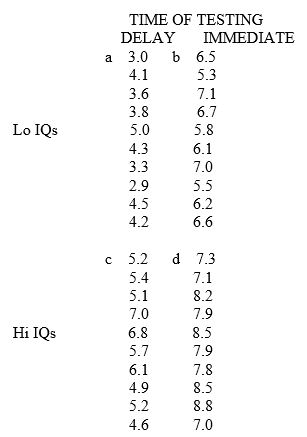 -Find the F ratio for columns, and if significant, state the alpha level.
 (Short Answer)
5.0/5 (78)
(78) When several independent variables are manipulated simultaneously, an appropriate analysis would be the
(Multiple Choice)
4.9/5 (76)
(76) An F ratio of 5, tells us specifically that the variance between groups is
(Multiple Choice)
4.7/5 (86)
(86) For questions below use the data on the following page: A researcher is interested in establishing whether memory is a function of both IQ and time of testing. A random sample of 40 university students was selected and each student was given an IQ test. Half of the students scored above 115 and were assigned to the high IQ category. The students were than all given a series of paragraphs to read, followed by a memory test on the content of what had been read. Half the students took the memory test immediately after reading the material, while the other half waited an hour before testing. The results were as follows (high scores indicating better memory retention):
-Was the column independent variable manipulated or assigned?
-Was the column independent variable manipulated or assigned? (Short Answer)
4.8/5 (99)
(99) The factorial ANOVA should not be used unless there is more than one independent variable.
(True/False)
4.8/5 (79)
(79) If one had to calculate 15 successive t tests, it would mean
(Multiple Choice)
4.9/5 (84)
(84) If the F ratio were performed on a two-group design and F were equal to 9, then t would be equal to
(Multiple Choice)
4.7/5 (73)
(73) Calculate the F ratio on the following sets of scores. Group 1 Group 2 Group 3 4 6 7 3 3 5 1 2 1
(Short Answer)
4.8/5 (94)
(94) When analyzing experimental research via the F ratio, the action of the independent variable is most clearly shown in the value of the
(Multiple Choice)
4.9/5 (83)
(83) The F ratio may only be calculated when the independent variable has exactly two levels.
(True/False)
4.7/5 (71)
(71) For questions below use the data on the following page: A researcher is interested in establishing whether memory is a function of both IQ and time of testing. A random sample of 40 university students was selected and each student was given an IQ test. Half of the students scored above 115 and were assigned to the high IQ category. The students were than all given a series of paragraphs to read, followed by a memory test on the content of what had been read. Half the students took the memory test immediately after reading the material, while the other half waited an hour before testing. The results were as follows (high scores indicating better memory retention):
-Find the F ratio for rows, and if significant, state the alpha level.
-Find the F ratio for rows, and if significant, state the alpha level. (Short Answer)
4.8/5 (79)
(79) 
Filters
- Essay(0)
- Multiple Choice(0)
- Short Answer(0)
- True False(0)
- Matching(0)