



 Chat with AI
Exam 6: Inventory Costing and Valuation

Exam 1: Accounting in Business242 Questions
Exam 2: Analyzing and Recording Transactions137 Questions
Exam 3: Adjusting Accounts for Financial Statements205 Questions
Exam 4: Completing the Accounting Cycle and Classifying Accounts140 Questions
Exam 5: Accounting for Merchandising Activities129 Questions
Exam 6: Inventory Costing and Valuation149 Questions
Exam 7: Internal Control and Cash142 Questions
Exam 8: Receivables147 Questions
Exam 9: Property, Plant and Equipment Intangibles203 Questions
Exam 10: Payroll Liabilities61 Questions
Exam 11: Accounting Information Systems102 Questions
Select questions type


A company that has operated with a 30% average gross profit ratio for a number of years had $110,000 in net sales during the first quarter of this year. If it began the quarter with $28,000 in inventory at cost and purchased $75,000 of merchandise during the quarter, its estimated ending inventory by the gross profit method is
(Multiple Choice)
4.8/5  (79)
(79) If the supplier pays freight charges, then ownership of inventory passes when goods arrive at their destination.
(True/False)
4.8/5 (58)
(58) During January, a company that uses a perpetual inventory system had beginning inventory, purchases, and sales as follows:
Units Cast per unit Begin Inventory 100 12 Jan 5 Sale 50 10 Purchase 70 16 15 Sale 25 25 Sale 35 Prepare a schedule to show the cost of goods sold and ending inventory using the FIFO cost flow assumption.
(Essay)
4.9/5 (82)
(82) The principle of faithful representation requires that information be complete, neutral and free from error so that assets and income are not overstated and liabilities and expenses are not understated.
(True/False)
4.8/5 (81)
(81) Generally accepted accounting principles require that the inventory of a company be reported at:
(Multiple Choice)
5.0/5 (88)
(88) An understatement of ending inventory will understate cost of goods sold and overstate net income.
(True/False)
4.8/5 (78)
(78) One of the most important decisions in accounting for inventory is determining the per-unit costs assigned to inventory items.
(True/False)
4.9/5 (71)
(71) Trekking Company's cost of goods sold was $15,550. Its average merchandise inventory was $4,575. Its merchandise turnover was 3.4.
(True/False)
4.9/5 (78)
(78) Would an entry be needed if the calculation of LCNRV was made on a group basis? If so, make the entry. If not, state why.
(Essay)
4.8/5 (89)
(89) On September 30, Stark Company needed to estimate its ending inventory in order to prepare its third-quarter financial statements. The following information is available: (1) Inventory, July 1: $12,500 (2) Third quarter net sales: $40,000 (3) Third quarter net purchases: $17,500 Stark's gross profit ratio is 15%. Estimated cost of goods sold would be
(Multiple Choice)
4.9/5 (79)
(79) Errors in inventory valuation only affect the current period's records and financial statements.
(True/False)
4.9/5 (89)
(89) There is no difference in the amount of inventory calculated by the periodic and perpetual inventory systems when using the FIFO cost flow assumption.
(True/False)
4.8/5 (80)
(80) Trekking Company's cost of inventory was $317,500. Due to phenomenal demand the net realizable value has increased to $323,000. Trekking Company should write up the value of inventory under the LCNRV rule.
(True/False)
5.0/5 (74)
(74) In a period of inflation, FIFO usually gives a lower taxable income and thus a tax advantage.
(True/False)
4.8/5 (75)
(75) Bakstreet Company wants to estimate inventory destroyed by flood. Its average gross profit percentage is 37%. The following information is available:
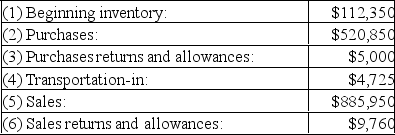 Instructions: Calculate the value of the destroyed ending inventory using the gross profit method. Round numbers to the nearest dollar, if necessary.
 (Essay)
4.9/5 (82)
(82) 
Filters
- Essay(0)
- Multiple Choice(0)
- Short Answer(0)
- True False(0)
- Matching(0)