



 Chat with AI
Exam 1: What Is Economics

Exam 1: What Is Economics644 Questions
Exam 2: The Economic Problem503 Questions
Exam 3: Demand and Supply558 Questions
Exam 4: Measuring Gdp and Economic Growth375 Questions
Exam 5: Monitoring Jobs and Inflation434 Questions
Exam 6: Economic Growth450 Questions
Exam 7: Finance, Saving, and Investment260 Questions
Exam 8: Money, the Price Level, and Inflation616 Questions
Exam 9: The Exchange Rate and the Balance of Payments547 Questions
Exam 10: Aggregate Supply and Aggregate Demand452 Questions
Exam 11: Expenditure Multipliers: They Keynesian Model484 Questions
Exam 12: U.S. Inflation, Unemployment, and Business Cycle443 Questions
Exam 13: Fiscal Policy328 Questions
Exam 14: Monetary Policy284 Questions
Exam 15: International Trade Policy207 Questions
Select questions type


 -In the figure above, the value on the x- axis increases as we move from
 (Multiple Choice)
4.9/5  (69)
(69) Which of the following is a macroeconomic decision or concept?
(Multiple Choice)
4.9/5 (79)
(79) When an economy produces more houses and fewer typewriters, it is answering the question.
(Multiple Choice)
4.8/5 (74)
(74) With y measured on the vertical axis and x measured on the horizontal axis, the slope of a straight line is defined as
(Multiple Choice)
4.9/5 (88)
(88) The formula for the slope across an arc is used to approximate the slope for
(Multiple Choice)
4.8/5 (93)
(93) What is the difference between a total benefit and a marginal benefit?
(Essay)
4.8/5 (86)
(86) 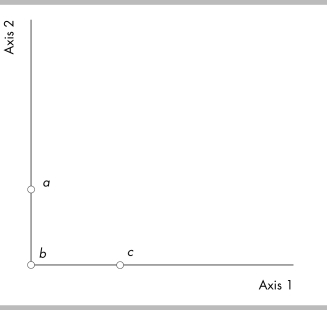 -Using the above figure, the origin is at which point?
Which of the following is NOT an example of an opportunity cost?
(Multiple Choice)
4.8/5 (70)
(70) In the United States, the percentage of people employed in over the last 60 years.
(Multiple Choice)
4.8/5 (67)
(67) 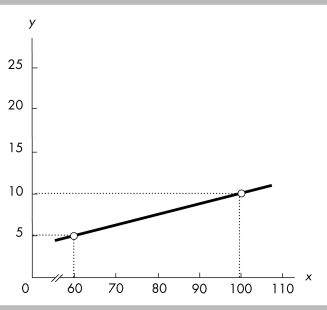 -The slope of the line in the above figure is
Rather than go out to eat by yourself, you decide to stay at home and fix dinner for yourself and your two roommates. Your roommates applaud your decision. Your first roommate tells you that your decision to eat at home has no opportunity cost because you already have all the dinner ingredients in your pantry. Is this roommate's comment correct?
(Essay)
5.0/5 (73)
(73) Jerry is studying three nights per week and his grade point average is 3.1. He wants a higher GPA and decides to study an extra night each week. His GPA now rises to 3.5. Had Jerry not decided to study an extra night, he would have spent this night with his friends. What is Jerry's marginal benefit from studying for one additional night a week? What is his marginal cost of increasing the study time by one night per week? Why does Jerry decide to study an extra night?
(Essay)
4.9/5 (73)
(73) 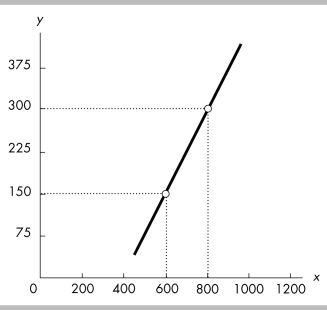 -The slope of the line shown in the above figure is
Jane is deciding whether to go to school for 8 weeks this summer. The cost of tuition and textbooks is $1,700 and housing and other expenses will cost her $600. If she does not go to school, she will live in her parents' house for free and they will cover her food and other expenses for her. Also, if Jane does not go to summer school she could work fulltime. But the best job she can get pays only $600 per week, and Jane would only agree to give up free time for no less than $750 per week. However, if she goes to summer school, she'll have to spend 40 hours a attending classes and studying.
a) What will the summer school cost Jane in terms of money spent?
b) What are the opportunity costs of going to summer school that Jane does not pay explicitly? Explain.
c) What is Jane's total opportunity cost of going to school this summer? Explain your answer.
d) Suppose that if Jane does not go to summer school, she will eventually take the classes anyway. What is Jane marginal benefit of going to summer school?
e) Suppose Jane decides to go to school in the summer. Explain her decision using the concepts of marginal cos marginal benefit.
(Essay)
4.8/5 (94)
(94) 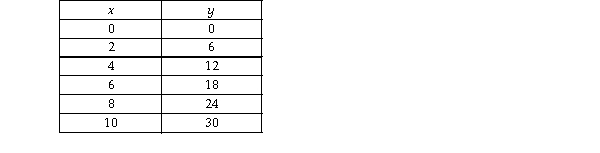 -In the above table, when x increases from 4 units to 6 units, y changes by _ units.
 (Multiple Choice)
4.8/5 (81)
(81) You decide to take a vacation and the trip costs you $2,000. While you are on vacation, you do not report to work where you could have earned $750. The opportunity cost of the vacation is
(Multiple Choice)
4.8/5 (81)
(81) 
Filters
- Essay(0)
- Multiple Choice(0)
- Short Answer(0)
- True False(0)
- Matching(0)