



 Chat with AI
Exam 8: Money, the Price Level, and Inflation

Exam 1: What Is Economics644 Questions
Exam 2: The Economic Problem503 Questions
Exam 3: Demand and Supply558 Questions
Exam 4: Measuring Gdp and Economic Growth375 Questions
Exam 5: Monitoring Jobs and Inflation434 Questions
Exam 6: Economic Growth450 Questions
Exam 7: Finance, Saving, and Investment260 Questions
Exam 8: Money, the Price Level, and Inflation616 Questions
Exam 9: The Exchange Rate and the Balance of Payments547 Questions
Exam 10: Aggregate Supply and Aggregate Demand452 Questions
Exam 11: Expenditure Multipliers: They Keynesian Model484 Questions
Exam 12: U.S. Inflation, Unemployment, and Business Cycle443 Questions
Exam 13: Fiscal Policy328 Questions
Exam 14: Monetary Policy284 Questions
Exam 15: International Trade Policy207 Questions
Select questions type


Sarah buys shares from a financial institution that uses her funds together with other funds to purchase U.S. treasury bills. Sarah has deposited her money into a .
(Multiple Choice)
4.9/5  (89)
(89) An increase in decreases the quantity of money people want to hold.
(Multiple Choice)
4.8/5 (86)
(86) 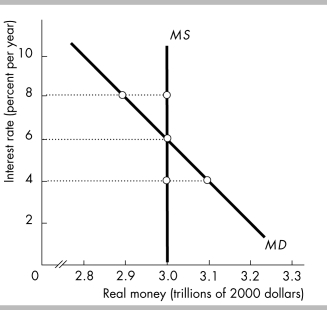 -In the above figure, if the interest rate is 4 percent, people
 (Multiple Choice)
4.8/5 (84)
(84) Which of the following is NOT an asset of the Federal Reserve System?
(Multiple Choice)
4.7/5 (77)
(77)  -The above table has the balance of the University National Bank. All figures are in millions of dollars. The desired reserve ratio is 20 percent. What would be the total increase in loans at this bank if all excess reserves were loaned out?
 (Multiple Choice)
4.8/5 (74)
(74) Checks and credit cards are NOT considered part of M1 because
(Multiple Choice)
5.0/5 (87)
(87) The monetary policy- making body of the Federal Reserve is the
(Multiple Choice)
4.8/5 (71)
(71) The increased use of automatic teller machines has decreased the demand for money.
(True/False)
5.0/5 (93)
(93) 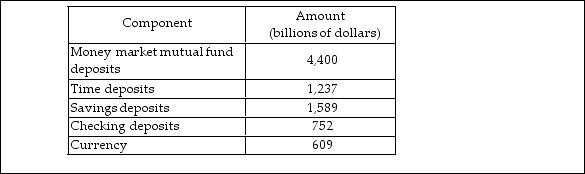 -Based on the data in the table above, what is the value of M1?
 (Multiple Choice)
4.9/5 (66)
(66) The quantity theory of money argues that, in the long run, the percentage change in money will create an equal percentage change in
(Multiple Choice)
4.8/5 (80)
(80) According to the quantity theory of money, a 10 percent increase in the quantity of money ultimately leads to a 10 percent increase in
(Multiple Choice)
4.9/5 (99)
(99)  -The above table gives the initial balance sheet for Mega Bank. Barney comes into the bank and deposits $50 of currency into his checking account. The desired reserve ratio is 3 percent. After Barney's deposit, but before any other actions occur, MegaBank will have excess reserves of
 (Multiple Choice)
4.8/5 (84)
(84) The quantity of nominal money people want to hold decreases if
(Multiple Choice)
4.9/5 (86)
(86) An individual wanting the most liquid asset possible will hold
(Multiple Choice)
4.8/5 (84)
(84) Since 2008, has served as chairman of the Federal Reserve.
(Multiple Choice)
4.8/5 (81)
(81) Which of the following is NOT included in the M2 definition of money?
(Multiple Choice)
4.9/5 (75)
(75) In the economy of Briskland, the commercial banks have deposits of $500 billion. Their reserves are $50 billion, 8 percent of which is in deposits with the Central Bank. There is $20 billion in Central Bank notes outside the bank there are no coins.
a) What is the monetary base?
b) If all the deposits are money, what is the total quantity of money?
c) What is the banks' reserve ratio?
d) What is the currency drain as a percentage of the quantity of deposits?
(Essay)
4.9/5 (75)
(75) According to the quantity theory of money, in the long run an increase in the quantity of money creates an increase in the price level but does not increase real GDP.
(True/False)
4.8/5 (80)
(80) If you have assets that include $50 in cash, a checking account with $135, a savings account with $500, and a jar of coins for laundry of $15.75, how much M1 do you have?
(Essay)
4.7/5 (74)
(74) 
Filters
- Essay(0)
- Multiple Choice(0)
- Short Answer(0)
- True False(0)
- Matching(0)