



 Chat with AI
Exam 1: Units of Measurement for Physical and Chemical Change

Exam 1: Units of Measurement for Physical and Chemical Change192 Questions
Exam 2: Atoms and Elements174 Questions
Exam 3: Molecules, Compounds, and Nomenclature187 Questions
Exam 4: Chemical Reactions and Stoichiometry261 Questions
Exam 5: Gases163 Questions
Exam 6: Thermochemistry161 Questions
Exam 7: The Quantum-Mechanical Model of the Atom170 Questions
Exam 8: Periodic Properties of the Elements144 Questions
Exam 9: Chemical Bonding I: Lewis Theory155 Questions
Exam 10: Chemical Bonding Ii: Molecular Shapes, Valence Bond Theory, and Molecular Orbital Theory180 Questions
Exam 11: Liquids, Solids, and Intermolecular Forces144 Questions
Exam 12: Solutions167 Questions
Exam 13: Chemical Kinetics170 Questions
Exam 14: Chemical Equilibrium150 Questions
Exam 15: Acids and Bases156 Questions
Exam 16: Aqueous Ionic Equilibrium173 Questions
Exam 17: Gibbs Energy and Thermodynamics134 Questions
Exam 18: Electrochemistry122 Questions
Exam 19: Radioactivity and Nuclear Chemistry116 Questions
Exam 20: Organic Chemistry I: Structures109 Questions
Exam 21: Organic Chemistry Ii: Reactions102 Questions
Exam 22: Biochemistry55 Questions
Exam 23: Chemistry of the Nonmetals50 Questions
Exam 24: Metals and Metallurgy49 Questions
Exam 25: Transition Metals and Coordination Compounds55 Questions
Select questions type


If a car gets 43.0 miles per gallon (mpg) fuel efficiency, calculate the fuel efficiency in litres per 100 km. (1 US gal = 3.78541 L; 1 mile = 1609.34 m)
(Multiple Choice)
4.8/5  (71)
(71) A fishing boat accidentally spills 3.0 barrels of diesel oil into the ocean. Each barrel contains 42 gallons. If the oil film on the ocean is 2.5 × 10² nm thick, how many square metres will the oil slick cover?
(Multiple Choice)
4.9/5 (80)
(80) Describe the difference between an intensive and extensive property using examples.
(Essay)
4.9/5 (78)
(78) What is the correct answer, with the proper number of significant figures, for the following calculation?
11.5 × 8.78
(Short Answer)
4.8/5 (73)
(73) A student performs an experiment to determine the density of a sugar solution. She obtains the following results: 1.71 g mL-1, 1.73 g mL-1, 1.67 g mL-1, 1.69 g mL-1. If the actual value for the density of the sugar solution is 1.40 g mL-1, which statement below best describes her results?
(Multiple Choice)
5.0/5 (80)
(80) ________ is the energy associated with the position or composition of an object.
(Multiple Choice)
4.8/5 (88)
(88) What answer should be reported, with the correct number of significant figures, for the following calculation? 
(Multiple Choice)
4.8/5 (73)
(73) If the speed limit is 40 miles per hour, calculate the speed limit in kilometres per hour. (1 km = 0.6214 miles)
(Multiple Choice)
4.8/5 (81)
(81) Gasoline is sold for $1.399 per litre in Toronto. Your car needs 12.00 gallons. How much will your credit card be charged in Canadian dollars?
(Multiple Choice)
5.0/5 (64)
(64) The melting point of copper is 1984 °F. What is the melting point in K?
(Multiple Choice)
4.9/5 (72)
(72) What answer should be reported, with the correct number of significant figures, for the following calculation? 3.000 × 10⁵ + 614283
(Multiple Choice)
4.8/5 (82)
(82) Read the water level with the correct number of significant figures. 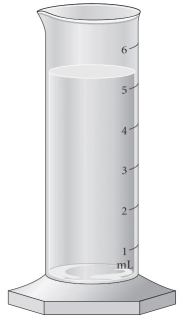
(Multiple Choice)
4.9/5 (77)
(77) A sample of liquid isopropyl alcohol is placed in a sealed container. Some of the volatile isopropyl alcohol vaporizes. Does the mass of the sealed container and its contents change during the vaporization? Explain.
(Essay)
4.9/5 (93)
(93) The diameter of an atom is approximately 1 × 10⁻¹⁰ m. What is the diameter in millimeters?
(Multiple Choice)
4.8/5 (82)
(82) Which of the following is an example of extensive properties?
(Multiple Choice)
4.8/5 (84)
(84) 
Filters
- Essay(0)
- Multiple Choice(0)
- Short Answer(0)
- True False(0)
- Matching(0)